

Salt-Baked Tilapia 盐烤吴郭鱼
Salt-Baked Tilapia is featured among the local specialties of Taiwan.
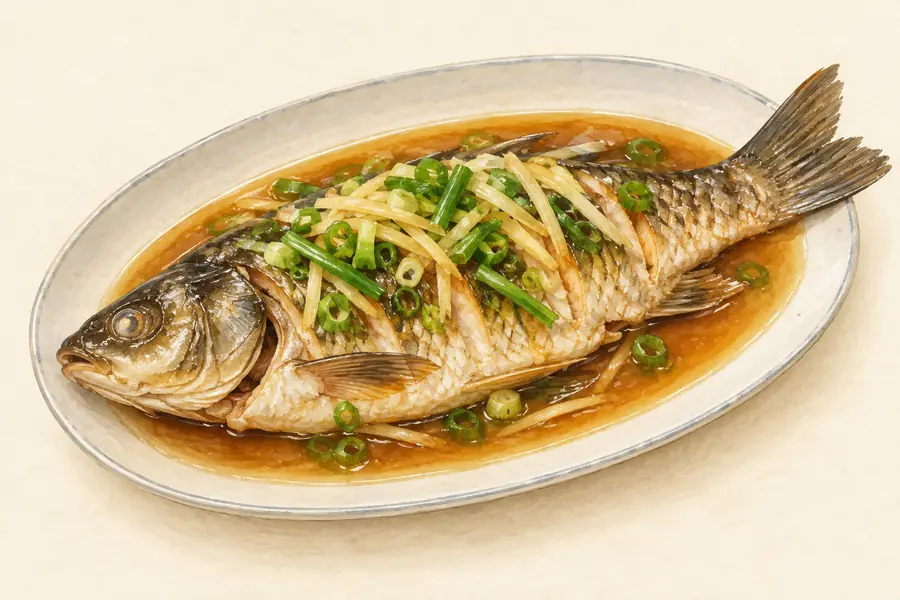
Salt-Baked Tilapia (盐烤吴郭鱼) is salt-baked tilapia: a whole fish packed into hot salt and cooked through in the crust. 吳郭魚 is the Taiwanese name for tilapia, and 盐烤 names the salt-bake method.
How the salt bake works
Salt baking is a sealed method rather than an open grill. In the classic Cantonese and Hakka version of the technique, the ingredients are dried, wrapped and buried in a heap of heated salt, then left over a low fire for roughly half an hour until they are cooked through; the same logic transfers to a whole fish, which is dried, packed into coarse salt and left in the crust until the flesh has set.
The crust is not a seasoning to be eaten — it is a lid. Salt holds and radiates heat evenly, and it traps the moisture coming off the fish, so the cook gets a firm, steam-cooked texture without adding water to a pan. Cracking the crust open at the table is the moment the dish is built around.
What the fish tastes like
Tilapia is a mild, tender, fine-boned fish with very few small bones, which is a large part of why it became so widely farmed; it also carries a faint earthy note that gives the fish its reputation. Salt baking plays to the first quality and against the second, because the sealed crust keeps the flesh from drying out while the salt and the skin screen the muddier flavours.
The result is gentle rather than punchy. What you taste is the fish, salt and whatever went into the cavity, so ask what seasoning was used before the fish went into the salt.
How tilapia got a Taiwanese name
The name 吳郭魚 is a memorial. Two men, 吳振輝 and 郭啟彰, smuggled fry of an African mouth-brooding cichlid out of a Singapore breeding station in 1946 and brought them back to Taiwan; only thirteen fish survived the journey, and the species was named after the surnames of the two who introduced it.
Farming spread fast after that. The fish grows quickly, tolerates poor water and is easy to keep, so it became a cheap source of protein — tender, fine-boned and faintly earthy, in the words of the same account.
Ingredients and dietary questions
The two essentials are a whole fish and a lot of coarse salt. Ginger, scallion, garlic or a splash of rice wine are commonly put in the cavity before the fish is sealed, but they are a choice rather than a requirement of the method.
If you are watching your salt intake, note that the crust is usually discarded and only the flesh is eaten, so the dish is far less salty than its crust suggests. If the fish is farmed in brackish or seawater, ask about its origin: seawater-raised stock is a distinct product with a slower growth cycle.
Ordering it
Ask whether the fish is salt-baked or simply grilled, because the two are different dishes and only one arrives in a crust. The fish is usually sold whole, so portions are set by its size rather than by the plate — ask for the weight or pick the fish yourself.
Whole fish also means bones. If that is a concern, ask the kitchen to open the fish and take out the main spine before it comes to the table; tilapia has few small bones, which makes the job easier than it sounds.
How it is eaten
The crust is cracked and lifted away, the skin is peeled back, and the flesh is eaten with rice or with a cold drink. Because the method adds no sauce, the table usually supplies one: a squeeze of citrus, a chilli dip or a light soy dressing, taken at the side rather than poured over the fish.
Tilapia also turns up in Taiwan as fish balls and other processed forms, which is the other way the same farmed fish reaches the table.
More dishes to compare
Explore related local specialties and compare their names, preparation notes and ordering guidance.
Grilled Fish Cake Skewers 烤黑轮 →
Grilled Fish Cake Skewers (烤黑轮) is grilled oden — fish paste shaped into cakes or skewers and cooked over a grill — and it represents the opposite end of tilapia from 盐烤吴郭鱼. One is a whole fish buried in hot salt and eaten with a spoon; the other is processed fish paste taken from a stick.
Questions before you order
Is salt-baked fish very salty?
Usually not. The salt is packed around the fish as a crust and is broken off before eating, so it seasons the outside and helps cook the flesh rather than dissolving into the meat.
Why is tilapia called 吳郭魚 in Taiwan?
The name combines the surnames of 吳振輝 and 郭啟彰, the two men who brought the first fry to Taiwan from Singapore in 1946; only thirteen fish survived the trip.
Source introduction: Wikipedia contributors: 罗非鱼 · CC BY-SA 4.0 (https://creativecommons.org/licenses/by-sa/4.0/). English guide adapted from the cited material, with additional preparation and ordering guidance.
Source introduction: Wikipedia contributors: 鹽焗雞 · CC BY-SA 4.0 (https://creativecommons.org/licenses/by-sa/4.0/). English guide adapted from the cited material, with additional preparation and ordering guidance.