

Pork Buns with Peeled Chili Peppers 剥皮辣椒肉包
Pork Buns with Peeled Chili Peppers is featured among the local specialties of Taiwan.
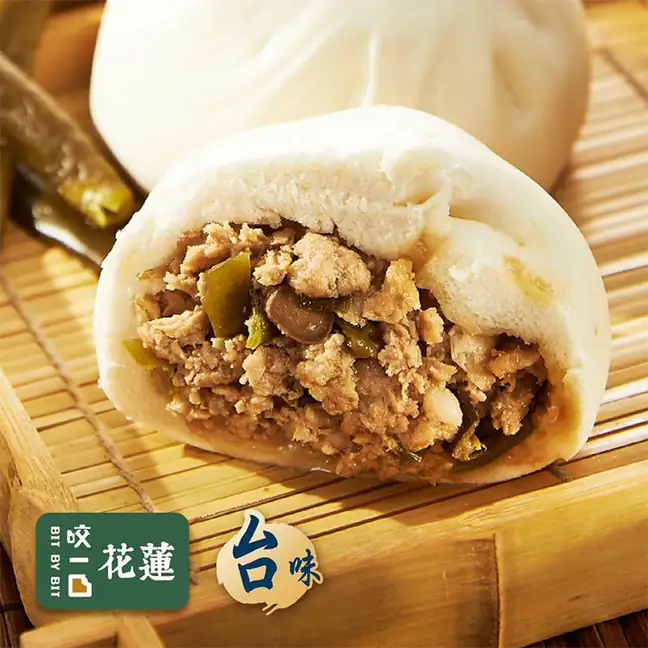
Image notes
Resized for the web; the photo itself has not been edited.
Pork Buns with Peeled Chili Peppers (剥皮辣椒肉包) is a steamed pork bun filled with Taiwan's peeled-and-pickled green chilli, a modern twist on the classic meat bun.
How the bun is made
A 包子 is leavened wheat dough wrapped around a filling and steamed: flour is mixed with water, fermented, filled and cooked in a steamer basket. The dough is the same as for any meat bun; what changes is what goes inside.
The filling here is pork with 剝皮辣椒, the eastern Taiwanese pickle made by deep-frying green chillies, peeling them and preserving them in soy sauce, sugar and salt. The pickle's brine sweetens and salts the pork, and the fried, peeled chilli gives a soft texture that survives the steamer, which is why it works as a bun filling rather than as a raw relish.
What it tastes like
The first impression is a soft, slightly sweet yeast dough, then a juicy pork centre with the chilli's soy-sweet tang and a low, lingering warmth rather than a sharp bite. The reference notes that the chillies are peeled specifically so the texture improves, which is what makes the filling soft rather than crunchy.
The components and their places
The chilli half of the name belongs to Yilan's Nan'ao area, Hualien and Taitung, where the pickle is documented as a local speciality with a founding shop in Fenglin, Hualien, and a sales area stretching across Hualien County. The bun half belongs to the older and much wider 包子 tradition, described in the reference as a traditional Chinese food of steamed fermented wheat dough with many regional forms, from Cantonese barbecue-pork buns to Tianjin's goubuli.
Put together, the bun is a case of one region's preserve travelling into a nationwide form: the pickle supplies the local identity, the steamed bun supplies the shape.
Ingredients and dietary questions
Expect wheat flour, yeast, pork, green chilli, soy sauce, sugar, salt and seasoning, which means gluten, pork and soy are all present. Steamed buns are often made with lard or with a pork-based filling, so ask 素的 if a vegetarian version is needed and confirm whether the dough itself contains animal fat — 麵皮有豬油嗎 is the question that settles it.
Ordering it
Ask for 剥皮辣椒肉包, or point at the steamer and ask 有肉包嗎. Buns are sold by the piece, often warm from the basket, and the useful questions are 辣不辣 and 有幾顆 — how hot, and how many to a portion. Some shops also sell the pickle on its own as 剝皮辣椒 if you want to take the flavour home.
How it is eaten
It is hand food: bought from the steamer, eaten warm in two or three bites, with the juice from the pork and pickle running into the dough. In Hualien and Yilan it sits in the same round as the other steamed buns sold at breakfast and at market stalls, rather than being a plated dish.
More dishes to compare
Explore related local specialties and compare their names, preparation notes and ordering guidance.
Lukang Pork Buns 鹿港肉包 →
Lukang Pork Buns (鹿港肉包) is the traditional Lukang pork bun — soft dough, savoury pork centre — and it is the base the pickled-chilli version modifies. Comparing them shows how a regional preserve enters an established form: the bun stays the same, the filling picks up the soy-sweet tang and softened heat of Hualien's pickled chillies.
Questions before you order
Is the chilli in the bun raw?
No. It is 剝皮辣椒, made by deep-frying and peeling green chillies and preserving them in soy sauce, sugar and salt, so the heat is softened and the texture is tender.
Where is the filling from?
The pickle is documented as a speciality of Yilan's Nan'ao area, Hualien and Taitung; the steamed bun form itself is a long-established Chinese one.
Source introduction: Wikipedia contributors: 剝皮辣椒 · CC BY-SA 4.0 (https://creativecommons.org/licenses/by-sa/4.0/). English guide adapted from the cited material, with additional preparation and ordering guidance.
Source introduction: Wikipedia contributors: 包子 · CC BY-SA 4.0 (https://creativecommons.org/licenses/by-sa/4.0/). English guide adapted from the cited material, with additional preparation and ordering guidance.
