

Deep-Fried Oyster Fritters 炸海蚵
Deep-Fried Oyster Fritters is featured among the local specialties of Taiwan.
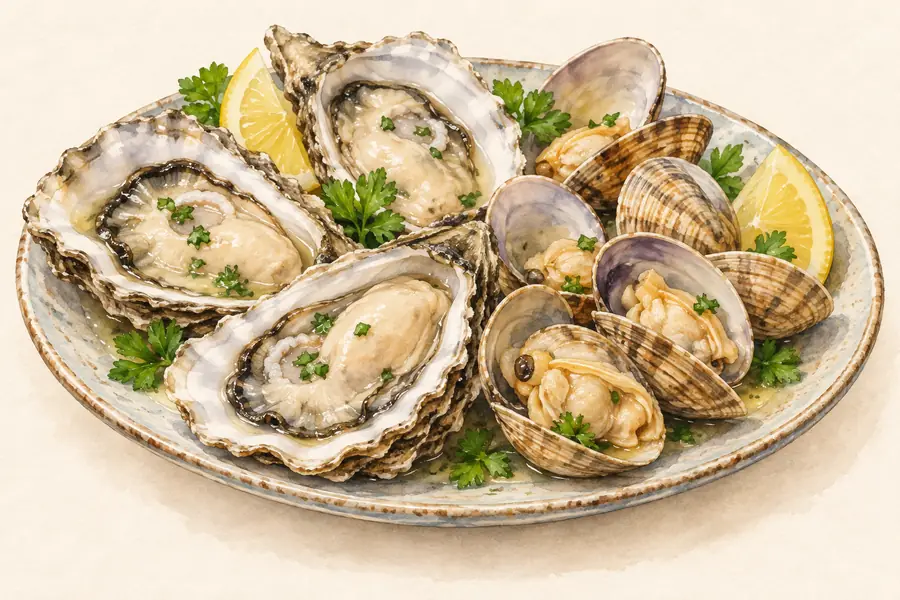
Deep-Fried Oyster Fritters (炸海蚵) is the deep-fried oyster fritter known across Taiwan and southern Fujian as 蚵嗲 or 蚵仔炸 — a ladle-shaped shell of batter holding oysters, cabbage and pork.
Built in a ladle, in order
The reference describes the method precisely: a slightly concave iron ladle is lined with a batter of flour and egg, then layered with shredded cabbage, chopped chives, minced pork and oysters, topped with more cabbage and sealed with another coat of batter before the whole ladle goes into the oil. When the fritter is cooked through — crisp outside, set within — it releases from the ladle at a tap and is left to drain.
The order matters because the cabbage forms walls around the oyster, keeping it from bursting and letting it steam inside its own shell of batter. Regional kitchens vary the extra ingredients, with bean sprouts added in some places.
What the fritter is like
The pleasure of a 蚵嗲 is the contrast in one bite: a brittle, oil-crisped batter around sweet steamed cabbage, savoury pork and an oyster that has just set. It is eaten with a sauce, and the reference notes it as a deep-fried snack of Taiwan and the Minnan coast, sold in the fishing villages and port towns where oysters are farmed.
The cabbage is not a filler but the mechanism: it holds moisture and sweetness around the oyster, so a fritter whose cabbage is thin will taste oilier and flatter.
Kinmen's stone oysters
The article maps the fritter onto oyster-growing country: on the main island it centres on Tainan and reaches south to Kaohsiung and north to Changhua, and the street of oyster-fritter shops at Wanggong fishing harbour in Changhua is singled out as a concentration. It also records that the fritter varies by area, with soybean sprouts and chives common in the west and pork with raw oyster as the core.
Kinmen's version is described as closer to Xiamen: cabbage with stone oyster, a smaller fritter and a paler colour than the main-island style. The record places this entry in Kinmen, where that local form is the one to look for.
Ingredients and dietary questions
The documented contents are batter, cabbage, chives, minced pork and oysters, so a standard fritter contains wheat, egg, pork and shellfish. It is therefore neither vegetarian nor shellfish-free as usually made.
Deep-frying also means shared oil and shared equipment; if you are avoiding pork or shellfish, ask whether a version can be made without them rather than assuming the fritter is only oyster and cabbage.
Ordering it
Ask for 蚵嗲 or 蚵仔炸, or 炸海蚵 if you want the name used in this record. It is sold by the piece from a frying counter, and the sensible order is one to test the oil and then more if it is good.
Useful questions are 有沒有肉 — whether pork is included — and 醬料辣不辣, since the sauce is applied at the counter and can be hot.
How it is eaten
It is a market snack eaten hot, in the hand or from a small plate, usually in the afternoon rather than at a formal meal. Because the batter softens as it cools, the fritter is at its best in the first minutes after it leaves the oil.
Ordered with a bowl of soup or a drink, it makes a light meal; the reference frames it as one of the ordinary fried foods of the coastal towns rather than a speciality for occasions.
More dishes to compare
Explore related local specialties and compare their names, preparation notes and ordering guidance.
Oyster omelet 蚵仔煎 →
Oyster omelet (蚵仔煎) is the griddle-cooked oyster dish of Taiwan, bound with sweet-potato starch and egg into a soft, chewy omelet. 炸海蚵 goes into deep oil instead, built in a ladle with cabbage walls around the oyster, so the result is a crisp fritter rather than a soft omelet. Both belong to the same oyster-farming coast and the same street-food repertoire; the difference is the cooking medium, which changes the texture from slippery to brittle.
Questions before you order
What is inside 蚵嗲?
The reference lists a batter of flour and egg, shredded cabbage, chopped chives, minced pork and oysters, layered in a ladle and deep-fried; some regions add bean sprouts.
How does Kinmen's version differ?
Chinese-language Wikipedia describes Kinmen's fritter as closer to Xiamen's: cabbage with stone oyster, a smaller size and a paler colour than the main-island style.
Source introduction: Wikipedia contributors: 蚵炱 · CC BY-SA 4.0 (https://creativecommons.org/licenses/by-sa/4.0/). English guide adapted from the cited material, with additional preparation and ordering guidance.
Sources & reading
The supplied food list supports this name and regional association. The culinary terms below are explained as menu vocabulary; a local recipe, origin story and venue availability have not been independently verified.