

Yellow Croaker Fish Balls 黄鱼鱼丸
Yellow Croaker Fish Balls is featured among the local specialties of Taiwan.

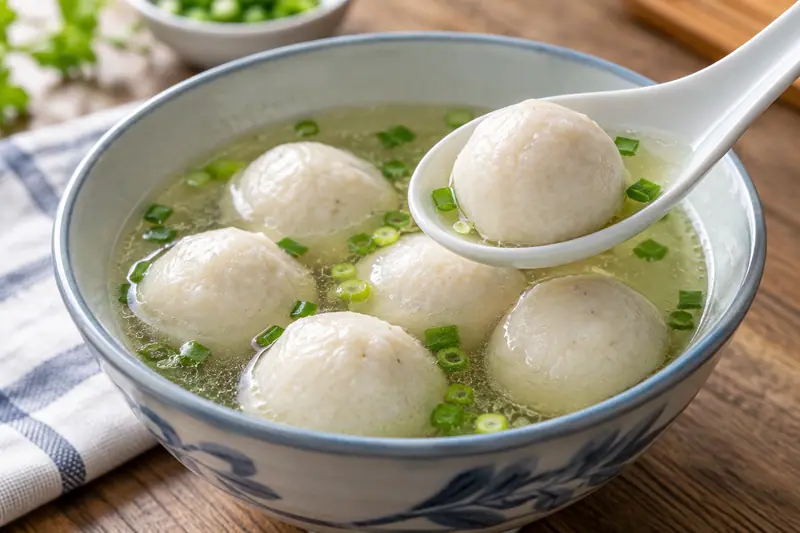
Yellow Croaker Fish Balls (黄鱼鱼丸) is a fish ball made from yellow croaker — a Taiwanese-reading of the same paste method that produces the island classic fish balls from shark, mackerel and milkfish.
How it is made
The technique is old and simple: fresh fish is taken apart for its flesh, ground cold, then pounded with salt in a wooden mortar so that the salt-soluble proteins re-form into a network. What comes out is a fine, glossy paste that is spooned into boiling water to set.
A fish ball is essentially fish flesh plus starch, and the shape need not be a sphere — Chinese-language Wikipedia notes kidney shapes and cubes as well. Yellow croaker fits the method because the technique rewards a lean white fish, and the salt is doing the structural work rather than a binder.
What they taste like
Good fish balls are springy with a clean, faintly sweet marine flavour and a surface that resists the tooth. The crisper style is common enough in Taiwan to have its own name, 脆丸, and that is the texture to expect when the paste has been pounded hard and boiled briefly.
Because the paste is mostly fish, the flavour is delicate and takes on whatever broth it is cooked in. That is why fish balls work as a soup ingredient rather than as a dish that carries a sauce.
Where it comes from
Taiwan has a deep bench of fish balls, and Chinese-language Wikipedia names four as representative: 淡水鯊魚丸 from Tamsui, 南方澳鬼頭刀魚丸 from Nanfang ao, 臺南虱目魚丸 from Tainan and 高雄旗魚丸 from Kaohsiung. Each is named for the fish it is made from, which is exactly the naming pattern 黄鱼鱼丸 follows.
The wider family includes 鱈魚丸, 花枝丸 and 蝦丸, so a menu that lists 黄鱼鱼丸 is marking the fish rather than the technique. The article Taiwanese section does not single out yellow croaker, so the fish here is taken from the dish own name.
Ingredients and dietary questions
The ingredients are fish, salt and starch; some makers add egg white or sugar. Starch is part of the definition rather than a filler, although the proportion is what separates a firm ball from a bouncy paste.
Fish balls are seafood, so they are not suitable for anyone avoiding fish, and cross-contact in a kitchen that also handles shellfish is common. Ask about added starch and any egg white if you are eating around an intolerance.
Ordering them
Fish balls appear on menus as 魚丸湯 in soup, on hotpot and oden lists, and as fried snacks. Because Chinese-language Wikipedia notes that Taiwanese fish balls are also packed and sold frozen, they are a supermarket item as much as a street one.
Ask which fish is in the ball if it matters — the difference between the four representative styles is the fish, and a shop that makes its own will usually say so. Portion sizes are small; a bowl is typically six to eight balls.
How they are eaten
In soup they are eaten with a spoon, usually with white pepper or a scatter of chopped spring onion, and the broth is drunk afterwards. Fried, they are eaten hot from paper, and in oden they sit in a soy broth with the rest of the skewers.
The same paste is the base of other Taiwanese fish-paste foods — fish cake, fish noodles and the like — so a kitchen that makes one usually makes several. That shared base is why the fish ball is a good index of how a shop handles its fish generally.
More dishes to compare
Explore related local specialties and compare their names, preparation notes and ordering guidance.
Matsu Fish Balls 马祖鱼丸 →
Matsu Fish Balls (马祖鱼丸) follows the Fuzhou line, where the balls are typically stuffed with pork and made from fish such as 鮸魚, and they are noticeably larger. 黄鱼鱼丸 is an unstuffed ball named for its fish, so the comparison is between the island two naming habits: the Matsu fish balls are known for their style and filling, while this one is known for its fish.
Questions before you order
Why is the fish named in 黄鱼鱼丸?
It follows the Taiwanese habit of naming a fish ball after its fish — the article does the same with 淡水鯊魚丸, 南方澳鬼頭刀魚丸, 臺南虱目魚丸 and 高雄旗魚丸.
Do fish balls contain flour?
A fish ball is made from fish flesh plus starch, so some starch is normal rather than a cheat. The proportion varies, and a higher fish content gives the springy bite that the crisper 脆丸 style is known for.
Source introduction: Wikipedia contributors: 魚丸 · CC BY-SA 4.0 (https://creativecommons.org/licenses/by-sa/4.0/). English guide adapted from the cited material, with additional preparation and ordering guidance.
Sources & reading
The supplied food list supports this name and regional association. The culinary terms below are explained as menu vocabulary; a local recipe, origin story and venue availability have not been independently verified.
Image credits & notes (1)
- Reference photo of a similar dish · 同类菜品参考照片A similar preparation is pictured; the local version may differ. 同类菜品参考照片,当地做法可能不同。Photo: Alpha · CC BY-SA 2.0Resized for the web; the photo itself has not been edited. Thumbnails may show a cropped view.
