

Keelung Miaokou Pork Thick Soup 基隆庙口肉羹
Keelung Miaokou Pork Thick Soup is featured among the local specialties of Taiwan.
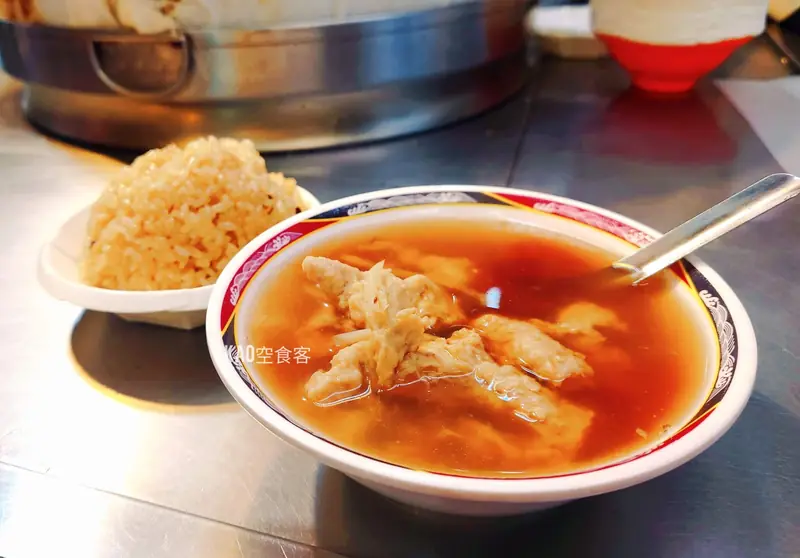
Image notes
Resized for the web; the photo itself has not been edited.
Keelung Miaokou Pork Thick Soup (基隆庙口肉羹) is pork thick soup served in Keelung Miaokou market, the round-the-clock snack district built around the 奠濟宮 temple on Ren 3rd Road.
How it is made
Rou geng is a thickened soup rather than a stew. Pork is cooked in a broth that is bound so it coats a spoon, and at Miaokou it is often served over rice or alongside rice sheets — 鼎邊趖 at the market lists 肉羹 among its main components, together with rice sheets, shrimp thick soup, daylily, mushroom, squid, dried fish, bamboo shoot, dried shrimp and crisp fried garlic.
The thickening is what defines the family. The same market serves 旗魚羹, 蝦仁羹, 紅燒鰻羹 and 排骨羹, each with a different main ingredient in a similarly bound broth, so a shop skill shows in the texture of the soup as much as in the meat.
What it tastes like
It is savoury and slightly sweet, with the body of the broth carrying the pork rather than a strong sauce. The soup is eaten hot and thickens further as it cools, which is why it is served in small bowls with a spoon.
The toppings matter: fried shallot and garlic, a little vinegar and white pepper in the bowl, and a piece of pickled radish on the side if the shop serves rice with it. Those garnishes are the same ones the market uses across its thick-soup stalls.
Where it comes from
Miaokou grew around 奠濟宮, built in 1873 and known as the 聖王公廟, dedicated to the Tang general 陳元光 whom Zhangzhou immigrants in Keelung worshipped. The surrounding land was once paddy, and the area kept the name 玉田 from the praise 田美如玉 attributed to the Qing governor 劉銘傳 in 1884.
The food district itself is modern: after 1945 the Keelung city government planned the stalls on Ren 3rd Road between Ai 3rd and Ai 4th Roads into a food street, with more than sixty registered shops. Over time the snack trade outgrew the temple in reputation, and the market now runs around the clock.
Ingredients and dietary questions
Pork is the main ingredient, in a thickened broth; the toppings typically include fried shallot or garlic, and the soup is often thickened with starch, which also means it is usually wheat-free but not always.
Two questions are worth asking: whether the broth is made with pork bone or seafood stock, and whether shellfish is prepared in the same pot, because the market serves shrimp and squid thick soups side by side. Anyone avoiding pork should look at 旗魚羹 or 蝦仁羹 instead.
Ordering it
Say 肉羹 for the soup, 肉羹飯 or 肉羹麵 if you want it over rice or noodles, and 鼎邊趖 if you want the rice-sheet bowl that uses 肉羹 as one of its components. The market named stalls include 天一香-肉羹順, which is known for both 肉羹 and braised pork rice.
Portions are small and cheap by design — this is a market built for eating across several stalls. Order one bowl, then move on to 天婦羅, 泡泡冰 or 營養三明治 rather than trying to make a single shop the whole meal.
How it is eaten
It arrives in a small bowl, eaten with a spoon at a shared table or standing at the stall, with vinegar and pepper adjusted by the customer. Because the district trades all day, the same bowl is breakfast for some and a late-night stop for others.
The market is laid out in an L shape along Ren 3rd Road and Ai 4th Road, with 奠濟宮 at the centre, so the practical way to eat here is to walk the lanes and take one dish per stall — the thick soups first, sweets afterwards.
More dishes to compare
Explore related local specialties and compare their names, preparation notes and ordering guidance.
Shiitake and Pork Thick Soup 香菇肉羹 →
Shiitake and Pork Thick Soup (香菇肉羹) is pork thick soup with shiitake mushroom added, while 基隆庙口肉羹 is the Keelung market bowl that keeps the pork at the centre. The base technique is shared — a thickened savoury broth with pork — and the difference is the mushroom, which deepens the broth and shifts the balance away from the pork.
Questions before you order
What is 羹 in 肉羹?
It is a thickened soup. The pork is cooked in a broth that is bound so it coats a spoon, which is why the market serves several versions — 旗魚羹, 蝦仁羹, 排骨羹 — with the same thick base.
Is the Keelung market open at night?
Chinese-language Wikipedia describes shops trading 24 hours a day, with the night-market period the busiest, so it is not limited to evening service.
Source introduction: Wikipedia contributors: 基隆廟口 · CC BY-SA 4.0 (https://creativecommons.org/licenses/by-sa/4.0/). English guide adapted from the cited material, with additional preparation and ordering guidance.
Sources & reading
The supplied food list supports this name and regional association. The culinary terms below are explained as menu vocabulary; a local recipe, origin story and venue availability have not been independently verified.