

West Lake Longjing green tea 西湖龙井茶
A pan-fired green tea tied to a defined tea-growing area in Hangzhou’s West Lake District; compare its fresh, gently sweet cup with the leaf’s flat shape and the story of the hands that make it.
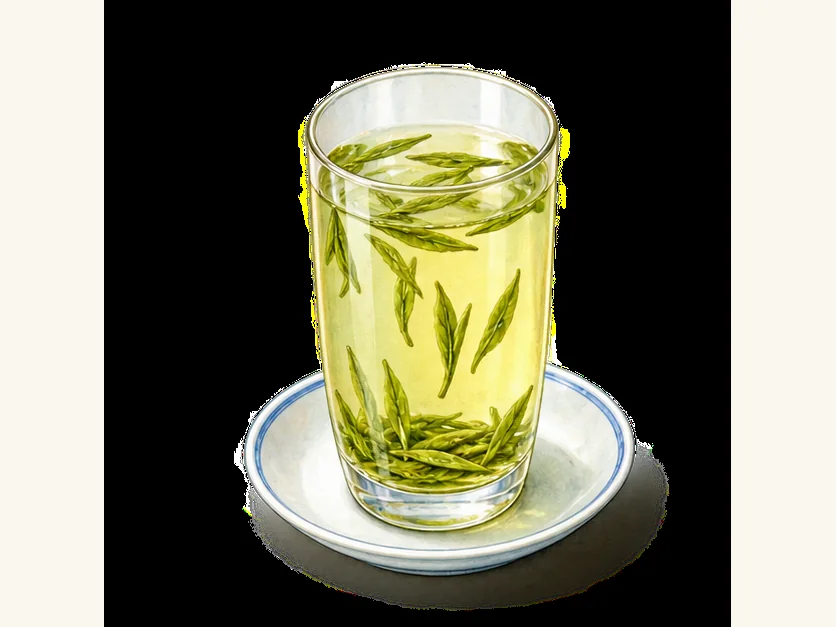
West Lake Longjing is not simply any tea sold as “Longjing.” Hangzhou’s ordinance defines it as a flat green tea made locally from fresh leaves grown in the West Lake Longjing production area, using Longjing group cultivars or approved cultivars such as Longjing 43 and Longjing Changye. The legally defined area lies in present-day West Lake District, including designated protected tea bases and other city-recognized tea plots within the ordinance’s boundary. Longjing tea is also made in other areas of Zhejiang; those regional teas are not thereby West Lake Longjing.
The fresh leaves are spread to lose moisture, then heated and worked in a hot pan. Traditional production includes the stages known as qingguo (initial pan-firing), resting or reconditioning, and huiguo (final firing), among other sorting and finishing steps. The maker’s hands repeatedly lift, press, flick, and flatten the leaves: this craft gives the dry tea its pressed-flat, smooth appearance while halting oxidation for a green tea. Both hand skill and the quality of the leaf matter; the protected name is about origin and production, not a promise that every batch tastes identical.
Look for flat, tidy leaves and a clear, fresh aroma. In the cup, expect a light green to yellow-green liquor and a clean, vegetal sweetness; some lots show a gentle bean-like or toasted note, while others are subtler. Tenderness, cultivar, harvest date, grade, and the maker’s hand all change the balance. “Before Qingming” (“pre-Qingming”) is a harvest period, not a guarantee that a tea is genuine or that it will suit every palate. A brisk edge can emerge if the tea is brewed too strongly; there is no single flavor profile that applies to every village or batch.
For a first tasting, order it plain and ask where the leaves were grown, which harvest and cultivar they are, and whether the seller can show the current West Lake Longjing traceability mark. Hangzhou’s rules require the mark on packaged West Lake Longjing sold at retail; it carries producer, year, specification, serial, and anti-counterfeit information. Ask before buying loose tea, since loose-leaf service is not the same as a packaged product bearing a mark.
A glass lets you watch the flat leaves unfurl; a small lidded bowl is another common way to brew and compare aroma. Hangzhou consumer guidance gives a practical starting point of about 3 g per glass, water around 85–95°C, a short initial wetting, then a top-up; with a lidded bowl, use roughly 3–5 g and adjust the steep to taste. Treat those as starting points rather than a fixed recipe: cooler water or a shorter steep can soften a strong cup, and you can refill to compare later infusions. Some sellers also offer cold-brewed Longjing, which is generally milder and takes longer to extract.
How to order: “西湖龙井茶” (Xīhú Lóngjǐng chá). Ask “这是西湖产区的吗?有当年的溯源码吗?” (“Is this from the West Lake production area? Can I see this year’s traceability code?”). Availability, harvest and prices vary by seller and season; this guide does not endorse a particular shop or promise a tasting at the museum.
Where to eat it
You can find West Lake Longjing green tea all over Hangzhou, so there is no need to seek out one particular restaurant. To find one near you, search for “西湖龙井茶” in Meituan (美团) or Amap (高德地图) and check recent reviews, distance and opening hours.
More dishes to compare
Explore related local specialties and compare their names, preparation notes and ordering guidance.
Wushan flaky sweet pastries 吴山酥油饼 →
The dough is worked into fine layers and cooked until crisp. Producers may make flatter cakes or the familiar tapered layered form. The pastry breaks into delicate flakes, with sweetness on or within the layers. A fresh version can be fragile and rich.
Osmanthus glutinous-rice lotus root 桂花糯米藕 →
Glutinous rice is packed into the holes of a lotus root, which is slowly cooked in sweet liquid and sliced. Osmanthus flowers or syrup add the final fragrance. Tender lotus root retains a little structure around the sticky rice, with a rich, floral sweetness throughout. The slices are more substantial than a light fruit dessert.
Sources & reading
Recipes and servings vary between kitchens.