


Photo adjustments
Proportionally resized and converted to WebP without cropping, retouching or changing the photographed subject.
Explore the region
About Tianlongshan Grottoes
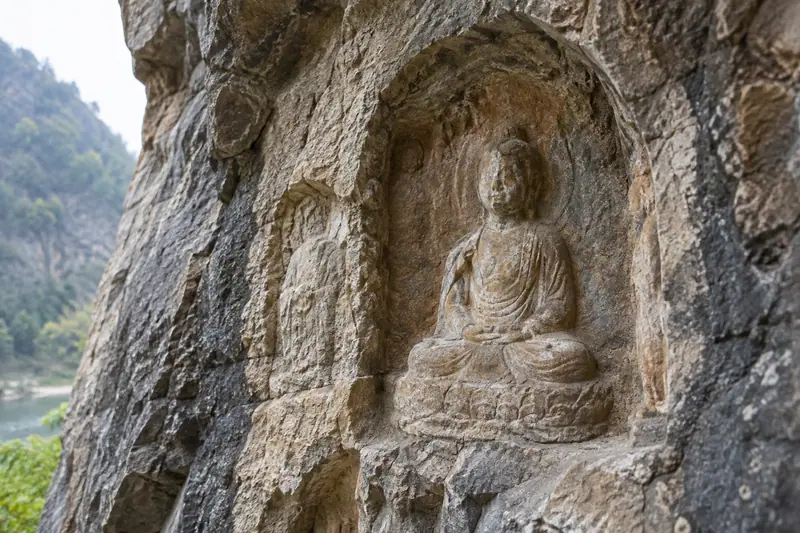
Caves 2 and 3 preserve the earlier architectural language, while Cave 9, associated with Manshan Pavilion, presents a larger layered composition. Missing heads and damaged figures are an essential part of what you see: many sculptures were cut away for the international art trade. The surviving settings and modern interpretation help reconnect those fragments with their original caves.
The grottoes were first cut in the late Northern Wei and Eastern Wei periods and are considered representative of Northern Qi Buddhist culture, beginning with the Foyan grotto temple built under the Northern Qi Emperor Wenxuan and the Tianlong grotto temple of Emperor Xiaozhao; later dynasties continued carving caves at the site into the Tang period. In the 1920s many of the statues were removed and sold to foreign collectors, a trade that grew after the Japanese dealer Yamanaka Sadajiro published a book on the caves' contents, and numerous sculptures from Tianlongshan are now held in museums abroad.
The site's caves extend about 500 metres along the south-facing cliffs of the eastern and western peaks, with 25 caves in total, twelve on the eastern peak and thirteen on the western, containing more than 500 surviving sculptures. Tang-dynasty carvings, which form the majority, are noted for their soft modelling, flowing drapery and naturalism and are recognised as a distinct regional 'Tianlongshan style'. The grottoes were listed as a Major Historical and Cultural Site Protected at the National Level (全国重点文物保护单位) in 2001.
What to look for
- Caves 2 and 3, with early chamber forms and relief decoration.
- Cave 9 and the Manshan Pavilion setting, contrasting with the earlier caves.
The surrounding area
Provincial city base for Jinci, museums and the Zhonglou Street food-and-walking district.
Location & getting there
Getting to Tianlongshan Grottoes
Approach Tianlongshan through the Jinci area of Taiyuan's Jinyuan District; the tourism-road connection begins by Jinci Museum and joins the mountain road.
- Arrange the final mountain transfer for Tianlongshan itself and confirm the open cave route before ascending.
Combine your visit
Suggested order within this visit:
-
Early caves 2 and 3
Start with the earlier sculptural and architectural forms where the open circuit allows.
-
Cave 9 / Manshan Pavilion
Compare the larger composition and later imagery.
-
Site interpretation displays
Use the explanations to understand removed sculpture and digital reconstruction.
This sequence is an editorial suggestion based on the features described in the sources. Access to individual buildings or areas should be checked locally; no travel time or shared admission is implied.
Find Tianlongshan Grottoes
天龙山石窟 · 太原市
The pin marks the area, not the entrance.
More places nearby
Approximate straight-line distances between map pins, not travel distances.
Jinci 晋祠
7 km awayJinci brings spring water, garden scenery and early timber architecture together at the foot of Xuanweng Mountain. Its Hall of the Holy Mother is especially rewarding for the coiled wooden dragons outside and the individually…
View guide →Mengshan Giant Buddha 蒙山大佛
8 km awayThe Mengshan Buddha is a huge rock-cut figure whose weathered body and modern replacement head tell two distinct chapters of the site's history. The original carving belongs to the Northern Qi period and stood behind Kaihua…
View guide →Shanxi Museum 山西博物院
19 km awayShanxi Museum is a useful starting point for understanding why the province's tombs, temples and merchant houses contain such different kinds of art. The Jin Soul displays connect archaeology with later religious and commercial…
View guide →Sources & visit information
The sources below support the place-specific description and arrival information. Suggested combinations are editorial planning ideas; confirm current opening, entry arrangements and transport services for your date.
- Wikipedia: 天龙山石窟 ↗
- Tianlongshan tourism-road connection from Jinci ↗
- Tianlongshan sculpture, cave histories and losses ↗
- English Wikipedia: Tianlongshan Grottoes (revision 1364721285, 2026-07-18) ↗
Visitor information adapted and edited from Wikipedia contributors · CC BY-SA 4.0. Source revision 93447753.
Background paragraphs translated and condensed from Wikipedia contributors, "天龙山石窟", Chinese Wikipedia · CC BY-SA 4.0. Source revision 93447753.
Background paragraphs condensed from Wikipedia contributors, "Tianlongshan Grottoes", English Wikipedia · CC BY-SA 4.0. Source revision 1364721285.