

Photo adjustments
Resized and WebP compressed; subject not altered.
Explore the region
About Mengshan Giant Buddha
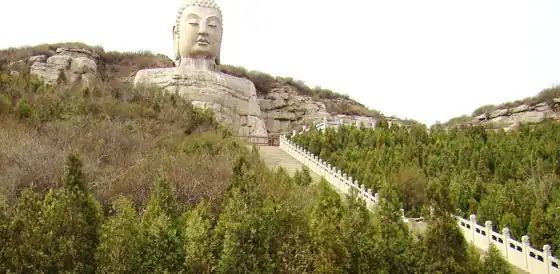
The original carving belongs to the Northern Qi period and stood behind Kaihua Temple; its damaged, partly buried remains were recognised again during a modern place-name survey. The surrounding cliff still helps explain how the statue occupied the mountain. Look at the surviving body and the restoration together, without mistaking the present silhouette for an entirely untouched ancient sculpture.
The Buddha originally stood behind Kaihua Temple (开化寺), built in 559, the second year of the Tianbao era (天保) of the Northern Qi dynasty, when a path was cut into the hillside and the statue carved further up the slope. Taiyuan, then called Jinyang, was the Northern Qi dynasty's secondary capital. The statue was destroyed at the end of the Yuan dynasty, and ancient records give its original height as 200 chi (二百尺), equal to 59 metres in modern measure.
The niche is an open-fronted recess 29.60 metres wide and 17 metres deep, roughly semi-elliptical in plan; the statue's head is missing, and researchers suggest a natural rock outcrop there may originally have been carved into it. Behind the statue a flat terrace holds the ruins of a monastery, with scattered brick, tile fragments and a broken stele. The Buddha stands alone, with no evidence of attendant figures around the niche, and its sandstone body has weathered so severely that the original robe folds can no longer be made out.
The Buddha is now a municipal-level cultural relic protection site in Taiyuan. Researchers estimate its original height, including the modern base, at about 46 metres. Conservation work from 2007 consolidated the statue's body and added the reconstructed head, and the site opened to the public in October 2008.
What to look for
- The weathered rock-cut torso and seated body, contrasted with the replacement head installed during the modern restoration.
- The cliff niche and traces of the former sheltering architecture around the Buddha.
The surrounding area
Provincial city base for Jinci, museums and the Zhonglou Street food-and-walking district.
Location & getting there
Getting to Mengshan Giant Buddha
The site is northwest of Sidi Village in Luocheng, Taiyuan's Jinyuan District; use Mengshan Giant Buddha at that village for the final road approach.
- Follow the designated mountain visitor route to the viewing area rather than approaching the carving through the surrounding slopes.
Combine your visit
Suggested order within this visit:
-
Mountain approach and site interpretation
Establish the connection with Kaihua Temple and the rediscovery.
-
Buddha viewing platform
Compare ancient stone, weathering and modern restoration from the permitted position.
This sequence is an editorial suggestion based on the features described in the sources. Access to individual buildings or areas should be checked locally; no travel time or shared admission is implied.
Find Mengshan Giant Buddha
蒙山大佛 · 太原市
The pin marks the area, not the entrance.
More places nearby
Approximate straight-line distances between map pins, not travel distances.
Tianlongshan Grottoes 天龙山石窟
8 km awayTianlongshan's caves extend across two wooded mountain faces, tracing changes in Buddhist sculpture from the Eastern Wei and Northern Qi into the Tang period. Caves 2 and 3 preserve the earlier architectural language, while Cave…
View guide →Jinci 晋祠
8 km awayJinci brings spring water, garden scenery and early timber architecture together at the foot of Xuanweng Mountain. Its Hall of the Holy Mother is especially rewarding for the coiled wooden dragons outside and the individually…
View guide →Shanxi Museum 山西博物院
12 km awayShanxi Museum is a useful starting point for understanding why the province's tombs, temples and merchant houses contain such different kinds of art. The Jin Soul displays connect archaeology with later religious and commercial…
View guide →Sources & visit information
The linked encyclopedia sources support background and place descriptions. Current opening hours, ticket prices, booking rules and transport schedules have not been independently verified for this guide. Confirm them with the venue or operator before travelling.
Visitor information adapted and edited from Wikipedia contributors · CC BY-SA 4.0. Source revision 92021392.
Background paragraphs translated and condensed from Wikipedia contributors, "蒙山大佛", Chinese Wikipedia · CC BY-SA 4.0. Source revision 92021392.
Background paragraphs condensed from Wikipedia contributors, "Mengshan Giant Buddha", English Wikipedia · CC BY-SA 4.0. Source revision 1361288764.