

Photo adjustments
EXIF orientation normalized; resized without changing aspect ratio; converted to WebP. No subject edits.
Explore the region
About Hetu Ala
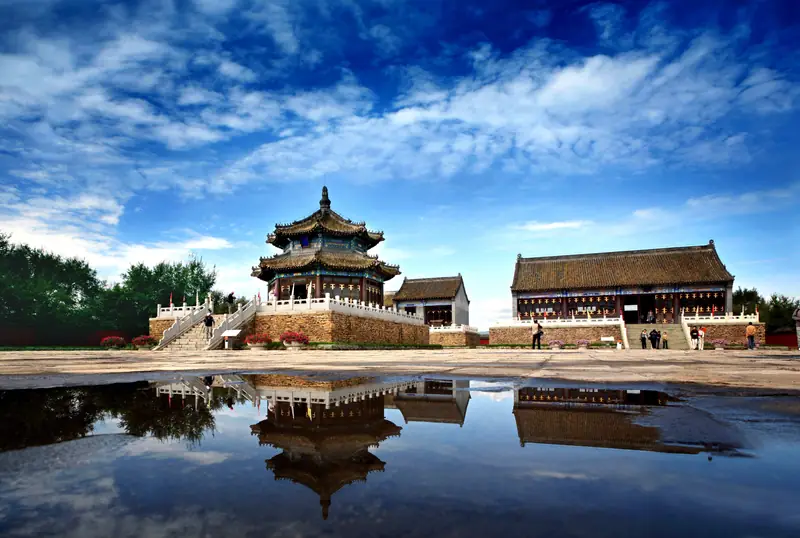
Its position on a ridge between waterways explains the Manchu name, often translated as a horizontal ridge. The inner and outer city enclosures organised political, military and domestic activity. Within the visitor site, the accession-platform area, office sites and old well provide a more concrete way to explore that history than treating every reconstructed building as an untouched early-seventeenth-century survivor.
Hetu Ala was built starting in 1603 as the first capital where Nurhaci founded his state and took the title of khan. After the capital moved to Liaoyang in 1622, Hetu Ala became known as the 'old city', and in 1634 its Chinese name was changed to Xingjing (兴京). In 2006 it was listed as a Major Historical and Cultural Site Protected at the National Level (全国重点文物保护单位).
The city stands on a terrace southeast of the confluence of the Suzi River (苏子河) and the Erdao River (二道河), about three kilometers east of present-day Yongling (永陵镇). It backs onto Baicha Mountain (白岔山) to the southeast, faces Yanchong Mountain (烟囱山) across the Erdao River to the west, connects to Yangbizi Mountain (羊鼻子山) to the south, and faces Yaoling Mountain (腰岭山) across the Suzi River to the north, with water on three sides and mountains on the fourth.
The city had an inner and an outer wall, with a circumference of five li for the inner wall and ten li for the outer, and nine gates in total. The outer wall enclosed an area with a perimeter of 5,230 meters, while the inner city, built on the ridge itself, had a perimeter of 2,027 meters and covered 246,000 square meters.
What to look for
- The inner and outer city layout, shaped by the ridge and surrounding waterways.
- The accession-platform area and surviving or interpreted office, well and settlement sites.
Location & getting there
Getting to Hetu Ala
Go to Laocheng Village in Yongling Town, Xinbin Manchu Autonomous County. Hetu Ala lies east of Yongling town and is a separate site from the Qing Yongling tombs.
Combine your visit
Suggested order within this visit:
-
City-wall and gateway approach
Understand the ridge-top layout.
-
Accession-platform area
Concentrate on the early court's political centre.
-
Old well and office-site interpretation
Connect the ceremonial centre with daily settlement functions.
This sequence is an editorial suggestion based on the features described in the sources. Access to individual buildings or areas should be checked locally; no travel time or shared admission is implied.

Find Hetu Ala
赫图阿拉城 · 抚顺市
The pin marks the area, not the entrance.
More places nearby
Approximate straight-line distances between map pins, not travel distances.
Wunü Mountain 五女山
62 km awayWunü Mountain's plateau preserves the remains of an early Goguryeo mountain city above Huanren. Steep cliffs supplied much of the defence, with built walls closing the more accessible gaps. On the summit, building foundations…
View guide →Benxi Water Cave 本溪水洞
78 km awayBenxi Water Cave is a limestone cave system with contrasting dry and water-filled sections. The entrance chamber opens towards passages where stalactites, stalagmites and columns cluster along natural fractures. The underground…
View guide →Pingdingshan Massacre Memorial Hall 平顶山惨案遗址纪念馆
79 km awayThe Pingdingshan memorial commemorates civilians killed by Japanese troops at a village near Fushun in 1932. Its historical exhibition explains the attack and subsequent investigations, while the hall containing excavated human…
View guide →Sources & visit information
The linked encyclopedia sources support background and place descriptions. Current opening hours, ticket prices, booking rules and transport schedules have not been independently verified for this guide. Confirm them with the venue or operator before travelling.
Visitor information adapted and edited from Wikipedia contributors · CC BY-SA 4.0. Source revision 92350403.
Background paragraphs translated and condensed from Wikipedia contributors, "赫图阿拉城", Chinese Wikipedia · CC BY-SA 4.0. Source revision 92350403.