

Explore the region
Service information checked: 21 October 2026. Hours, booking conditions and exhibits can change; confirm the museum’s live notices before travelling.
A museum shaped around evolution
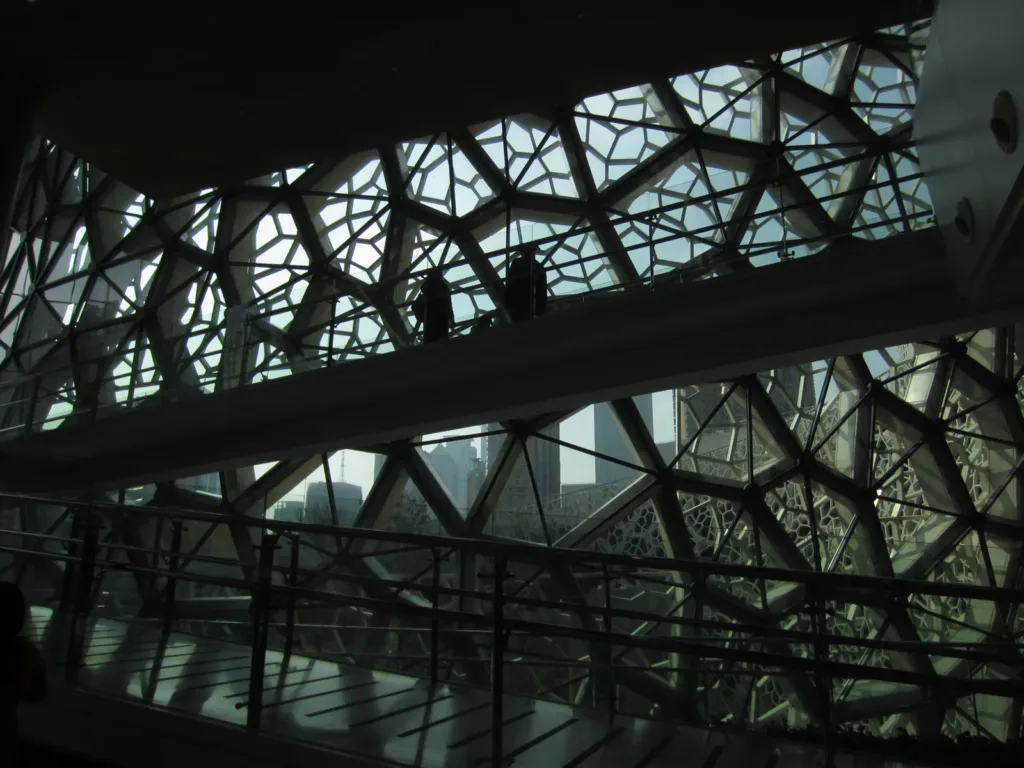
The museum is a branch of the Shanghai Science and Technology Museum at 510 West Beijing Road, within Jing’an Sculpture Park. Its building was designed with the layered spiral of a snail shell in mind: green roof planes rise from the park setting, while a large glazed structure brings daylight into the interior. This is a working science museum, not simply a collection of display cases—the official overview also describes hands-on Exploration Labs, live cultivation and immersive habitat displays. Programmes and individual exhibits may have different access arrangements.
The permanent displays use three broad themes: The Symphony of Evolution, The Picture Scroll of Life and The Epic of Civilization. Together they connect the origins and changes of life with the diversity of living things and the ways people have depended on—and altered—the natural environment. Rather than trying to race through every label, choose one question to follow: how life changed over time, how species adapt to different environments, or how human communities fit into ecological systems.
The museum’s published overview describes a large walk-through African savannah scene, alongside specimen displays, scientific illustrations, living plants and immersive theatres. These offer a useful contrast in scale: move from close inspection of specimens and explanatory devices to a habitat-sized scene, then look for the ways the displays connect organisms to their surroundings. Treat the named installations as examples from the museum’s overview, not a guarantee that every room or activity is open on your date.
A simple way to explore
Allow about three hours as an editorial planning estimate for a considered visit to the main displays; add time if you want to use interactive exhibits, join a scheduled activity or watch a film. This is not an official visit duration. The museum describes ten themed permanent exhibition zones within its three-part framework, so start with the evolution story, continue into the variety and adaptations of life, and finish with the human–environment relationship. Use the current floor guide to connect those themes in the galleries that are open, rather than assuming a fixed one-way route.
If time is short, spend it on a few contrasts: read a specimen label alongside its habitat or adaptation display; look across the larger recreated environment to see how scenery conveys ecological relationships; and compare those nature displays with the sections on people and the environment. The museum also describes Exploration Labs and special theatre experiences. These are add-ons, not necessary to understand the permanent exhibition, and some require advance booking or a separate ticket. Check the day’s programme before building them into a schedule.
The museum’s visitor app advertises gallery routes and reservation inquiry. The museum recommends downloading it before use because of its size.
When you have finished indoors, the surrounding Jing’an Sculpture Park offers a possible outdoor continuation among planted space and sculpture. The museum is located within the park, but the museum’s admission ticket should not be treated as a promise that a particular park gate, artwork or outdoor route will be accessible; follow park notices and on-site signs.
Tickets, hours and arrival
The official visitor-information page lists opening hours of 09:00–17:00, with entry ending at 16:00, and says the museum is closed on Tuesdays except national holidays. The same page warns that adjustments may be announced separately. These details were checked on 21 October 2026; check the current notice before setting out, especially around holidays.
The published individual-admission prices are CNY 30 for adults aged 18 and over, CNY 25 for visitors aged 60–69, and CNY 12 for eligible students and children over 1.3 metres. The museum also lists free-entry categories, including children no taller than 1.3 metres or aged six and under, and qualifying visitors with the required documents. Concessions depend on the museum’s eligibility rules and proof of status. The visitor-information page says admission uses online real-name ticketing and an identity check at entry. Use the booking route linked from the museum’s own website or its official WeChat account, and check the live booking screen for available dates and terms; do not assume walk-up admission is available.
The museum’s current visitor page gives the address as 510 West Beijing Road, Jing’an District, inside Jing’an Sculpture Park. It lists Natural History Museum Station on Metro Line 13 (no exit number given), Xinzha Road Station on Line 1 (Exit 1) and West Nanjing Road Station on Line 2 (Exit 2). The museum does not publish a turn-by-turn walk or walking time from these exits; use the address and follow current park signs. Its English visitor page lists buses 109, 301, 324, 41, 927 and 955 at Shimen Road/Shanhaiguan Road; 104, 136, 19, 36 and 64 at Xinzha Road/Shimen Road; and 15, 21, 301 and 315 at Beijing West Road/Taixing Road. It does not provide route-specific direction or frequency. There is no public parking at the museum.
The museum’s English visitor page places its visitor-service centre in the main lobby on the ground floor, but the museum pages do not identify an external visitor gate, an approved taxi drop-off point or a turn-by-turn approach from a park gate. For a taxi or ride-hail destination, use 上海自然博物馆,上海市静安区北京西路510号(静安雕塑公园内); this is the published address, not a verified curbside drop-off bay. Follow current park and museum signs on arrival, then present the ticket and required identification. If combining the museum with the sculpture park, check the park’s current access separately; no combined admission is stated.
Combine your visit
A suggested sequence linking the specific features of this visit.
-
Natural-history collections
Focus on the animal, plant or mineral subjects that interest you.
-
Jing’an Sculpture Park静安雕塑公园
Continue outside to the public artworks and gardens surrounding the museum.
This order is editorial. Confirm access and any transfers between stops; it does not establish a walking route, same-day connection or common admission ticket.
Find Shanghai Natural History Museum
上海自然博物馆 · 静安区
The pin marks the area, not the entrance.
More places nearby
Approximate straight-line distances between map pins, not travel distances.
Jing'an Sculpture Park 静安雕塑公园
Less than 1 km awayJing’an Sculpture Park combines outdoor art with lawns and planted space around Shanghai Natural History Museum. The works are distributed through a public park rather than arranged as a single indoor gallery sequence.
View guide →Shanghai History Museum 上海市历史博物馆
Less than 1 km awayShanghai History Museum occupies the former Race Club building on West Nanjing Road. The neoclassical clubhouse and its tall tower are part of the city history the museum interprets.
View guide →Sihang Warehouse 四行仓库
Less than 1 km awaySihang Warehouse stands beside Suzhou Creek and is associated with the final phase of the Battle of Shanghai in 1937. A Chinese battalion held the building while other forces withdrew westward.
View guide →Sources & visit information
Sources checked on 21 October 2026. Hours, tickets, reservations and transport can change; confirm with the operator before you go.
- Shanghai Natural History Museum visitor information ↗
- Shanghai Natural History Museum online ticket information ↗
- Shanghai Natural History Museum permanent exhibition overview ↗
- Shanghai Natural History Museum overview ↗
- Shanghai Natural History Museum visitor app ↗
- Shanghai Natural History Museum visitor information in English ↗
- OpenStreetMap and Overpass record for the museum building ↗
Image credits & notes (1)
- Interior roof structure at the Shanghai Natural History Museum, photographed in 2015. Photo: Another BelieverPhoto: CC BY-SA 4.0