

Photo adjustments
Full frame retained; proportionally resized and converted to WebP. No retouching or changes to the photographed subject. Card displays may crop the view.
Explore the region
About Shanghai Jewish Refugees Museum
Documents, photographs and personal objects explain the lives of European Jews who found refuge in Shanghai during Nazi persecution.
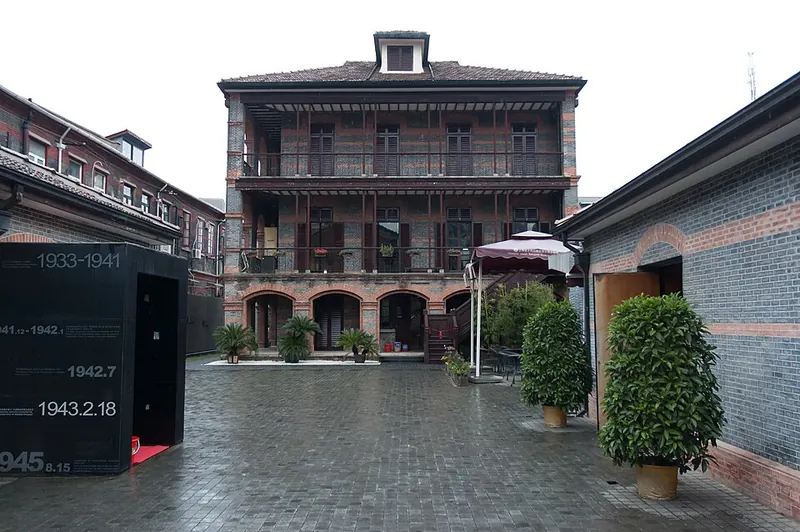
The restored synagogue provides the architectural setting, while the memorial wall records the names of refugees. Read the objects alongside the neighbourhood history rather than treating the site only as a former religious building. Current galleries may differ from older floor-by-floor descriptions.
The Ohel Moshe congregation was founded by Russian Jewish immigrants in Shanghai in 1907, an Ashkenazi community named for Moshe Greenberg. It had grown to 250 families by the 1920s, when Shanghai's chief rabbi, Meir Ashkenazi, supported building a new synagogue; the present structure was created in 1927 by remodeling an existing three-story building, removing its second floor and adding a mezzanine. The synagogue closed in 1956 and was later used as a factory, a mental-health clinic and Hongkou district's civil air defense office.
The building was restored to its original appearance in 2007, when the Shanghai Jewish Refugees Museum was established on the site. It was designated a Shanghai municipal cultural relic protected site (上海市文物保护单位) in 2014, the year a wall listing 13,732 Jewish refugees who sheltered in wartime Shanghai was unveiled, compiled with the assistance of a woman who had been born in the ghetto. A 2017 expansion enlarged the museum from about 1,000 to more than 4,000 square meters and increased its displayed relics from 150 to nearly 1,000 items before it reopened on December 8, 2020.
What to look for
- The former Ohel Moshe Synagogue preserves the museum’s historic religious setting.
- A memorial wall records the names of Jewish refugees.
- Documents and personal objects connect the wider history with individual lives.
Background & history
The Shanghai Jewish Refugees Museum is a museum commemorating the Jewish refugees who lived in Shanghai after fleeing Europe to escape Nazi persecution. It is located at the former Ohel Moshe or Moishe Synagogue, in the Tilanqiao Historic Area of Hongkou district, Shanghai, China. The museum features documents, photographs, films, and personal items documenting the lives of some of the more than 20,000 Jewish residents of the Restricted Sector for Stateless Refugees, better known as the Shanghai Ghetto, during the Japanese occupation of Shanghai.
Excerpt from Wikipedia: Shanghai Jewish Refugees Museum · Wikipedia contributors · CC BY-SA 4.0. Selected introductory sentences; formatting simplified. Background information, not current visitor-service advice.
Location & getting there
Getting to Shanghai Jewish Refugees Museum
Approach the museum on Changyang Road in the Tilanqiao historic area of Hongkou and use the current museum entrance.
Combine your visit
A suggested sequence linking the specific features of this visit.
-
Former Ohel Moshe Synagogue
Begin with the building that served the refugee community.
-
Refugee-history galleries
Connect documents and personal objects with individual experiences.
-
Memorial wall
Finish at the named commemoration of the refugees.
This order is editorial. Confirm access and any transfers between stops; it does not establish a walking route, same-day connection or common admission ticket.
Find Shanghai Jewish Refugees Museum
上海犹太难民纪念馆 · 虹口区
The pin marks the area, not the entrance.
More places nearby
Approximate straight-line distances between map pins, not travel distances.
Shanghai Ocean Aquarium 上海海洋水族馆
2 km awayShanghai Ocean Aquarium is an indoor aquatic attraction in Lujiazui. Its exhibits use geographic zones alongside an underwater tunnel sequence.
View guide →Oriental Pearl Tower 东方明珠
2 km awayThe Oriental Pearl Tower stands in Lujiazui on the eastern bank of the Huangpu, opposite the Bund. Its futuristic arrangement of spheres and supporting columns made it one of the city’s most recognizable television towers.
View guide →Shanghai Tower 上海中心大厦
2 km awayShanghai Tower rises beside Jin Mao Tower and Shanghai World Financial Center in Lujiazui. Gensler’s design divides the skyscraper into stacked zones for different uses, with public sightseeing spaces high above the river.
View guide →Sources & visit information
The linked encyclopedia sources support background and place descriptions. Current opening hours, ticket prices, booking rules and transport schedules have not been independently verified for this guide. Confirm them with the venue or operator before travelling.
- Shanghai Jewish Refugees Museum ↗
- Chinese Wikipedia: 摩西会堂 (revision 92089230, 2026-03-29) ↗
- English Wikipedia: Shanghai Jewish Refugees Museum (revision 1366935536, 2026-07-30) ↗
Visitor information adapted and edited from Wikipedia contributors, “Shanghai Jewish Refugees Museum” · CC BY-SA 4.0. Source revision 1366935536.
Background paragraphs translated and condensed from Wikipedia contributors, "摩西会堂", Chinese Wikipedia · CC BY-SA 4.0. Source revision 92089230.
Background paragraphs condensed from Wikipedia contributors, "Shanghai Jewish Refugees Museum", English Wikipedia · CC BY-SA 4.0. Source revision 1366935536.