


Explore the region
About Jinshan Temple (Zhenjiang)
The buildings wrap around the slopes, with Cishou Pagoda giving the ensemble its most visible vertical marker.
The main worship halls and stepped routes create changing views as the ground rises. Nearby Wenzong Pavilion is a modern reconstruction of a former imperial library, so it represents another period of interpretation rather than an untouched Qing building. Check which religious and library spaces are accessible.
The temple was first established in the Eastern Jin dynasty as Zexin Temple. It later fell into disrepair until the Chan master Lingtan reopened it in the Tang dynasty's Tianbao era, turning it into a Chan Buddhist temple, and in 805 it was named Jinshan (Golden Hill). In 1687 the Kangxi Emperor climbed the hill during a southern tour and, seeing sky and river merge into a single color, bestowed the name Jiangtian Chan Temple, which it retains today.
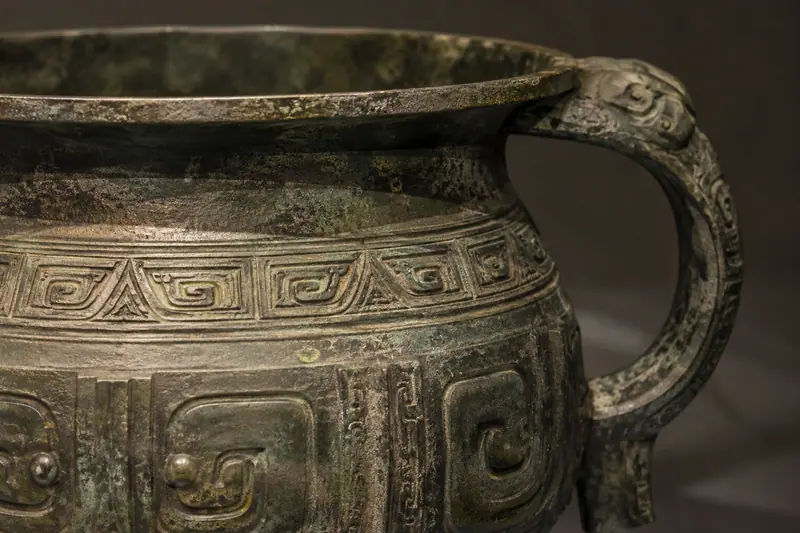
Jinshan hill rises 43.7 meters about two kilometers northwest of Zhenjiang and covers an area of 10 hectares; it was originally an island in the Yangtze River until the river's shifting course joined it to the south bank by the Guangxu era. The temple holds Su Dongpo's jade belt, a bronze ding vessel, a painting of Jinshan and a bronze drum, known together as the 'Four Treasures of Jinshan.'
Wenzong Pavilion, an imperial library that once held a copy of the Complete Library of the Four Treasuries, was built beside the temple in 1779 and destroyed in 1853 during fighting between Taiping and Qing forces. Its present reconstruction, based on an old illustrated record, covers a floor area of 1,286 square meters, displays a reprint of the Four Treasuries, and reopened on 26 October 2011.
What to look for
- The temple halls are arranged tightly against the hill’s slopes.
- Cishou Pagoda forms the high point of the architectural composition.
Location & getting there
Getting to Jinshan Temple (Zhenjiang)
Approach Jinshan Scenic Area in northwestern Zhenjiang and use the temple’s current public entrance at the hill.
Combine your visit
A suggested sequence linking the specific features of this visit.
-
Main temple halls
Begin with the buildings wrapping around the slope.
-
Cishou Pagoda viewing area
Follow the permitted route toward the ensemble’s vertical landmark.
-
Wenzong Pavilion exterior
Compare the temple with a reconstructed imperial-library building.
This order is editorial. Confirm access and any transfers between stops; it does not establish a walking route, same-day connection or common admission ticket.
Find Jinshan Temple (Zhenjiang)
金山寺 · 镇江市
The pin marks the area, not the entrance.
More places nearby
Approximate straight-line distances between map pins, not travel distances.
Xijindu Ancient Street 西津渡
1 km awayXijindu developed around a historic ferry crossing below Yuntai Hill in western Zhenjiang. The lanes preserve a layered streetscape connected with river travel, religion and the treaty-port period.
View guide →Beigu Mountain 北固山
4 km awayBeigu Mountain rises on the southern bank of the Yangtze in northeastern Zhenjiang. Its historic landscape is organized around a series of low peaks and linked ridges.
View guide →Jiaoshan 焦山
6 km awayJiaoshan is a wooded island hill in the Yangtze north of Zhenjiang. Dinghui Temple is set among the trees, giving the religious buildings a different relationship with the landscape from nearby Jinshan.
View guide →Sources & visit information
The linked encyclopedia sources support background and place descriptions. Current opening hours, ticket prices, booking rules and transport schedules have not been independently verified for this guide. Confirm them with the venue or operator before travelling.
Visitor information adapted and edited from Wikipedia contributors, “江天禅寺” · CC BY-SA 4.0. Source revision 91334519.
Background paragraphs translated and condensed from Wikipedia contributors, "江天禅寺", Chinese Wikipedia · CC BY-SA 4.0. Source revision 91334519.
Image credits & notes (1)
- Entrance of Jinshan Temple in Zhenjiang. Photograph date recorded by the source: Taken on 6 October 2007.Photo: Tiger@西北 · CC BY-SA 3.0Resized for the web; the photo itself has not been edited. Thumbnails may show a cropped view.
