

Explore the region
About Jiaoshan
Dinghui Temple is set among the trees, giving the religious buildings a different relationship with the landscape from nearby Jinshan.
East of the temple, Baomo Xuan houses the Jiaoshan stele collection, including the celebrated Yihe Ming inscription. Compare the temple setting with the carved calligraphy rather than relying on disputed stories about the inscription’s author. Island access and the return connection should be confirmed before the visit.
The hill takes its name from Jiao Guang (焦光), a recluse who lived here in seclusion during the final years of the Eastern Han dynasty. A smaller peak between its eastern and western summits is known as Biefeng (别峰), and the hill has also been known by several other historical names.
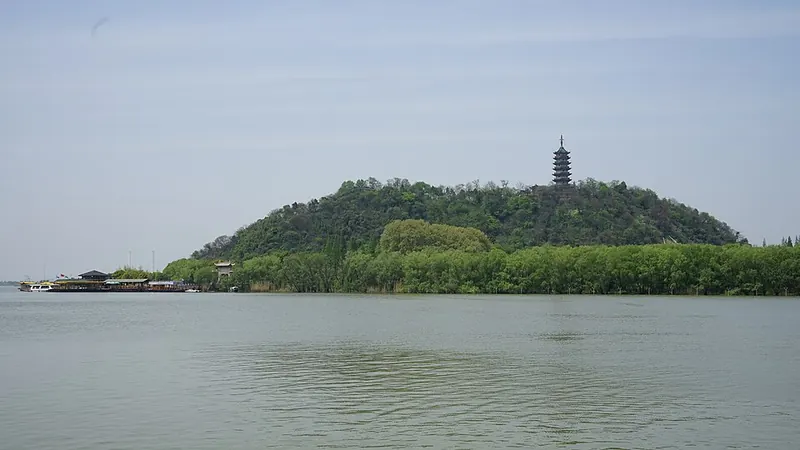
Dinghui Temple's halls stand amid the hill's forest, giving rise to the saying that 'Jiaoshan wraps the temple.' East of the temple, the Baomo Xuan (宝墨轩) stele collection holds more than four hundred stone steles from successive dynasties, the largest number of any in the Jiangnan region, and is registered as a Major Historical and Cultural Site Protected at the National Level. Zhenjiang's scenery is traditionally paired with that of Jinshan across the river: an old saying describes Jinshan as skillful and Jiaoshan as plain, Jinshan as a noble youth and Jiaoshan as a quiet recluse, Jinshan suited to roaming and Jiaoshan to seclusion.
What to look for
- Dinghui Temple is partly enclosed by the island’s wooded hill.
- Baomo Xuan preserves the stele collection and Yihe Ming inscription.
Background & history
Jiaoshan (Chinese: 焦山, Jiāoshān) is a mountain in the city of Zhenjiang, in southwestern Jiangsu Province, People's Republic of China. It lies next to the Yangtze River. It is a National AAAA-designated tourism area, located 71 meters (230 ft) above sea level.
Excerpt from Wikipedia: Jiaoshan · Wikipedia contributors · CC BY-SA 4.0. Selected introductory sentences; formatting simplified. Background information, not current visitor-service advice.
Location & getting there
Getting to Jiaoshan
Travel to the Jiaoshan visitor landing on the Yangtze north of Zhenjiang and confirm the current island crossing and return service.
Combine your visit
A suggested sequence linking the specific features of this visit.
-
Dinghui Temple setting
Begin with the religious buildings among the wooded slopes.
-
Baomo Xuan stele collection
Examine the carved inscriptions east of the temple.
-
Yihe Ming display
Focus on the collection’s best-known calligraphic inscription.
This order is editorial. Confirm access and any transfers between stops; it does not establish a walking route, same-day connection or common admission ticket.
Find Jiaoshan
焦山 · 镇江市
The pin marks the area, not the entrance.
More places nearby
Approximate straight-line distances between map pins, not travel distances.
Beigu Mountain 北固山
3 km awayBeigu Mountain rises on the southern bank of the Yangtze in northeastern Zhenjiang. Its historic landscape is organized around a series of low peaks and linked ridges.
View guide →Jinshan Temple (Zhenjiang) 金山寺
6 km awayJinshan Temple climbs the hill in northwestern Zhenjiang through a dense arrangement of halls and towers. The buildings wrap around the slopes, with Cishou Pagoda giving the ensemble its most visible vertical marker.
View guide →Xijindu Ancient Street 西津渡
6 km awayXijindu developed around a historic ferry crossing below Yuntai Hill in western Zhenjiang. The lanes preserve a layered streetscape connected with river travel, religion and the treaty-port period.
View guide →Sources & visit information
The linked encyclopedia sources support background and place descriptions. Current opening hours, ticket prices, booking rules and transport schedules have not been independently verified for this guide. Confirm them with the venue or operator before travelling.
- en.wikipedia.org ↗
- 焦山 ↗
- Chinese Wikipedia: 焦山 (revision 91116450, 2026-01-15) ↗
- English Wikipedia: Jiaoshan (revision 1340199396, 2026-02-24) ↗
Visitor information adapted and edited from Wikipedia contributors, “焦山” · CC BY-SA 4.0. Source revision 91116450.
Background paragraphs translated and condensed from Wikipedia contributors, "焦山", Chinese Wikipedia · CC BY-SA 4.0. Source revision 91116450.
Background paragraphs condensed from Wikipedia contributors, "Jiaoshan", English Wikipedia · CC BY-SA 4.0. Source revision 1340199396.
Image credits & notes (1)
- Jiaoshan and its pagoda viewed across the water. Photograph date recorded by the source: 2017-04-14 12:33:52.Photo: Huangchenhai · CC BY-SA 4.0Resized for the web; the photo itself has not been edited. Thumbnails may show a cropped view.
