

Explore the region
About Beigu Mountain
Its historic landscape is organized around a series of low peaks and linked ridges.
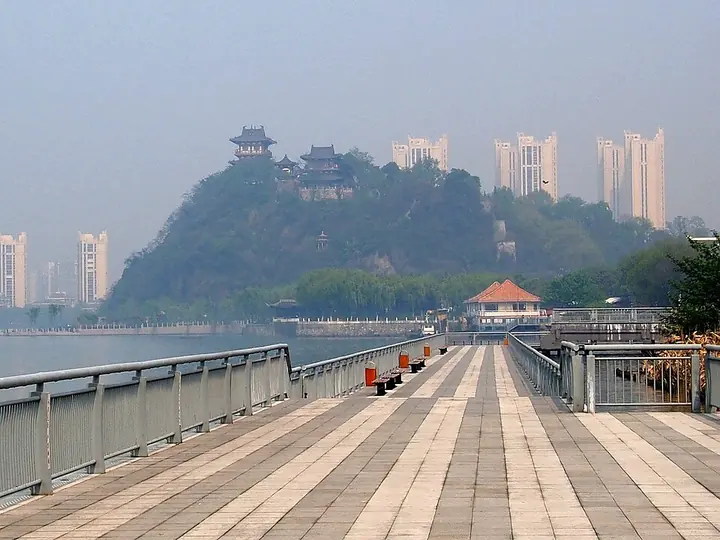
Ganlu Temple stands on the rear peak, with Duojing Tower behind it. The temple-and-tower sector is the clearest focus for a first visit. Dongwu Road separates the front peak from the central part of the hill, so the whole historical mountain should not be treated as one uninterrupted footpath.
From south to north, Beigu Mountain consists of a front peak, a central peak and a rear peak. The rear peak, also called North Peak, has a flat, gently sloping top with a two-tier terrace on its southern side at an elevation of about 55.6 meters; Ganlu Temple (甘露寺) stands on this peak, and Duojing Tower (多景楼) behind it, also known as Beigu Tower, is noted for a plaque inscribed by Mi Fu (米芾) reading “foremost tower of rivers and mountains under heaven” (天下江山第一楼). The central peak is flat-topped, with a two-tier terrace on its eastern side at about 35.3 meters, and the two peaks are linked by a ridge over 500 meters long.
The mountain's main peak reaches an elevation of 55.2 meters, with the Yangtze immediately to its north; its steep, defensible terrain gave rise to the name Beigu, and the hill was traditionally called the “foremost hill of Jingkou” (京口第一山). The front peak, also known as South Peak or Main Peak, is roughly oval in plan, wider and lower in the south and higher in the north. Its northern part holds the Zhenjiang Martyrs' Cemetery (镇江市烈士陵园), and its southern part, the site of the old Tiewengcheng (铁瓮城), is now the Gulou Xincun (鼓楼新村) residential area.
What to look for
- Ganlu Temple occupies the rear peak.
- Duojing Tower links the hill’s architecture with its celebrated river-facing setting.
Location & getting there
Getting to Beigu Mountain
Approach the rear-peak Ganlu Temple sector in northeastern Zhenjiang; use the specific scenic entrance, since Dongwu Road divides parts of the historical hill.
- Confirm the selected entrance and current internal access before departure.
Combine your visit
A suggested sequence through the source-confirmed features.
-
Ganlu Temple
Ganlu Temple occupies the rear peak.
-
Duojing Tower
Duojing Tower links the hill’s architecture with its celebrated river-facing setting.
The sequence is editorial. Check local access and connections between sectors; no walking time or same-ticket access is promised.
Find Beigu Mountain
北固山 · 镇江市
The pin marks the area, not the entrance.
More places nearby
Approximate straight-line distances between map pins, not travel distances.
Jiaoshan 焦山
3 km awayJiaoshan is a wooded island hill in the Yangtze north of Zhenjiang. Dinghui Temple is set among the trees, giving the religious buildings a different relationship with the landscape from nearby Jinshan.
View guide →Xijindu Ancient Street 西津渡
3 km awayXijindu developed around a historic ferry crossing below Yuntai Hill in western Zhenjiang. The lanes preserve a layered streetscape connected with river travel, religion and the treaty-port period.
View guide →Jinshan Temple (Zhenjiang) 金山寺
4 km awayJinshan Temple climbs the hill in northwestern Zhenjiang through a dense arrangement of halls and towers. The buildings wrap around the slopes, with Cishou Pagoda giving the ensemble its most visible vertical marker.
View guide →Sources & visit information
The sources below support the place-specific description and arrival information. Suggested combinations are editorial planning ideas; confirm current opening, entry arrangements and transport services for your date.
Visitor information adapted and edited from Wikipedia contributors, “北固山” · CC BY-SA 4.0. Source revision 92583436.
Background paragraphs translated and condensed from Wikipedia contributors, "北固山", Chinese Wikipedia · CC BY-SA 4.0. Source revision 92583436.
