

Explore the region
Tap any red Chinese text to hear it in Mandarin.
Why this bridge matters
Anping Bridge lies at the junction of Anhai in Jinjiang and Shuitou in Nan’an, within Quanzhou’s wider heritage landscape rather than in the central temple district. It was built as a land-transport link between the port area and the coastal routes to the south. UNESCO includes it in the serial property Quanzhou: Emporium of the World in Song-Yuan China, whose ancient bridges, docks and pagodas together explain how the maritime hub connected its hinterland to wider Asian trade.
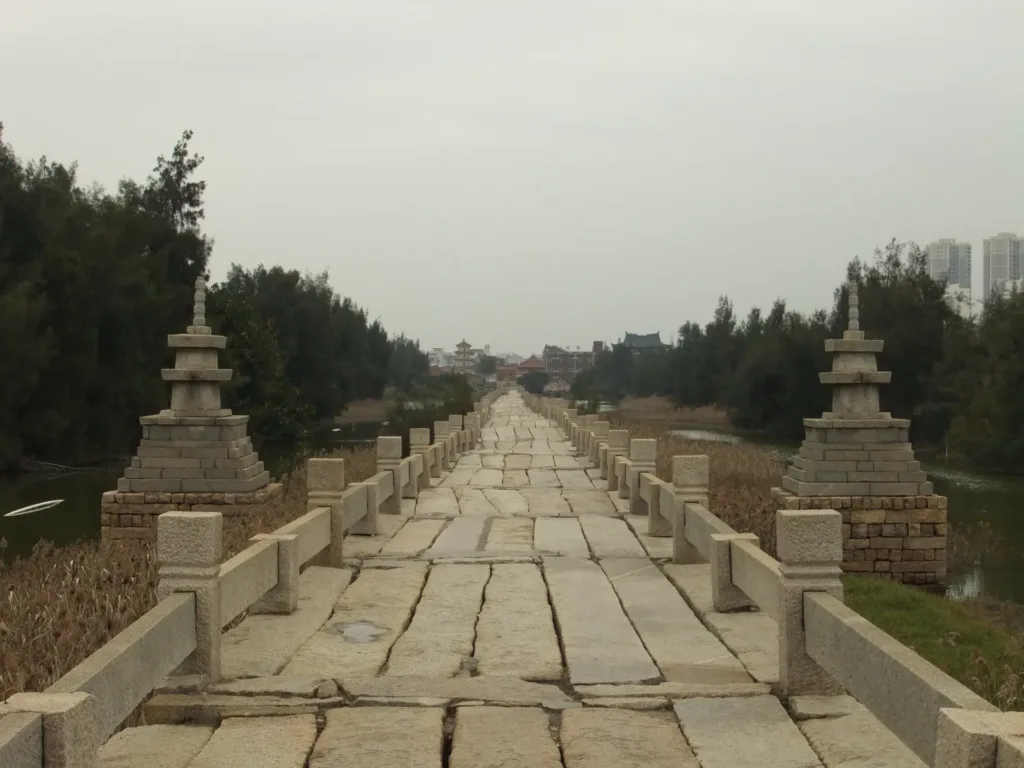
Construction began in 1138 and was completed in 1152. The bridge now extends for about 2,255 metres, with a 2.9–4-metre-wide granite deck and stone piers of several forms; the local heritage account describes rectangular, single-pointed boat-shaped and double-pointed boat-shaped piers responding to different channels and currents.
The bridge is compelling at walking pace. Instead of treating it as a single photographic viewpoint, read the repeated slabs and piers as a piece of infrastructure. Its scale becomes clearer from the Anhai approach, where the White Pagoda marks the historic harbour side, and again around Water Heart Pavilion in the middle of the crossing. The pavilion is associated with repair steles and two Song-period stone guardian figures. At the Shuitou end, the bridge’s gateway buildings and the Tidal Shrine belong to the same historic setting, although access to individual buildings may not match access to the open bridge.
What to look for
- The changing piers. Their rectangular and boat-shaped profiles were used for different water depths and currents rather than as a repeated decorative pattern.
- The granite deck. Long stone beams rest across the piers, making the bridge’s horizontal line more legible than any single monument on it.
- Water Heart Pavilion. This is the main stopping point within the crossing and the place to look for repair inscriptions and the guardian stone figures.
- The harbour-side monuments. The five-storey, hexagonal Ruiguang Pagoda, usually called the White Pagoda, stood by the Anhai end as a landmark for vessels; the opposite end has the Listening Tide gateway and the Tidal Shrine.
- The building technique. In muddy, deep channels, builders used a “sleeping-timber foundation”: timber layers were weighted until they settled onto a firm layer, while deeper channels also used driven piles. This is best understood as a response to the estuary’s ground conditions, not as a claim that every pier uses one identical foundation.
Visiting the bridge
The Anhai entrance is in Anping Bridge Cultural Park at 3 Xing’an Road, Anhai Town, Jinjiang. The bridge’s opposite end is in Wuliqiao Cultural Park in Shuitou, Nan’an. The two ends are in different county-level cities, so give the driver the side you actually want: 安平桥景区(晋江市安海镇兴安路3号) for the Anhai entrance, or 五里桥文化公园 Wǔlǐ Qiáo Wénhuà Gōngyuán for the Shuitou side.
Local visitor information lists the scenic area as free to enter and gives public hours of 09:00–18:00, with entry stopping at 18:00. These are practical visitor listings rather than a dated, season-by-season operator calendar. A repair notice reported a July 2025–May 2026 trial restoration on the Jinjiang section and partial closures during the works; because I found no newer formal notice guaranteeing that every span and pavilion is open, check the entrance notice on the day and do not cross barriers.
For a first visit, start at the Anhai side and see the White Pagoda and the opening run of stone spans before walking toward Water Heart Pavilion. If the full crossing is open, continue to Shuitou and arrange a pickup there; otherwise return to the Anhai entrance. The bridge is long enough that a one-way walk and a return walk are different plans. There is no verified seasonal boat service or shuttle to use as a fallback, so do not build the visit around a water crossing.
Getting there and back
- Bus to the Anhai side: local visitor information lists Quanzhou bus K608 and Jinjiang bus 3 at 安平桥公园站 Ānpíng Qiáo Gōngyuán Zhàn. Another current visitor listing sends K608 and Jinjiang 26, 28, 38, 39, 44 and Z5 to 金沙城(大润发); from there, follow local signs toward the White Pagoda and the Anhai entrance. Check the live direction and stop name before boarding because local routes can change.
- Taxi or ride-hailing: show 安平桥景区,晋江市安海镇兴安路3号 for the Anhai entrance. For a planned one-way walk, show 五里桥文化公园,南安市水头镇 Wǔlǐ Qiáo Wénhuà Gōngyuán, Nán’ān Shì Shuǐtóu Zhèn as the pickup side, and agree the return point before setting out.
- Return: the simplest reliable plan is to return to the same Anhai-side stop. If you walk west, pre-arrange a car at Wuliqiao Cultural Park rather than assuming that the same bus coverage continues on the Shuitou side. The bridge is a regional heritage stop, not a central Quanzhou interchange.
Combine your visit
A suggested sequence linking the specific features of this visit.
-
Anhai bridge approach
Begin by reading the scale and alignment of the stone spans.
-
Shuixin Pavilion
Pause at the surviving pavilion and inspect the construction around it.
This order is editorial. Confirm access and any transfers between stops; it does not establish a walking route, same-day connection or common admission ticket.
Find Anping Bridge
安平桥 · 泉州市
The pin marks the area, not the entrance.
More places nearby
Approximate straight-line distances between map pins, not travel distances.
Quanzhou Tianhou Temple 泉州天后宫
25 km awayQuanzhou’s Tianhou Temple honours Mazu, whose protection was sought by sailors and trading communities. The main hall’s richly decorated double-eaved roof contrasts with the broader, simpler sleeping hall behind it. Courtyards…
View guide →Zhenwu Temple 法石真武庙
25 km awayFashi Zhenwu Temple stands on a small hill beside the old Quanzhou port landscape. A monumental gateway leads up stone steps towards the Tunhai stele, worship pavilion and main hall. The pavilion’s layered roof and decorated…
View guide →Qingjing Mosque 清净寺
26 km awayQingjing Mosque preserves a monumental stone entrance on Quanzhou’s Tumen Street. Its sequence of vaulted arches leads towards the remains of the original prayer hall, where walls, niches and inscriptions give a sense of the…
View guide →Sources & visit information
Sources checked on 24 October 2026. Hours, tickets, reservations and transport can change; confirm with the operator before you go.
- Anping Bridge — Quanzhou Municipal People's Government ↗
- Quanzhou: Emporium of the World in Song-Yuan China — UNESCO World Heritage Centre ↗
- Fujian Quanzhou Anping Bridge — Fujian Provincial Cultural Heritage Bureau ↗
- Anping Bridge — Quanzhou Gastronomy and Heritage ↗
- Anping Bridge visitor information — Jinjiang News ↗
- Quanzhou Anping Bridge visitor guide — Quanzhou Local Treasure ↗
- Anping Bridge restoration and partial closure — Quanzhou Evening News ↗
- Anping Bridge — Jinjiang Municipal People’s Government ↗
- Quanzhou: Emporium of the World in Song-Yuan China World Heritage protection measures — Quanzhou Municipal People’s Government ↗
- Anhai festival activities by Anping Bridge — Xinhua News ↗
Image credits & notes (1)
- The granite deck in the eastern (Anhai Town) section of Anping Bridge, viewed toward the east end, with stone monuments at the bridge edge; photographed on 24 February 2012. Photo: VmenkovPhoto: CC BY-SA 3.0