

Explore the region
Tap any red Chinese text to hear it in Mandarin.
A stone fortress beside the Taiwan Strait
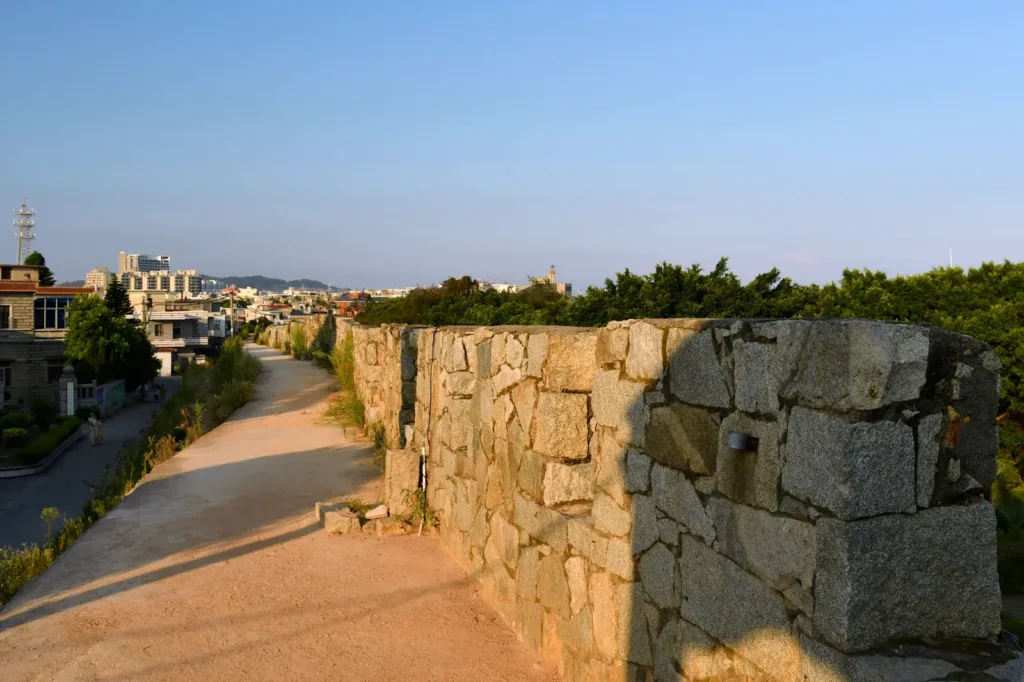
Chongwu sits at the eastern end of the Chongwu Peninsula in Chongwu Town, Hui’an County, Quanzhou. The old city faces the Taiwan Strait between Quanzhou Bay and Meizhou Bay, so its character is shaped by both defence and the sea. The walls are not an isolated ruin: homes, small streets and daily movement remain part of the historic core.
The Ming government began the fortress in 1387, during the Hongwu era, as a coastal defence city and established the Chongwu garrison here. Later repairs included raising the walls and adding the east and west crescent-shaped barbicans. The surviving layout makes the military logic legible: gates control movement, the wall turns with the peninsula, and the seaward edge gives the stonework its reason for being.
A good visit moves between two scales. Inside the walls, look closely at granite building fronts, lane surfaces and the way a defensive enclosure became a town. Outside the southern wall, the broader scenic area reaches toward the Zhonghua Stone Carving Arts Expo Park and the shore, where local stone craft and the coast form a different experience from the protected city itself.
What to look for
The wall and its gates
The city wall measures about 2,567 metres around an area of roughly 370,000 square metres. The plan is slightly trapezoidal, with four gates; the east, west and north gates have outer crescent-shaped barbicans, while the south side uses a screen wall. The official heritage description also records watch positions, beacon structures and patrol paths. Walk at street level first, then use any currently open wall section to understand how the fortification looks over the town and the water.
A lived-in stone town
The point is not to rush around the perimeter. Pause in the lanes within the defensive outline and compare the scale of present-day houses with the thick granite boundary. Some sections are ordinary neighbourhood space rather than a staged exhibition, so keep entrances clear and do not photograph residents at close range without permission. The stone streets and houses are part of the place’s architectural interest, not a promise that every building is open to visitors.
The southern stone-carving and coastal edge
The Zhonghua Stone Carving Arts Expo Park lies south of the old wall in the wider scenic area. It is a separate experience from reading the fortress itself: carved stone works set against the narrow strip between wall and beach. If your ticket is for the scenic area rather than only a wall section, check exactly which managed areas it covers. Continue toward the shore only where access is open; tides, surf and uneven rocks change the practical conditions.
Visit scope and practical details
崇武古城 is the historic walled core of the broader Chongwu coastal scenic area. The address used by local visitor information is 福建省泉州市惠安县崇武镇海门村海马巷41号. For a taxi or ride-hailing car, show 崇武古城风景区 Chóngwǔ Gǔchéng fēngjǐngqū and then specify 西门停车场 Xīmén tíngchēchǎng, 东门停车场 Dōngmén tíngchēchǎng or the 海门村停车场 Hǎimén Cūn tíngchēchǎng according to the entrance you intend to use.
A local ticket notice dated 29 September 2025 listed an adult ticket at CNY 40 and a CNY 20 child/senior concession, with opening hours of 07:00–17:30. A separate 2025 notice gave the same adult price and a broader concession schedule, but both notices say that the live price and rules should be checked at the time of purchase. Treat these as dated planning figures rather than a guaranteed 2026 tariff. The sources reviewed here do not state a passport-specific purchase or admission procedure, so overseas visitors should confirm the current ID and payment requirements before setting out.
Allow time for the walled core, the southern stone-carving area if included in your admission, and a short look at the coast. Do not assume that every wall, building, gallery or shore section shares one opening rule. A separate museum or managed attraction may close earlier than the open town lanes.
Getting there and back
Chongwu has no verified metro leg for this visit; use a road connection from Quanzhou or Hui’an and keep the Chinese destination name ready.
- Local bus: A September 2025 visitor notice lists 惠安211路 and 惠安225路 to 古城风景区 Gǔchéng fēngjǐngqū; it gives an approximate 578-metre walk to the scenic-area entrance. An earlier route guide also names 225路 and the stop 崇武古城风景区 Chóngwǔ Gǔchéng fēngjǐngqū. Check the live direction and stop display before boarding.
- Chongwu Ancient City tourism bus: The Hui’an government’s published route runs in both directions between 文创园公交站 Wénchuàngyuán gōngjiāozhàn and 惠安民俗馆站 Huì’ān Mínsúguǎn Zhàn. It calls at 崇武古城风景区 Chóngwǔ Gǔchéng fēngjǐngqū, 古渡码头(橘若), and 崇武古城东门 Chóngwǔ Gǔchéng dōngmén, among other stops. The announcement gives a CNY 1 fare, with service listed as 08:30–18:30 in summer and 08:30–18:00 in winter. Use the reverse-direction list for the return and recheck that the service is running on your date.
- Coach: A 12 November 2025 local report announced a round-trip 泉州汽车北站 ⇌ 惠安崇武 Quánzhōu Qìchē Běizhàn ⇌ Huì’ān Chóngwǔ coach line, with three round trips a day at the time of publication. The same report said that a separate 泉州客运中心汽车站 Quánzhōu Kèyùn Zhōngxīn Qìchēzhàn service for the Chongwu direction had begun in November 2025. The report does not provide a live timetable or a precise final stop at the wall, so confirm the current departure and arrival wording with the operator; use the scenic-area or east-gate stop for the final local transfer rather than assuming the coach stops at an entrance.
- Rail connection: There is no railway station at the ancient city. A train ticket should be checked for its exact Quanzhou-area station, then connected to a current coach or local road service; the 2025 “high-speed rail + coach” announcement is not a substitute for a current train-to-Chongwu timetable.
For the return, the tourism bus is the clearest named two-way option in the official announcement. If using a coach, reserve or confirm the return from the named Quanzhou or Hui’an terminal before entering the old city, since the 2025 report does not guarantee today’s departures.
Combine your visit
A suggested sequence linking the specific features of this visit.
-
Old fortress streets
Study the granite houses inside the defensive boundary.
-
Southern wall and sculpture park
Compare the fortification with its seaward landscape.
This order is editorial. Confirm access and any transfers between stops; it does not establish a walking route, same-day connection or common admission ticket.
Find Chongwu
崇武古城 · 泉州市
The pin marks the area, not the entrance.
More places nearby
Approximate straight-line distances between map pins, not travel distances.
Luoyang Bridge 洛阳桥
27 km awayLuoyang Bridge crosses the tidal river mouth on rows of stone piers, with Zhongzhou island interrupting the long span. Its construction is associated with Cai Xiang and innovative foundation work, including oyster cultivation to…
View guide →Meizhou Island 湄洲岛
29 km awayMeizhou is a pilgrimage island centred on Mazu, the sea goddess whose ancestral temple has grown into a substantial religious complex. The island’s coastal landscape gives that devotion a visible setting: boats, beaches and…
View guide →Zhenwu Temple 法石真武庙
32 km awayFashi Zhenwu Temple stands on a small hill beside the old Quanzhou port landscape. A monumental gateway leads up stone steps towards the Tunhai stele, worship pavilion and main hall. The pavilion’s layered roof and decorated…
View guide →Sources & visit information
Sources checked on 24 October 2026. Hours, tickets, reservations and transport can change; confirm with the operator before you go.
Image credits & notes (1)
- Granite wall and an inner road on Chongwu Ancient City, Hui'an County, Quanzhou Photo: Tyg728Photo: CC BY-SA 4.0