

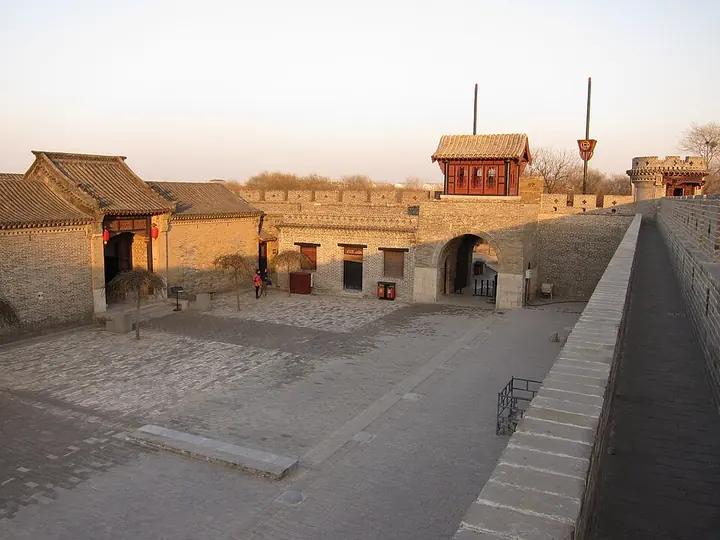
Photo adjustments
Full frame retained; proportionally resized and converted to WebP. No retouching or changes to the photographed subject. Card displays may crop the view.
Explore the region
About Wei Family Manor
Its three building groups are Shudetang, Fushoutang and Xiyitang.
Shudetang, begun in 1890, is the principal group. The separate courtyards make it possible to read the estate as an extended family complex rather than one isolated house.
The manor was included in the fourth batch of Major Historical and Cultural Sites Protected at the National Level (全国重点文物保护单位) in 1996. Shudetang (树德堂), its principal group of buildings, occupies an area of 27,613 square metres. The distance between Fushoutang (福寿堂) and the main Shudetang group is about 200 metres. It was built in the fourth year of the Tongzhi era (同治), in 1865, and therefore predates Shudetang. The third group of buildings, known as Xiyitang (徙义堂), is closer to the principal buildings, at a distance of about 100 metres from Shudetang.
What to look for
- Shudetang is the manor’s main late-Qing building group.
- Fushoutang and Xiyitang show how the estate developed as several related compounds.
Location & getting there
Getting to Wei Family Manor
Approach Weiji village in Huimin County and identify the Shudetang group as the principal part of the estate.
- Confirm the visitor entrance and access to the named areas before departure.
Combine your visit
A suggested sequence through the named features described in the source.
-
Shudetang
Begin with the manor’s principal late-Qing compound.
-
Fushoutang
Compare this separate family building group with the main Shudetang precinct.
-
Xiyitang
Complete the comparison with the third named part of the family estate.
The order is an editorial suggestion. Internal opening arrangements and transfers between sectors need checking; no walking duration or access entitlement is implied.
Find Wei Family Manor
魏氏庄园 · 滨州市
The pin marks the area, not the entrance.
More places nearby
Approximate straight-line distances between map pins, not travel distances.
China Ceramics and Glazed Glass Museum 淄博陶瓷琉璃博物馆
56 km awayZibo Ceramics and Glass Museum follows two crafts closely associated with the city: pottery and porcelain, and liuli glass. Its ceramics range from early archaeological material to industrial and artistic production. The celadon…
View guide →Linzi 齐国故城
69 km awayAncient Linzi survives as an archaeological landscape of the Qi capital, with earthen remains spread through the modern Qi-du area. Its plan combined a larger city with a smaller palace enclosure, and the raised platform called…
View guide →Shandong Museum 山东博物馆
91 km awayShandong Museum brings together the province’s early cultures, stone sculpture and natural history in a large modern building east of central Jinan. Dawenkou and Longshan material introduces prehistoric communities, while Han…
View guide →Sources & visit information
The linked encyclopedia sources support background and place descriptions. Current opening hours, ticket prices, booking rules and transport schedules have not been independently verified for this guide. Confirm them with the venue or operator before travelling.
Visitor information adapted and edited from Wikipedia contributors, “魏氏庄园” · CC BY-SA 4.0. Source revision 92210122.
Background paragraphs translated and condensed from Wikipedia contributors, "魏氏庄园", Chinese Wikipedia · CC BY-SA 4.0. Source revision 92210122.