

Explore the region
Tap any red Chinese text to hear it in Mandarin.
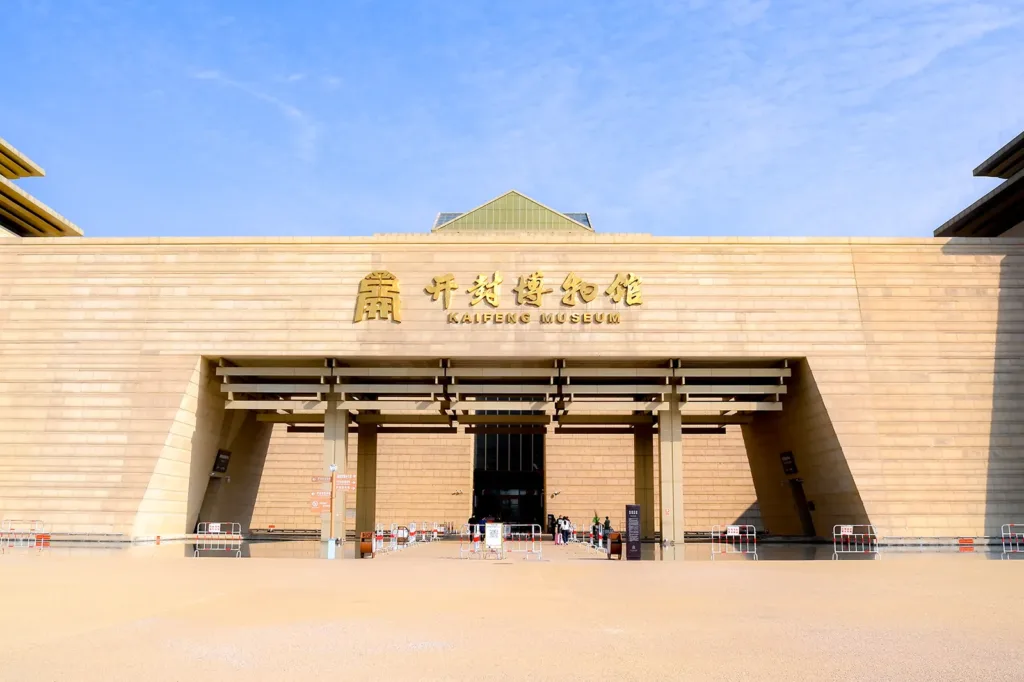
Kaifeng Museum is worth visiting when you want the former capital explained through things that can be looked at closely, not only through a rebuilt street or a palace façade. Its collections range across ceramics, bronze, calligraphy and painting, sculpture, stone carving, coins, jade, lacquer, textiles and other categories. The municipal museum was founded in 1962 and is now a National First-Grade Museum. The present building, beside Zhongyi Lake on Zhengkai Avenue, uses a layered plan inspired by the three-part structure of the Northern Song city.
What to look for
Start with the objects that make Kaifeng’s political and cultural history tangible. The Northern Song “Dasheng Yize” bronze chime connects the city with the court-music reforms of the Song period. The Kaifeng Prefecture Name Inscription Stele is a different kind of record: it lists successive prefects and turns an administrative post into a readable history of people and office. A 2024 feature published on the city culture-and-tourism bureau’s website highlights both as signature objects and explains why the bell matters to the history of musical pitch.
Then widen the frame. The museum’s historical galleries set earlier material culture alongside the Northern Song capital, while themed rooms cover Song technology, carved stone, Ming and Qing court objects, Zhuxianzhen woodblock New Year prints and modern urban life. The municipal introduction describes a permanent historical display, a modern-life gallery and several specialist rooms; the August 2026 visitor listing also named temporary exhibitions, so do not assume that a temporary title will still be on view when you arrive.
The building itself is part of the visit. From the entrance, notice the lower outer volumes, the ring-like inner court and the taller central hall rather than treating the architecture as an imitation of one surviving Song building. Inside, read labels slowly: the museum is most rewarding when you compare a court object, an inscription and an everyday material rather than rushing after a single “treasure.”
Planning the visit
The museum is free but uses real-name reservation. The September 2026 holiday notice says that reservations were available through the official “开封市博物馆” WeChat account and the “汴博预约” WeChat mini-program, with slots released seven days ahead. A separate museum notice dated April 24, 2026 records the change to the official reservation mini-program for visits from May 1 onward. Check the museum’s official account before choosing a date, because the interface and available slots are operational details.
The normal schedule listed in the August 2026 visitor information is Tuesday to Sunday, 09:00–17:00, with ticket distribution ending at 16:00 and entry ending at 16:30. Monday is normally closed, except when a public holiday or a special arrangement changes the calendar. The September 2026 holiday notice is a useful reminder that holiday opening and closure dates can override the weekly pattern.
If you are travelling on a passport and cannot complete online reservation, 2026 visitor guidance says to take your passport to the visitor-service desk for manual reservation. The museum’s earlier government notice likewise states that Hong Kong, Macao, Taiwan and foreign visitors without a Chinese identity card could use the manual window. This is a current operational rule rather than a promise that every passport type will pass through the same online flow, so confirm the procedure and the day’s requirements through the official account or the museum ticket office before travel. The municipal page lists the ticket-centre number as 0371-23299192.
Getting there
Use the current address in Chinese: 河南省开封市郑开大道第六大街 Hénán Shěng Kāi Fēng Shì Zhèng Kāi Dàdào Dì Liùdà Jiē. The visitor entrance is on the building’s west side. The museum moved from the older Yingbin Road/Baogong Lake site to this newer western location; the city’s travel notice says that only the current museum precinct is open. Put 开封市博物馆 Kāi Fēng Shì Bó Wù Guǎn and the Chinese address into Amap/Gaode Maps when ordering a taxi or ride-hailing car, and show the driver the west-entrance wording. Do not let an old map result send you to the former museum.
For buses, the museum’s official travel notice lists 44, K101, 36, 57 and 63 as services that reach the museum; the August 2026 local visitor guide repeats the same set. Because the checked official notice does not fix a permanent stop name, direction or return timetable, select the museum by its Chinese name in Amap/Gaode on the day, verify the live stop and direction, and check the return journey before leaving the building. Do not rely on a historic route screenshot.
If you arrive by high-speed rail at Kaifeng North Railway Station, a taxi or ride-hailing car to the museum is the simplest point-to-point option to verify on the day. A city-government page described a special tourist-bus loop from Kaifeng North whose fourth loop reached Kaifeng Museum for a May 2024 holiday programme. That was a seasonal announcement, not evidence of a permanent service, so it is not presented here as an all-year connection.
Eat by dish, not by shop list
The museum is not a reason to choose a particular restaurant. If you want to continue with Kaifeng’s food culture, search the dish names in Chinese on Meituan (美团) or Amap/Gaode (高德地图) and inspect nearby results yourself. Before going, check the current menu, recent reviews, opening status and whether the dish is actually being served; platform order and ratings are not a recommendation.
Useful search names are 开封灌汤小笼包 Kāi Fēng Guàn Tāng Xiǎo Lóng Bāo, thin-skinned steamed dumplings carrying seasoned filling and hot soup; 四味菜 Sì Wèi Cài, a mutton-broth dish combining braised beef brisket, braised gluten, daylily and meatballs; 胡辣汤 Hú Là Tāng, a peppery breakfast soup commonly paired with wheat-based breakfast foods; and 炒凉粉 Chǎo Liángfěn, sweet-potato-starch jelly stir-fried with seasonings so the outside can become lightly crisp while the centre stays soft. Ask about meat, wheat gluten, sesame, peanuts and other ingredients if you have allergies or dietary restrictions. These are dishes to look for, not endorsements of any named venue.
Combine your visit
A suggested sequence linking the specific features of this visit.
-
Early-history collections
Establish the material background before Kaifeng’s best-known capital period.
-
Song-period collections
Focus on the bell, inscriptions and the city’s political and cultural roles.
-
Painting and decorative arts
Continue into later collecting traditions where those galleries are open.
This order is editorial. Confirm access and any transfers between stops; it does not establish a walking route, same-day connection or common admission ticket.
Find Kaifeng Museum
开封博物馆 · 开封市
The pin marks the area, not the entrance.
More places nearby
Approximate straight-line distances between map pins, not travel distances.
Millennium City Park 清明上河园
8 km awayQingming Riverside Garden is a modern recreation inspired by Zhang Zeduan’s painting of urban life along a river. The artificial waterway links market streets, bridges and performance areas, with Rainbow Bridge forming a central…
View guide →Kaifeng 开封
9 km awayKaifeng’s former capital status is visible through a mixture of surviving monuments and later recreations. The Song-period Iron Pagoda provides an architectural anchor, while Daxiangguo Temple and the raised Dragon Pavilion…
View guide →Dragon Pavilion 龙亭
9 km awayDragon Pavilion stands on a high brick platform above the lakes of northern central Kaifeng. The visible hall belongs to the later history of a site occupied by earlier palaces; it should not be read as an intact Northern Song…
View guide →Sources & visit information
Sources checked on 31 October 2026. Hours, tickets, reservations and transport can change; confirm with the operator before you go.
Image credits & notes (1)
- Front entrance of Kaifeng Museum's current building (new site), photographed on 25 October 2024. The Chinese and English museum signs are visible above the recessed entrance. Photo: WindmemoriesPhoto: CC BY-SA 4.0