

Photo adjustments
The exact downloaded source bytes are separately retained and hashed. Prepared JPEG is proportionally reduced to a maximum 720-pixel long edge; full frame retained, no subject alteration. Final website rendition: full frame retained, proportionally resized to at most 720 pixels and converted to WebP. No additional retouching or subject alteration. Card displays may crop the view.
Explore the region
About Xianling (Ming dynasty)
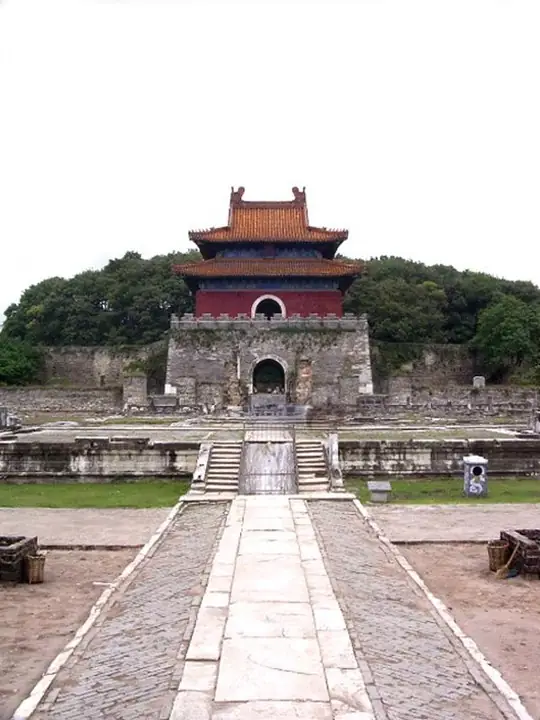
Its processional route works with the hills and water, leading past stone figures towards the burial precinct. The unusual paired tomb arrangement and winding imperial watercourse distinguish it from a standard single-mound image of an imperial tomb. Read the landscape and ritual sequence together; the protected underground burial chambers are not a general visitor attraction.
Zhu Youyuan (朱祐杬), fourth son of the Chenghua Emperor, was enfeoffed Prince of Xing in 1487, moved to Anlu in Huguang in 1494, and died in 1519, when he was buried at Songlin Hill (松林山). After his son succeeded to the throne as the Jiajing Emperor in 1521, the prince was posthumously honoured as emperor in 1522, and his tomb was rebuilt to imperial standard, renamed Xianling in 1524 and enlarged in stages up to 1539, when his mother's coffin was interred alongside his father's in a newly completed underground chamber. In 1642 rebel forces burned the mausoleum's surface buildings and began digging into the burial mound before a storm stopped them.
The mausoleum's outer wall is shaped like a vase, and beyond its gates a spirit way over 1,300 metres long bends first west and then east in a reverse-S curve like a winding dragon before reaching the paired burial mounds; ninety-nine carved white marble dragon-head spouts drain the surrounding burial wall. Xianling is the largest single mausoleum among the Ming dynasty's imperial tombs; it was inscribed on the UNESCO World Heritage List in 2000 and approved as a National 5A Tourist Attraction (国家5A级旅游景区) in 2024.
What to look for
- The processional route, stone figures and winding imperial watercourse.
- The unusual paired burial precinct set into the hillside landscape.
Location & getting there
Getting to Xianling (Ming dynasty)
Go to the Xianling visitor entrance at Songlin Mountain in Huangcheng Village, Zhongxiang. Follow the designated above-ground heritage route and allow for the walk along the ceremonial axis.
Combine your visit
A suggested order for exploring this place and its immediate setting.
-
Entrance and watercourse陵区入口与九曲御河
Read how the water and terrain structure the approach.
-
Spirit Way and stone figures神道与石像生
Follow the ceremonial progression towards the tomb.
-
Ming Tower and burial precinct明楼与宝城
Observe the paired layout from the permitted visitor areas.
Check access to the individual stops. A suggested sequence does not imply a combined ticket or guaranteed transfer.
Find Xianling (Ming dynasty)
明显陵 · 荆门市
The pin marks the area, not the entrance.
More places nearby
Approximate straight-line distances between map pins, not travel distances.
Shijiahe culture 石家河遗址
64 km awayShijiahe is a major prehistoric settlement landscape on the middle Yangtze, with evidence of urban planning, craft production and ritual life. The site museum opened to the public in May 2026, giving visitors a practical…
View guide →Chuwang Chariot and Horse Formation Scenic Area 楚王车马阵
88 km awayThe Xiongjiazhong archaeological park, marketed as Chuwang Chariot and Horse Formation, reveals the scale of an elite Chu burial landscape. The chariot-and-horse pits make rank and ceremonial display visible through the…
View guide →Suizhou Museum 随州博物馆
90 km awaySuizhou Museum introduces the ancient state of Zeng through bronzes, burial discoveries and the region’s celebrated musical archaeology. Bells from Leigudun Tomb No 2 form a distinct collection, often described as sisters to the…
View guide →Sources & visit information
The sources below support the place-specific description and arrival information. Suggested combinations are editorial planning ideas; confirm current opening, entry arrangements and transport services for your date.
- Hubei government — identity and Songlin Mountain location ↗
- Tourism authority — ritual layout and paired burial chambers ↗
- Chinese Wikipedia: 明显陵 (revision 93402515, 2026-07-10) ↗
Background paragraphs translated and condensed from Wikipedia contributors, "明显陵", Chinese Wikipedia · CC BY-SA 4.0. Source revision 93402515.