

Photo adjustments
EXIF orientation normalized; resized without changing aspect ratio; converted to WebP. No subject edits.
Explore the region
About Ningyuan Temple of Culture
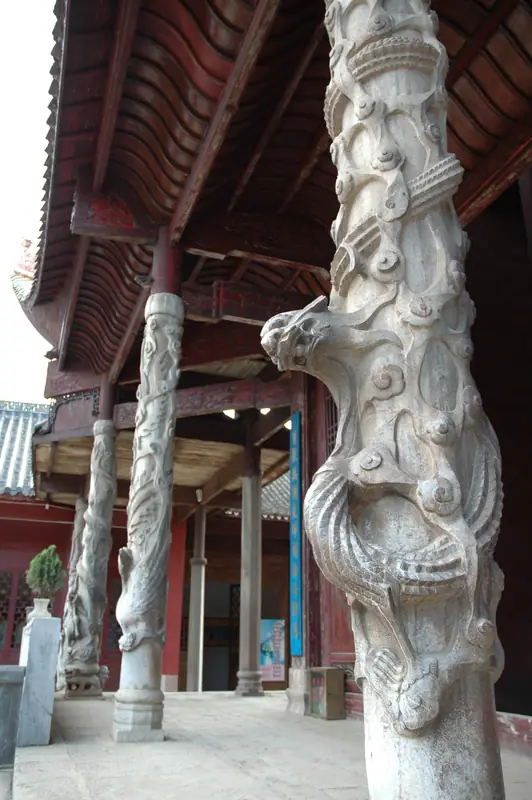
The formal approach through the pool, gates and courtyards leads towards Dacheng Hall, making the sculptures part of a wider ritual-educational layout. Compare the stonework at different distances: the overall column rhythm and the small carved details offer different views of the craftsmanship. This town-centre temple is a separate visit from the Shun memorial landscape at Jiuyishan.
Also known as Xuegong (学宫, 'the school palace'), the temple was originally built in the Tang dynasty at the old city of Lingdao (泠道), now called Dongcheng (东城), and moved to its present site when the county seat relocated in the third year of the Qiande era of the Northern Song (965). It was repaired and restored fifteen times across the Song, Yuan, Ming and Qing dynasties; the surviving buildings were rebuilt between the twelfth year of the Tongzhi era (1873) and the eighth year of the Guangxu era (1882) of the Qing dynasty.
Among China's surviving authentic Confucian temple buildings, including those termed Wenxuanwang Temple, Confucius Temple and Xianshi Temple, it has the earliest founding date and is one of the best preserved, and it is the largest and most intact Confucian temple in the six provinces and regions of south-central China.
The temple faces south and measures 60.2 meters from east to west and 170.8 meters from north to south, covering 10,282 square meters. Its buildings are arranged symmetrically along a central axis that runs, from south to north, through a screen wall (照壁), a pool (泮池), Lingxing Gate (棂星门), Dacheng Gate (大成门), Dacheng Hall (大成殿) and the Chongsheng Shrine (崇圣祠), flanked symmetrically by paired gate towers, shrines, corridors and a Zunjing Pavilion (尊经阁) and Minglun Hall (明伦堂).
What to look for
- The dragon-and-phoenix stone columns with high-relief and openwork carving.
- The axial sequence from the pool and gates to Dacheng Hall.
Location & getting there
Getting to Ningyuan Temple of Culture
Use No 78 Wenmiao Street in Ningyuan’s county town. Confirm the public temple entrance and current interior access before travelling onward to the separate Jiuyishan area.
Combine your visit
A suggested order for exploring this place and its immediate setting.
-
Pool and Lingxing Gate泮池与棂星门
Read the formal approach into the temple.
-
Dacheng Gate stonework大成门石雕
Examine the carved columns and their architectural setting.
-
Dacheng Hall大成殿
Complete the central axis and compare the sculptural detail.
Check access to the individual stops. A suggested sequence does not imply a combined ticket or guaranteed transfer.
Find Ningyuan Temple of Culture
宁远文庙 · 永州市
The pin marks the area, not the entrance.
More places nearby
Approximate straight-line distances between map pins, not travel distances.
Yongzhou Museum 永州博物馆
77 km awayYongzhou Museum is particularly useful for linking the region’s very early archaeology with its later cultural diversity. Yuchanyan material introduces prehistoric life, while displays on Jiangyong Nüshu and Yao customs reveal…
View guide →Liuzi Temple 柳子庙
78 km awayLiuzi Temple commemorates the Tang writer Liu Zongyuan beside Yu Stream in Yongzhou’s Lingling district. The gate-stage arrangement and successive halls provide an architectural setting for inscriptions associated with his life…
View guide →Jiuyi Mountains 九嶷山
113 km awayThe Jiuyi Mountains near Ningyuan combine limestone scenery with the ceremonial landscape associated with the legendary emperor Shun. The Shun mausoleum precinct and its inscriptions express a long tradition of commemoration…
View guide →Sources & visit information
The sources below support the place-specific description and arrival information. Suggested combinations are editorial planning ideas; confirm current opening, entry arrangements and transport services for your date.
- Hunan government — axial layout ↗
- Yongzhou heritage authority — dragon-and-phoenix column craftsmanship ↗
- Yongzhou — Ningyuan Temple of Culture ↗
- Chinese Wikipedia: 宁远文庙 (revision 88913936, 2025-08-28) ↗
Visitor information adapted and edited from Wikivoyage contributors: Yongzhou · CC BY-SA 4.0.
Background paragraphs translated and condensed from Wikipedia contributors, "宁远文庙", Chinese Wikipedia · CC BY-SA 4.0. Source revision 88913936.