

Explore the region
About Jiuyi Mountains
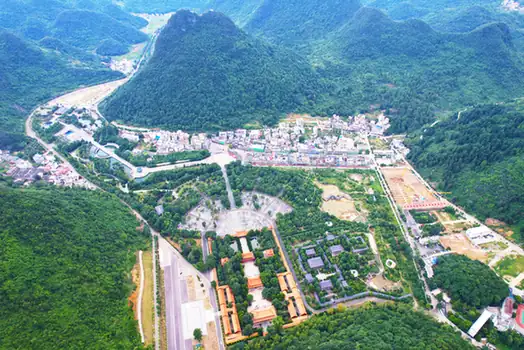
The Shun mausoleum precinct and its inscriptions express a long tradition of commemoration, while Zixia Cave offers a separate underground geological visit. The mountain name covers a broader range than these visitor sites, so a summit-style map pin is not a practical itinerary. Choose the cultural precinct first, then add a confirmed cave visit without treating the traditions about Shun as a securely documented prehistoric biography.
The range extends across Ningyuan and Lanshan counties in Yongzhou, on Hunan's border with Guangdong. It forms part of Mengzhu Ling (萌渚岭) in the Nanling range (南岭), extending for more than 2,000 li (里). It connects with Luofu Shan (罗浮山) to the south and Hengyue (衡岳) to the north. Its peaks consist mainly of sandstone and shale, granite and metamorphic rock, and the main peak, Benjiwo (畚箕窝), reaches 1,959 metres. The range is also known by the name Cangwu Shan. According to local tradition, it is the burial place of Emperor Shun (舜帝).
What to look for
- The Shun mausoleum and inscribed commemorative landscape.
- Zixia Cave’s limestone underground setting as a separate visitor area.
Location & getting there
Getting to Jiuyi Mountains
For the main cultural visit, navigate to the Shun mausoleum visitor area in Jiuyishan Town, Ningyuan County. Confirm the local transfer to Zixia Cave and its current admission rather than assuming one ticket covers the wider mountains.
Combine your visit
A suggested order for exploring this place and its immediate setting.
-
Shun mausoleum precinct舜帝陵
Begin with the ritual architecture and cultural tradition.
-
Stele and interpretation areas舜帝陵碑林与展厅
Read how later generations commemorated Shun.
-
Zixia Cave option紫霞岩
Add the separate cave route if access, mobility and time allow.
Check access to the individual stops. A suggested sequence does not imply a combined ticket or guaranteed transfer.
Find Jiuyi Mountains
九嶷山 · 永州市
The pin marks the area, not the entrance.
More places nearby
Approximate straight-line distances between map pins, not travel distances.
Dongjiang Lake 东江湖
55 km awayDongjiang’s best-known photographs show mist above the narrow Xiaodongjiang waterway, but the wider reservoir offers a different scale of lake scenery. The visitor system links the lower river area with the dam and, on the…
View guide →Ningyuan Temple of Culture 宁远文庙
113 km awayNingyuan’s Confucian Temple is especially notable for its richly carved stone columns, where dragons and phoenixes emerge from deep relief and openwork. The formal approach through the pool, gates and courtyards leads towards…
View guide →Mausoleum of the Yan Emperor 炎帝陵
127 km awayThe Yan Emperor Mausoleum at Luyuan is a ceremonial landscape associated with Yandi, also identified with the legendary culture hero Shennong. Halls, courtyards and inscribed memorials express a long tradition of ancestral…
View guide →Sources & visit information
The sources below support the place-specific description and arrival information. Suggested combinations are editorial planning ideas; confirm current opening, entry arrangements and transport services for your date.
- Jiuyi Mountains ↗
- Hunan government — principal visitor sites and Ningyuan connection ↗
- Chinese Wikipedia: 九嶷山 (revision 91637857, 2026-02-23) ↗
- English Wikipedia: Jiuyi Mountains (revision 1369302498, 2026-08-14) ↗
Visitor information adapted and edited from Wikipedia contributors: Jiuyi Mountains · CC BY-SA 4.0. Source revision 1369302498.
Background paragraphs translated and condensed from Wikipedia contributors, "九嶷山", Chinese Wikipedia · CC BY-SA 4.0. Source revision 91637857.
Background paragraphs condensed from Wikipedia contributors, "Jiuyi Mountains", English Wikipedia · CC BY-SA 4.0. Source revision 1369302498.
Image credits & notes (1)
- Jiuyi Mountains · 九嶷山Photo: cscec.comResized for the web; the photo itself has not been edited.