

Explore the region
About Mount Xiqiao
Baiyun Caves occupy the northwestern foothills, while higher visitor areas include Baofeng Temple and the large seated Guanyin. The contrast between carved religious architecture and the mountain’s eroded volcanic landscape gives the visit its character. Choose a few areas from the current visitor map; the separate gates and elevations mean that the whole mountain is not one short walking loop.
Xiqiao is the site of a large Neolithic quarry and stone-tool workshop, the only large such site known in South China and referred to as the 'Xiqiao Mountain culture'; human activity from 6,000-8,000 years ago produced a distinctive 'twin-shoulder stone tool culture' (双肩石器文化). During the Ming and Qing dynasties scholars, including Zhan Ruoshui (湛若水), studied Neo-Confucianism in seclusion on the mountain; the reformer Kang Youwei began his reform program after leaving it, and the martial artist Huang Feihong (黄飞鸿) was born here.
The mountain formed 40 to 50 million years ago when a volcanic eruption in an ancient bay of the Pearl River Delta ejected lava that cooled into a cone; further eruptions produced the mountain's 72 peaks, and later erosion flattened the surrounding delta, leaving Xiqiao an isolated extinct volcano. It has 42 caves and 232 springs and 28 waterfalls, among them the Yunya Feipu (云崖飞瀑), listed among the Eight Views of Guangzhou during the Qing dynasty.
Xiqiao lies in the southwest of Nanhai District, Foshan, 68 kilometers from Guangzhou, and covers 14 square kilometers with 72 peaks rising to a main peak of 346 meters. It is a National Key Scenic Area, a national forest park and a national geopark, and its religious sites include a 61.9-meter seated statue of Guanyin on Daxian Peak (大仙峰).
What to look for
- Baiyun Caves combine rock formations with springs and landscaped foothill spaces.
- Baofeng Temple and the seated Guanyin provide a contrasting religious focus higher on the mountain.
Location & getting there
Getting to Mount Xiqiao
The operator lists the South Gate on Huanshan Avenue in Xiqiao Town, Nanhai, Foshan. Use that named entrance for the main mountain visit, and confirm internal transport to your chosen areas; the Baiyun Caves approach is a separate western-side entrance.
Combine your visit
Suggested order for the visit:
-
South Gate visitor area
Choose the day’s route and internal transport.
-
Baofeng Temple and Guanyin area
Visit the religious complex where permitted.
-
Baiyun Caves
Add the foothill landscape as a separate section of the visit.
This is an editorial sequence of named spaces or places. It does not imply a verified walking connection or promise opening, ticket availability or a journey time.

Find Mount Xiqiao
西樵山 · 佛山市
The pin marks the area, not the entrance.
More places nearby
Approximate straight-line distances between map pins, not travel distances.
Nanfeng Kiln 南风古灶
14 km awayNanfeng Kiln is part of the ceramics heritage area in Shiwan, Foshan. The kiln belongs to the dragon-kiln tradition, named for the long form of the firing structure. Its mouth faces south, while banyan trees grow behind the…
View guide →Lingnan Tiandi 岭南天地
19 km awayLingnan Tiandi reuses historic Foshan streets as a district of restaurants, shops and cultural spaces. Grey brick walls, carved eaves and the high curved gables known as wok-ear walls preserve a distinctive southern…
View guide →Foshan Ancestral Temple 佛山祖庙
19 km awayFoshan Ancestral Temple brings together a Daoist sanctuary, a Confucius temple and memorial displays about the city’s martial-arts traditions. The main ancestral temple is dedicated to the Northern Emperor, known as Beidi or…
View guide →Sources & visit information
The sources below support the place-specific description and arrival information. Suggested combinations are editorial planning ideas; confirm current opening, entry arrangements and transport services for your date.
- Mount Xiqiao ↗
- Xiqiao Mountain: official operator ↗
- Guangdong Forestry: Xiqiao landscape ↗
- Chinese Wikipedia: 西樵山 (revision 93276316, 2026-07-01) ↗
- English Wikipedia: Mount Xiqiao (revision 1355913433, 2026-05-24) ↗
Visitor information adapted and edited from Wikipedia contributors, “Mount Xiqiao” · CC BY-SA 4.0. Source revision 1355913433.
Background paragraphs translated and condensed from Wikipedia contributors, "西樵山", Chinese Wikipedia · CC BY-SA 4.0. Source revision 93276316.
Background paragraphs condensed from Wikipedia contributors, "Mount Xiqiao", English Wikipedia · CC BY-SA 4.0. Source revision 1355913433.
Image credits & notes (1)
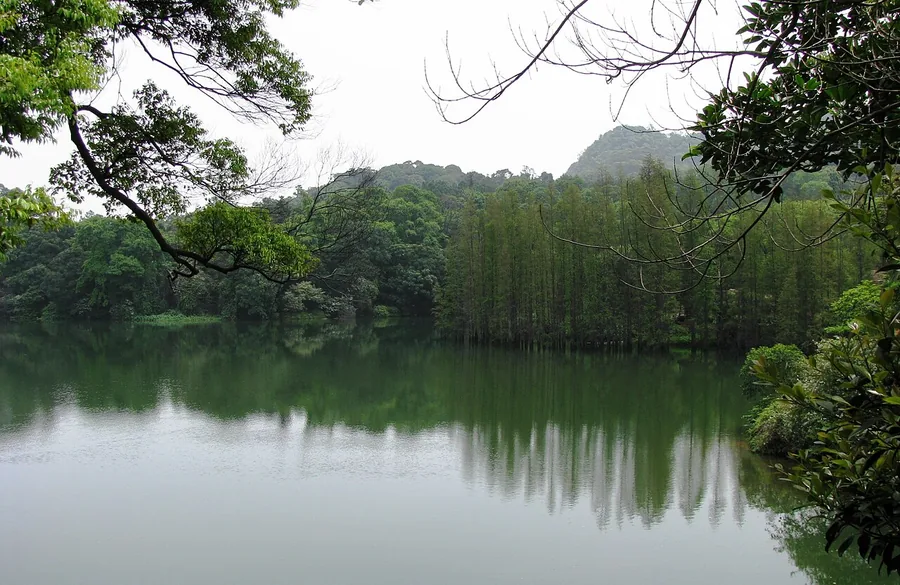
- A wooded lake landscape on Mount Xiqiao, Foshan. Photographed on 6 April 2008.Photo: David Chen (东北虎 / Manchurian Tiger) · CC BY 3.0Resized for the web; the photo itself has not been edited.
