

Explore the region
A canal built across a watershed
Lingqu lies in Xing’an County, within Guilin’s present jurisdiction. The canal system is about 36.4 kilometres long. It links the Xiang River, part of the Yangtze basin, with the Li River, which flows toward the Pearl River basin. In 214 BCE, Qin ruler Qin Shi Huang commissioned the official Shi Lu to build a water route that could move grain and supplies south. For centuries it served transport between central China and Lingnan; today its historic hydraulic works sit within a living water system used for irrigation, flood management and water supply.
The heritage designation needs a little precision. UNESCO’s World Heritage Centre lists Lingqu on China’s Tentative List; this is not an inscription on the UNESCO World Heritage List. Separately, the International Commission on Irrigation and Drainage included it in its World Heritage Irrigation Structures programme in 2018.
How to read the waterworks
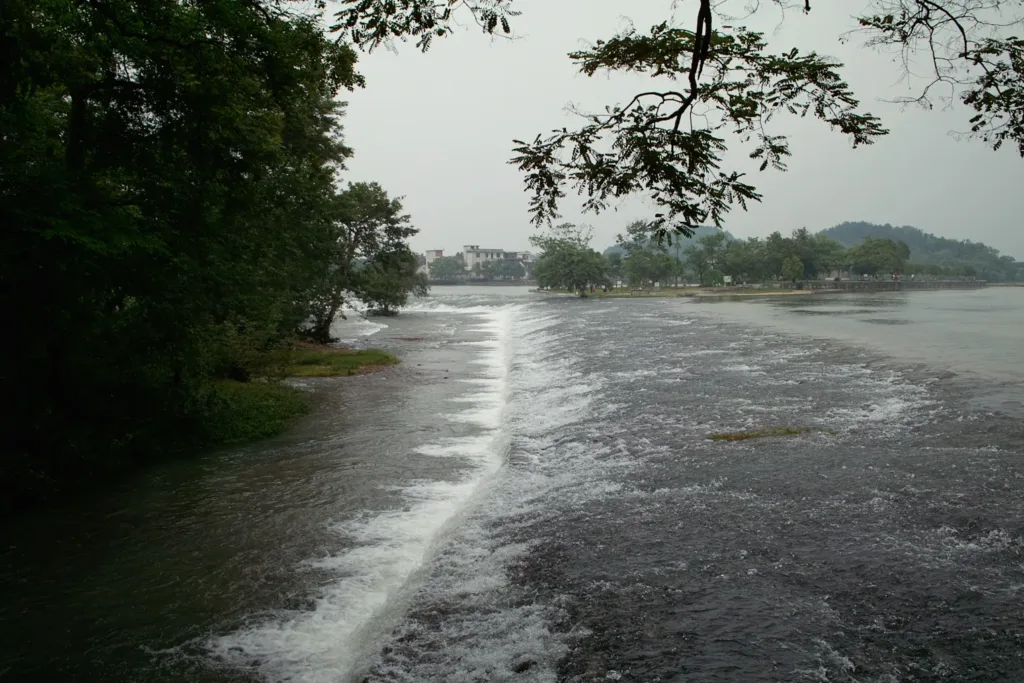
Begin at the canal-head works, where the water is divided. The Huazui (铧嘴), a pointed stone structure, guides the current toward the South and North Canals. The Tianping dams (天平) help raise and regulate the water level; channels, overflow routes and gates then distribute or release it. This is a system to observe in sequence: river, dividing head, weirs, and the branches that carry water away.
Follow signed public paths around the structures that are open on the day. Look for how the channels bend with the terrain rather than forcing a straight line, and notice the difference between the river’s natural course and the excavated or regulated reaches. Where preserved gates or lock remains are accessible, they help explain how a shallow, uneven canal could once be used by boats. Do not step onto a weir, dam crest or working embankment unless it is specifically open to visitors; these are water-control structures, not informal walkways.
The South and North Canals are not interchangeable “boat routes.” The waterway’s historic role as a long-distance freight route ended with modern rail and road links. At the same time, a 2025 Ministry of Ecology and Environment account says a 12.5-kilometre section of the South Canal had regained year-round navigability after water-management and restoration work. That does not establish a public through-service or guarantee a sightseeing boat on your visit. Treat any boat ride as a locally confirmed activity, not as transportation.
The county-town water-street area is a related urban stretch beside the canal, with bridges and waterside streets; it is not the whole 36.4-kilometre heritage waterway. If you visit both, regard the water street as a separate nearby stroll rather than assuming that one attraction ticket, gate or boat connects every section. Current admission arrangements for either area were not confirmed from a live official visitor notice.
Getting there and planning the visit
There is no metro serving this Xing’an visit. If arriving by rail, Xing’an North Railway Station (兴安北站) is connected to Lingqu Park by local bus 702. The latest service-restoration notice I could verify, dated 12 September 2026, lists a 07:00 departure from Xing’an North and a 17:45 departure from Lingqu Park; it also gives 18:30 as the evening departure from Xing’an North. These are the published terminal departures in that notice, not a promise of frequent all-day service. Plan around them only after checking the operator’s current notice locally, and preserve enough time for the return bus. If the timing does not fit, use a licensed taxi or ride-hailing car rather than assuming a boat or a village bus will run when needed.
For a car or taxi, give the driver 灵渠景区游客入口,广西桂林市兴安县双灵路灵渠公园内. Visitor listings identify the address as Lingqu Park on Shuangling Road, but do not give a reliable street number or a verified legal kerbside drop-off. Ask for the signed public visitor gate and alight only at a permitted roadside stopping place; do not ask to be dropped on a canal bank or service road. There is no verified metro exit, and none is relevant here. No current official opening hours, ticket price, reservation rule or daily boat schedule was found, so do not rely on old online prices or seasonal hours.
Combine your visit
Suggested order for the visit:
-
Huazui
Start with the dividing head and surrounding water.
-
Tianping dams
Look at the flow-control structures.
-
Qin embankment
Continue along the named canal-side feature.
This is an editorial sequence of named spaces or places. It does not imply a verified walking connection or promise opening, ticket availability or a journey time.
Find Lingqu Canal
灵渠 · 兴安县
The pin marks the area, not the entrance.
More places nearby
Approximate straight-line distances between map pins, not travel distances.
Mao'er Mountain 猫儿山
42 km awayMao’er Mountain rises into a cool, wet forest environment quite different from the lower Guilin river scenery. Southern hemlocks and high-elevation dwarf woodland are distinctive parts of its vegetation. The summit rock…
View guide →Yushan Park 虞山公园
51 km awayYushan Park combines a limestone hill with a deliberately composed garden of temple buildings, rockwork and water. The rebuilt Yudi Temple gives the southern area its ceremonial focus, while Wufu Pagoda and the Jiuchongtian…
View guide →Sources & visit information
Sources checked on 21 October 2026. Hours, tickets, reservations and transport can change; confirm with the operator before you go.
- Lingqu Canal, UNESCO World Heritage Centre Tentative List ↗
- Guangxi Zhuang Autonomous Region, Guilin City: Lingqu, Ministry of Ecology and Environment of China ↗
- Four Chinese Projects Enter the World Irrigation Structures List, Beijing Municipal Administration of Cultural Heritage ↗
- Xing’an Route 702 Restored; Service Notices, Sina relaying Xiaoxiang Morning Post reporting ↗
- Lingqu Address Listing, Guilin Local Life Service ↗
Image credits & notes (1)
- The broad stone weir at Lingqu’s water-control works, where the water divides. Photo: FarmPhoto: CC BY 3.0