

Photo adjustments
The exact downloaded source bytes are separately retained and hashed. Prepared JPEG is proportionally reduced to a maximum 720-pixel long edge; full frame retained, no subject alteration. Final website rendition: full frame retained, proportionally resized to at most 720 pixels and converted to WebP. No additional retouching or subject alteration. Card displays may crop the view.
Explore the region
About Litang Monastery
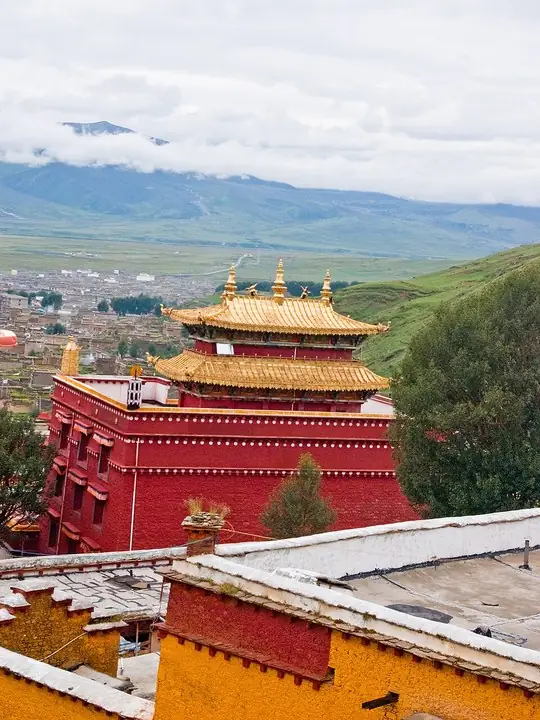
Its large temple halls and tiered setting make it more than a single shrine. Much of the visible complex has been reconstructed after destruction and later fire, so its present architecture should not be described as wholly original. Begin with the open courtyards and enter only halls currently receiving visitors; the hill views and external building forms remain part of the visit.
The monastery was founded in 1581, during the era of the third Dalai Lama, in Litang County, Ganzi Tibetan Autonomous Prefecture. Under the second Xianggen Living Buddha (香根活佛, 1908-1949) its monk population grew rapidly to reach 7,000. It was destroyed by bombing in March 1956 and was rebuilt beginning in 1982, when its Faxiang court (法相院) and Tantric court (密宗院) were restored.
The rebuilt main hall can hold 3,500 people, and the monastery now has close to 3,000 monks; it is the only Gelug monastery in the Kangba (康巴) region able to confer the Geshe degree. It was added to the sixth batch of Sichuan provincial cultural heritage sites in 2004 and listed among the seventh batch of Major Historical and Cultural Sites Protected at the National Level (全国重点文物保护单位) on 5 March 2013.
What to look for
- The main temple buildings occupy successive levels on Litang’s northern hillside.
- Large hall facades and the surrounding courtyards reveal the scale of the working monastery.
Location & getting there
Getting to Litang Monastery
Use Changqingchun Ke’er Temple at 113 Changqing Road, on the northern edge of Litang. Arrange a local transfer to its visitor entrance rather than beginning from a broad Litang town pin.
Combine your visit
Suggested order for the visit:
-
Lower courtyards
Begin with the hillside arrangement and temple facades.
-
Main temple halls
Enter the halls currently open to visitors and observe photography instructions.
-
Upper permitted courtyard
Look back across the compound and town without entering restricted roofs.
This is an editorial sequence of named spaces or places. It does not imply a verified walking connection or promise opening, ticket availability or a journey time.
Find Litang Monastery
长青春科尔寺 · 甘孜州
The pin marks the area, not the entrance.
Sources & visit information
The sources below support the place-specific description and arrival information. Suggested combinations are editorial planning ideas; confirm current opening, entry arrangements and transport services for your date.
- Wikivoyage: Litang ↗
- Amap: Changqingchun Ke’er Temple ↗
- Buddhist and thangka research: Litang Monastery ↗
- Chinese Wikipedia: 长青春科尔寺 (revision 93283704, 2026-07-02) ↗
Visitor information adapted and edited from Wikivoyage contributors, Litang · CC BY-SA 4.0. Source revision 4775813.
Background paragraphs translated and condensed from Wikipedia contributors, "长青春科尔寺", Chinese Wikipedia · CC BY-SA 4.0. Source revision 93283704.