

Explore the region
About Zhijin Cave
The Silver Rain Tree is its best-known individual formation, with branching, flower-like shapes that differ from the more familiar hanging stalactites. Move slowly through the managed route and compare forms at different scales: the size of a chamber can be striking, but the smaller deposits explain how water built the detail. The cave visit is distinct from the other landscapes in the wider geopark.
The cave was originally known as Daji Cave (打鸡洞) and was discovered in 1980 by the Zhijin County Tourism Resources Exploration Team. In 1988 the surrounding area, known as the Guizhou Zhijin Cave Scenic Area (贵州织金洞风景区), was designated a national-level tourist site by the State Council.
Split into three layers, the cave has an explored length of 13.5 kilometers within an area of 700,000 square meters. More than 120 different crystalline formations occur inside the cave along with stalactites and the Silver Rain Tree (银雨树), a flower-like transparent crystal formation about 17 meters tall. The cave is said to have the largest unsupported roof span of any cave in the world.
What to look for
- The Silver Rain Tree has a branching, flower-like mineral form.
- Large chambers contain varied stalactites and mineral columns.
Background & history
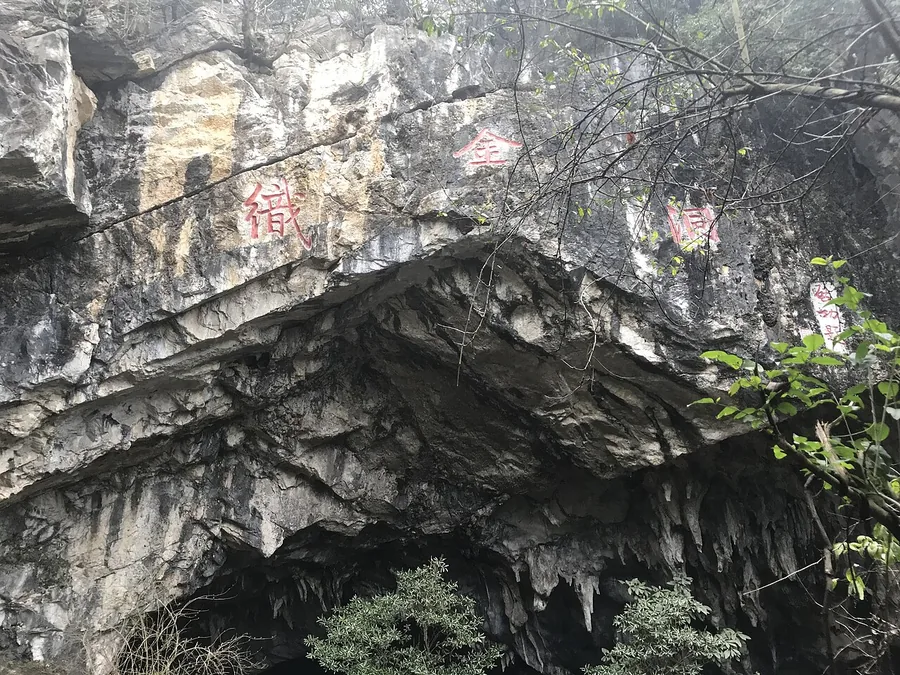
Zhijin Cave (simplified Chinese: 织金洞; traditional Chinese: 織金洞; pinyin: Zhījīn Dòng; lit. 'Weaving Gold Cave') is a karst cave located in Minzhai Village (民寨乡), Zhijin County, Guizhou Province, People's Republic of China. An important tourism area, the site lies 23 km (14 mi) northeast of the county town and 166 km (103 mi) from the provincial capital, Guiyang.
Excerpt from Wikipedia: Zhijin Cave · Wikipedia contributors · CC BY-SA 4.0. Selected introductory sentences; formatting simplified. Background information, not current visitor-service advice.
Location & getting there
Getting to Zhijin Cave
Search for 织金洞景区 in Guanzhai Miao Township, Zhijin County, then select the current visitor entrance in your map app. The wider geopark, visitor reception area and cave mouth are different locations; confirm the arrival point with the operator.
- Use the operator’s current arrival guidance to identify the visitor reception point before travelling.
Combine your visit
Suggested order for the visit:
-
Main cave chambers
Take in the space and range of formations.
-
Silver Rain Tree
Look closely at its branching mineral structure.
-
Remaining signed cave route
Continue through the permitted chambers to the exit.
This is an editorial sequence of named spaces or places. It does not imply a verified walking connection or promise opening, ticket availability or a journey time.
Find Zhijin Cave
织金洞 · Guanzhai Miao Township, Zhijin County, Guizhou · 贵州省织金县官寨苗族乡
No reliable map pin yet: search by the Chinese name.
Sources & visit information
The linked encyclopedia sources support background and place descriptions. Current opening hours, ticket prices, booking rules and transport schedules have not been independently verified for this guide. Confirm them with the venue or operator before travelling.
- Zhijin Cave ↗
- Zhijindong Cave Geopark operator: location and park extent ↗
- Amap: Zhijindong scenic-area POI (provider coordinates; not a verified cave entrance) ↗
- Chinese Wikipedia: 织金洞 (revision 90834908, 2025-12-25) ↗
- English Wikipedia: Zhijin Cave (revision 1361759269, 2026-06-29) ↗
Visitor information adapted and edited from Wikipedia contributors, “Zhijin Cave” · CC BY-SA 4.0. Source revision 1361759269.
Background paragraphs translated and condensed from Wikipedia contributors, "织金洞", Chinese Wikipedia · CC BY-SA 4.0. Source revision 90834908.
Background paragraphs condensed from Wikipedia contributors, "Zhijin Cave", English Wikipedia · CC BY-SA 4.0. Source revision 1361759269.
Image credits & notes (1)
- The natural rock entrance to Zhijin Cave, February 2019.Photo: Esiymbro · CC BY-SA 4.0Resized for the web; the photo itself has not been edited.
