

Explore the region
Tap any red Chinese text to hear it in Mandarin.
A close look at the Helankou carvings
The visitor area is at Helankou, on the eastern foothills of the Helan Mountains, about 56 kilometres from Yinchuan. It is not a claim to cover every carving in the mountain range: the ticketed visitor area and the wider distribution of rock art are different scales. The managed site is known for dense groups of human-face images and for the way the carvings remain part of their dry mountain setting.
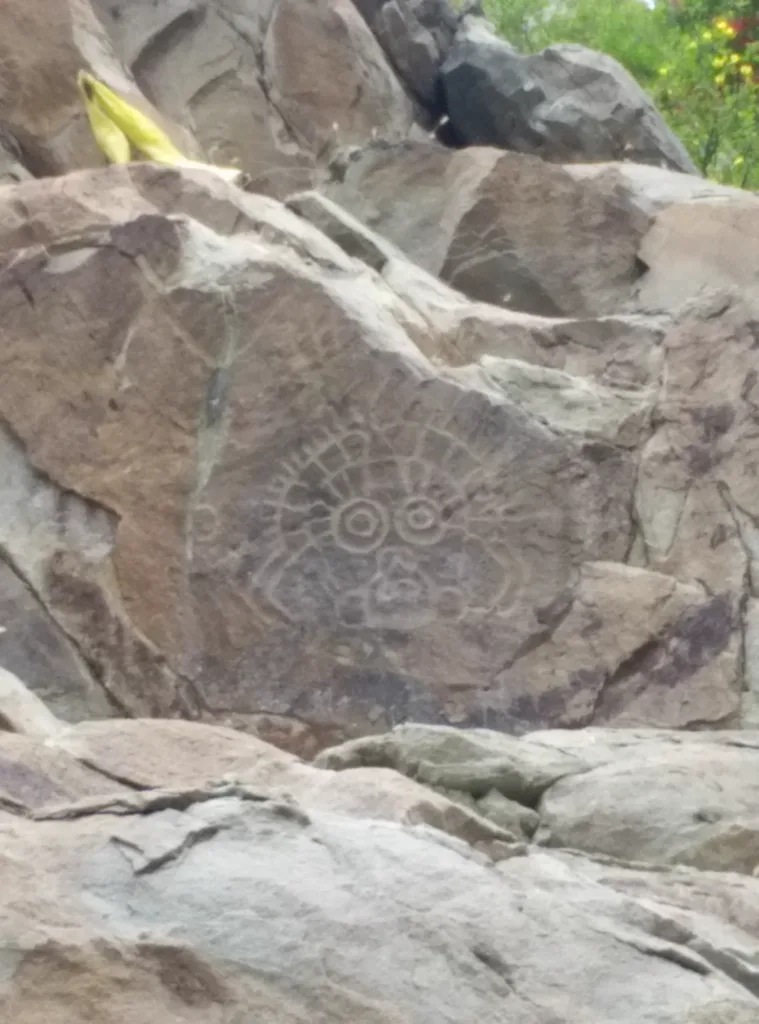
Begin with the human-face motifs. The best-known image, usually called the “Sun God”, has a round face, double-ring eyes, lashes and radiating lines around the head. The arrangement is striking even when you do not accept every interpretation of what it meant. Slow down enough to compare the faces with nearby animals, signs and other marks rather than treating the site as a single iconic photograph.
The wider Helankou record includes animals, plants, handprints, tools, fields and symbols, as well as scenes associated with herding, hunting, sacrifice and warfare. These are not illustrations from one neatly dated moment. Research and conservation accounts stress that the carvings were made over a long period and that exact dating remains difficult; the useful visitor question is what each mark shows about people observing, organising and explaining their world.
The open-air setting is part of the experience and part of the risk. Rain, flooding, weathering and rock instability can damage carvings that cannot be moved indoors. The Yinchuan management office runs protection and monitoring work for the Helankou area, while the nearby Yinchuan World Rock Art Museum provides a place to study rock-art images and conservation without touching the originals.
How to visit
Use the Chinese destination name 贺兰山岩画景区(贺兰口) or 贺兰山岩画遗址公园 Hèlán Shān Yánhuà Yízhǐ Gōngyuán when arranging the final ride. The visitor area is in Helankou, around 56 kilometres from Yinchuan, so plan it as a dedicated outing rather than a walk from the city centre.
From Yinchuan, the published regular tourist buses are 游2路 from 北门公交车场 Běimén Gōngjiāo Chēchǎng to 贺兰山岩画 Hèlán Shān Yánhuà, and 游3路 on the same general route via 镇北堡西部影城 Zhènběibǎo Xībù Yǐngchéng. Both call at 银川火车站东广场 Yínchuān Huǒchēzhàn Dōng Guǎngchǎng and continue through 滚钟口、拜寺口双塔、苏峪口 Gǔnzhōngkǒu, Bàisìkǒu Shuāngtǎ, Sūyùkǒu to the rock-art visitor area. The 2026 route notice lists the outward departures at 09:30 for 游2 and 09:20 for 游3; the published return departures from 贺兰山岩画 are 15:00 and 14:00 respectively. Fares are listed as section-based, with the full journey around CNY 10–15.
A separate 火车站东广场—贺兰山岩画 Huǒchēzhàn Dōng Guǎngchǎng — Hèlán Shān Yánhuà service was published for the western-line visitor route. It ran with departures between 08:30 and 11:30, and returns between 13:30 and 17:00, stopping at 镇北堡西部影城、漫葡小镇、苏峪口 Zhènběibǎo Xībù Yǐngchéng, Mànpú Xiǎozhèn, Sūyùkǒu before the rock-art site. It is a flexible service that may leave when full, so treat the published return window as the part to protect in your day plan and confirm the operating notice before setting out.
A taxi or ride-hailing car is the simpler fallback when the bus window does not fit. Give the driver the Chinese name 贺兰山岩画景区(贺兰口) and confirm the managed visitor entrance, not a generic pin elsewhere in the Helan Mountains. Arrange a return plan before you walk the site; there is no reason to assume that a car or a tourist bus will be waiting when you finish. The city’s tourist-bus programme has also changed by season and holiday period.
Current opening hours, ticket products, booking requirements and passport-specific entry rules were not stated in the sources used for this guide. Check the scenic area or Yinchuan’s current transport notice before travelling, especially outside the main visitor season. On site, stay on the managed route and do not touch, wet, trace or climb on the carved surfaces: the rock art is protected cultural heritage, not an outdoor wall for close handling.
Combine your visit
Choose from these complementary stops when planning your visit.
-
Visitor interpretation岩画解说区
Learn how the markings are identified and protected.
-
Open rock-art path开放岩画步道
Look for human and animal motifs.
-
Valley setting贺兰口山谷
Observe the rock surfaces within their landscape.
Follow the protected visitor path. Do not touch, wet, trace or climb on carved rock surfaces.
Find Helan Mountain rock art
贺兰山岩画 · 银川
The pin marks the area, not the entrance.
More places nearby
Approximate straight-line distances between map pins, not travel distances.
Helan Mountain National Forest Park 贺兰山国家森林公园
7 km awayHelan Mountain National Forest Park offers a wooded mountain outing at Suyukou, west of Yinchuan. Cherry Valley and conifer-covered slopes contrast with the drier plain below. Higher cliff paths provide a more demanding option…
View guide →Baisikou Twin Pagodas 拜寺口双塔
9 km awayThe Baisikou Twin Pagodas stand on a terrace at a Helan Mountain pass. Their Western Xia origins are visible through a long history of later repairs rather than untouched original fabric. Compare the two silhouettes and the…
View guide →Zhenbeibu Western Film Studio 镇北堡西部影城
15 km awayZhenbeibu Western Film Studio uses the rough earth walls and frontier-town setting of Zhenbeibu as a backdrop for cinema. Films including Red Sorghum and A Chinese Odyssey were shot here. The appeal lies in recognising sets…
View guide →Sources & visit information
Sources checked on 24 October 2026. Hours, tickets, reservations and transport can change; confirm with the operator before you go.
Image credits & notes (1)
- The ‘Sun God’ human-face petroglyph at Helankou in the Helan Mountains, west of Yinchuan. Photo: 霧島聖 (Wikimedia Commons username: 霧島聖)Photo: CC BY-SA 4.0