

Seaweed buns 大连海麻线包子
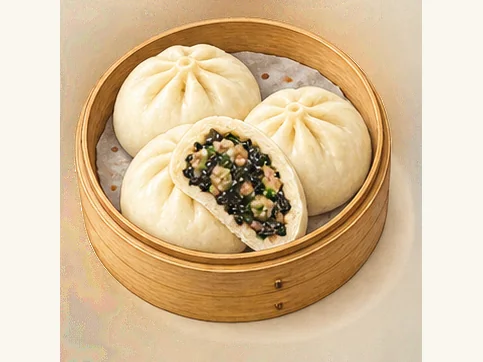
Dalian Seaweed Buns (大连海麻线包子) are steamed wheat buns built around chopped haimaxian, a seasonal brown seaweed also known as xuanzao (萱藻) or “camel hair” (骆驼毛). Pork, radish, fatty pork scraps, or other savoury additions may vary by kitchen, so the Chinese name describes the signature seaweed more reliably than one fixed recipe.
Tap any red Chinese text to hear it in Mandarin.
What makes them a Dalian food
Seaweed buns belong to Dalian’s everyday coastal food tradition rather than to one fixed restaurant or a single formal recipe. Dalian Library’s local-food record describes buns made with several kinds of near-shore seaweed and calls seaweed buns a traditional local specialty. In a 2024 provincial review, the Liaoning Department of Commerce listed 大连海麻线包子 among 27 Dalian geographical dishes.
The named ingredient is haimaxian, usually identified as xuanzao. It is a tube-shaped brown alga that grows in near-shore waters. Botanical and marine-food sources describe its visible growth in the cooler part of the year, with fresh availability changing as water temperatures rise; this is why a bun made with fresh haimaxian can feel like a seasonal coastal food, not an all-year fixed menu item.
How the filling works
The basic idea is simple: chop the seaweed into a filling, combine it with savoury ingredients, wrap it in wheat dough, and steam it. A government English food guide describes chopped seaweed mixed with minced pork for steamed buns. Dalian’s local recipe record gives one example with seaweed, pork, aromatics and fermented bean paste, while other local accounts describe versions with radish, fatty pork scraps or shellfish. These are kitchen-level variations, not a universal formula.
Haimaxian is not just a green garnish. Its marine savouriness is the point of the filling, while the bun wrapper softens the texture and holds the juices from the meat or seafood, when those are used. Fresh tubular seaweed is also commonly squeezed to remove trapped seawater before it is chopped and seasoned.
How to order it
Show 大连海麻线包子 Dàlián hǎimáxiàn bāozi when asking for this dish. You may also see the broader name 海菜包子 Hǎicài bāozi; “海菜” can refer to several edible seaweeds, so it does not always mean haimaxian specifically. Ask whether the filling contains 猪肉 (pork), 贝类 (shellfish) or other seafood, and whether the kitchen serves the buns steamed or pan-fried.
Do not treat “seaweed” as a vegetarian or allergen-free guarantee. The wrapper is wheat-based, pork is a common pairing, and some local versions add shellfish. If any of these matter to you, confirm the filling at the time of ordering. Fresh haimaxian is seasonal, and the availability or exact filling can change from one kitchen to another.
More dishes to compare
Explore related local specialties and compare their names, preparation notes and ordering guidance.
Dalian sea-urchin dumplings 大连海胆饺子 →
Wheat wrappers enclose a mixed filling that includes sea urchin, then are usually boiled. Other seafood, pork or vegetables may provide body, since the name does not mean pure sea-urchin filling. Sea urchin can bring a soft, rich marine note against the resilient dumpling skin, with the final balance depending on the mixture.
Crisp pork chunks in sauce 熘肉段 →
Pork chunks receive a starch-based coating, are fried until crisp and then quickly tossed in a glossy savory sauce. Pepper and other vegetables often join the final stir-fry. The defining contrast is a crunchy shell around tender pork, with a coating that is usually more savory than the bright sweet-sour glaze of guobaorou.
Sources & reading
Recipes and servings vary between kitchens.
- Dalian’s Ten Famous Snacks: Seaweed Buns
- 2024 ‘Meishi Meishi’ Liaoning Geographical Food Review Results
- Haimaxian Seaweed to Become a Mass Food
- Steamed seaweed bun (海菜包子/ Haicai Baozi)
- The New Favourite on the Tip of the Tongue: Xuanzao
- Which Seaweed Is Haimaxian?
- Eating Across Dalian: Fresh, Plump Seaweed Buns in Season