

Crispy Sweet and Sour Pork 锅爆肉
Crispy Sweet and Sour Pork is featured among the local specialties of Liaoning.
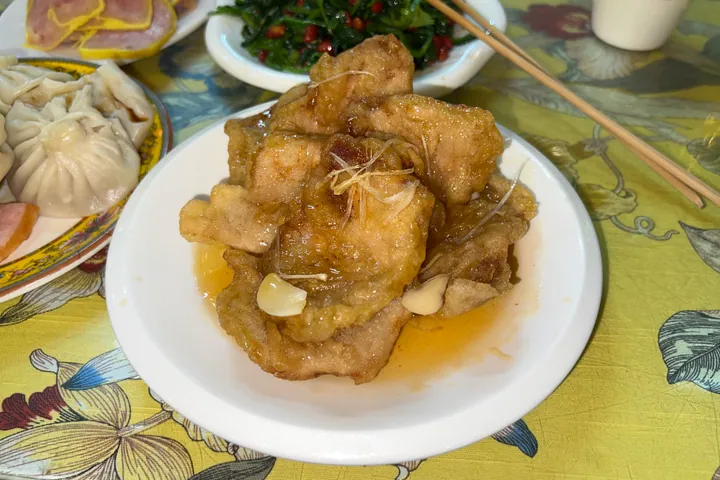
.jpg)
Photo adjustments
Full frame retained; proportionally resized and converted to WebP. No retouching or changes to the photographed subject. Card displays may crop the view.
Crispy Sweet and Sour Pork (锅爆肉) is guobaorou (锅包肉) under its original name: battered, fried pork in a sweet-and-sour sauce, a Northeast Chinese dish that began in Harbin (哈尔滨) at the end of the Qing dynasty. Almost all guobaorou in Liaoning is now made in a tomato-sauce style that dates from a conference held in Shenyang (沈阳) in 1911.
Where it comes from
Chinese Wikipedia credits the dish to Zheng Xingwen (郑兴文), head cook to Du Xueying (杜学瀛), the first intendant of the Binjiang circuit (滨江道) in Harbin. He reworked a Beijing dish of crisp-fried pork slices, jiaoliu roupian (焦熘肉片), whose savoury seasoning his Russian wife did not like, and gave it a sweet-and-sour sauce. He named it after the way it was cooked, writing it as "锅爆肉" ('wok-flash-fried pork'); the written name later drifted to the modern form, guobaorou (锅包肉).
After the plague in the Northeast, the Qing government held an international plague conference in Fengtian (奉天), today's Shenyang, from 3 to 28 April 1911. Zheng was its head cook, and to suit the foreign guests he replaced the sugar-and-vinegar sauce with tomato ketchup. That version became the Liaoning style and is still cooked there, and the dish appears on Chinese Wikipedia's list of representative Liaoning dishes with a note that tomato ketchup is stirred in.
How it is made
In the older method, called pengzhi (烹汁), slices of pork tenderloin are marinated, coated in batter and deep-fried until golden. They go back into the wok with a clear sauce of sugar, white vinegar, salt and sesame oil, which is thickened as they are tossed. The newer liuzhi (熘汁) method, which Zheng also devised, adds tomato ketchup and plenty of sugar near the end and cooks the sauce down until it is thick before the fried slices are turned through it.
Ingredients and flavour
Besides the pork and the starch for the coating, the dish carries shreds of carrot, spring onion and ginger. Halal restaurants use beef tenderloin in place of pork. The old style comes out golden, crisp outside and tender inside, and sweet and sour. The Liaoning tomato style is also sweet and sour, but red, with more sauce on the plate.
More dishes to compare
Explore related local specialties and compare their names, preparation notes and ordering guidance.
Shenyang chicken rack 沈阳鸡架 →
Another Shenyang staple; the tomato-sauce Liaoning style of Crispy Sweet and Sour Pork was first cooked in Shenyang in 1911.
Questions before you order
Is Crispy Sweet and Sour Pork the same dish as guobaorou (锅包肉)?
Yes. Its creator named the dish after its cooking method, and the written name later changed to the modern form, guobaorou.
Sources & reading
Written from the linked sources and checked sentence by sentence against quoted extracts by a separate reviewer on 2026-09-26. Recipes and servings vary between kitchens.