

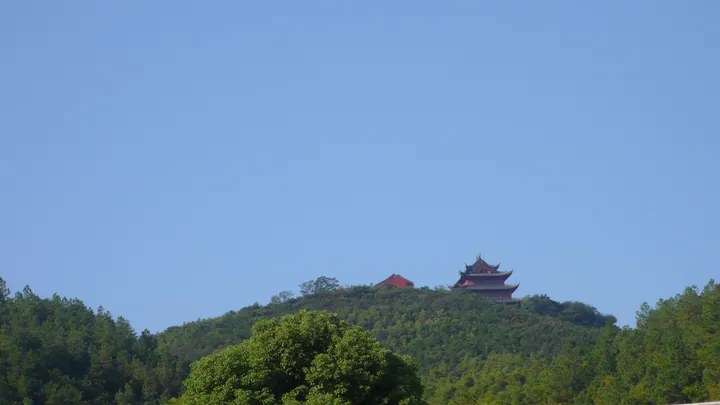
Photo adjustments
Full frame retained; proportionally resized and converted to WebP. No retouching or changes to the photographed subject. Card displays may crop the view.
Explore the region
About Qionglong Mountain
Qionglong Mountain (穹窿山) is a quartz-sandstone ridge in Wuzhong District (吴中区) spread across the towns of Guangfu (光福), Zangshu (藏书) and Xukou (胥口) and Xiangshan Subdistrict (香山街道) of Suzhou (苏州), Jiangsu. Its main summit, Limao Peak (笠帽峰), rises to 341.7 m; the Suzhou local chronicles office lists it as the highest of the hills on the east shore of Lake Tai (太湖) and the highest peak in Suzhou.
The ridge runs north-west for about 7.5 km, higher and wider in the north, up to 4 km across. Seen from below, the main peak looks like an upturned bamboo hat, which gives the peak its name. The summit is broad and flat, and boulders there are carved with "Limao Peak" and "Summit of Wuzhong" (吴中之巅). Woodland covers 1,340 hectares. In Maopeng Valley (茅蓬坞) dense bamboo grows at the valley mouth and mixed evergreen and deciduous broadleaf forest runs from the valley floor up the slopes, while Masson pine covers the highest ground; the valley became a Jiangsu provincial nature reserve in August 1981, and Dongwu National Forest Park (东吴国家森林公园) was set up in 1993.
Shangzhen Temple (上真观), a Taoist temple on Sanmao Peak (三茅峰), dates from the reign of Emperor Ping of the Han and once had 36 halls. The Qianlong Emperor (乾隆) climbed the mountain six times and stayed at the temple on five of them. Almost all of it was destroyed in the late 1960s; its gate hall and other halls were rebuilt in 1993, and Wanghu Pavilion (望湖亭), with a stele of Qianlong's poem "Wanghu", was rebuilt in 1999. Chinese Wikipedia describes the mountain as the place where the strategist Sun Wu (孙武) lived in seclusion and completed The Art of War (孙子兵法); Sun Wu Garden (孙武苑), built in 1998 on the site of the old Qionglong Chan Temple (穹窿禅寺) below Limao Peak, has a bronze statue of him and inscriptions of the text.
The footpath up is called the Qianlong Imperial Road (乾隆御道) and passes more than 20 cliff inscriptions, while a 6.5 km paved mountain road links the sights. To the east lies Xiaowang Hill (小王山), where the Republican politician Li Genyuan (李根源) lived for ten years from 1928. More than 100 cliff inscriptions by figures such as Zhang Taiyan (章太炎), Yu Youren (于右任) and Wu Changshuo (吴昌硕) survive there, a provincial protected site, and his tomb and memorial hall stand at the eastern foot of the hill.
What to look for
- Limao Peak (笠帽峰), the 341.7 m summit, with boulders carved "Summit of Wuzhong"
- Shangzhen Temple (上真观) on Sanmao Peak, the Taoist temple where the Qianlong Emperor stayed five times
- Wanghu Pavilion (望湖亭), rebuilt in 1999, with the stele of Qianlong's poem "Wanghu"
- Sun Wu Garden (孙武苑), with a bronze statue of Sun Wu and inscriptions of The Art of War
- Ningbang Temple (宁邦寺) at the northern foot of Limao Peak, with a ginkgo measured at more than 900 years old
- The Qianlong Imperial Road (乾隆御道), a footpath with more than 20 cliff inscriptions
- Xiaowang Hill cliff inscriptions (小王山摩崖石刻), over 100 Republican-era carvings, and Li Genyuan's tomb and memorial hall
Location & getting there
Getting to Qionglong Mountain
- Search for 穹窿山 with 苏州市 and 吴中区.
Find Qionglong Mountain
穹窿山 · 吴中区
No reliable map pin yet: search by the Chinese name.
Sources & visit information
Written from the linked sources and checked sentence by sentence against quoted extracts by a separate reviewer on 2026-09-23. Opening hours, admission and access arrangements are not covered; confirm current visitor information with the site.
Some facts checked against Wikipedia contributors, "穹窿山" · CC BY-SA 4.0.