


Explore the region
About Mount Jinshan
Mount Jinshan (金山) is a 44-metre hill in the northwest of urban Zhenjiang (镇江), Jiangsu, whose slopes are covered by the halls of Jinshan Temple (金山寺), formally Jiangtian Chan Temple (江天禅寺). The Zhenjiang city government lists the Jinshan scenic area as a national 5A-rated scenic area.
The hill measures 520 metres around. The Zhenjiang city government describes it as once the only island in the Yangtze (扬子江). As the river shifted course, the island gradually joined the south bank by the Guangxu reign of the Qing. Riding a donkey up Jinshan then became a fashionable outing in the late Qing and early Republican years.
The temple was founded in the Eastern Jin under the name Zexin Temple (泽心寺). The city government records that Emperor Wu of Liang (梁武帝) held a grand water-and-land ritual (水陆道场) for the souls of the dead here in the Southern Dynasties. In the Tang, the Chan master Lingtan (灵坦) refounded the abandoned temple, and the Toutuo Rock Record (头陀岩记) dates the grant of the name Jinshan to 805. The Kangxi Emperor climbed the hill in autumn 1687 and gave the temple its present name, Jiangtian, 'river and sky'. The temple's water-and-land ritual music entered the national intangible cultural heritage list in 2014, and Jinshan Temple has been a Jiangsu provincial protected heritage site since 2011.
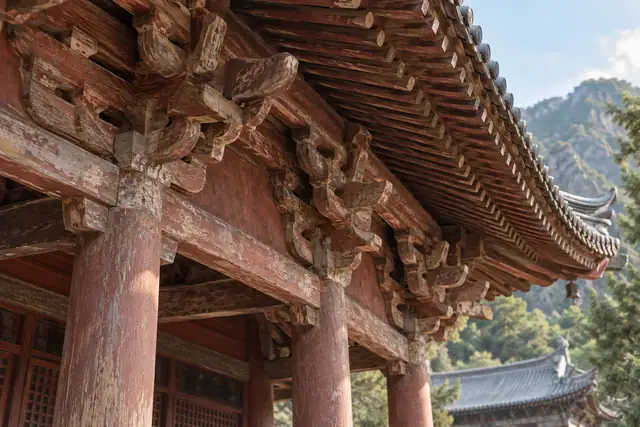
The halls are built up the hillside and linked together, so the saying goes that the temple wraps the hill, with the Cishou Pagoda (慈寿塔) on the summit. The temple keeps four objects known as the Four Treasures of Jinshan (金山四宝): a jade belt of Su Dongpo (苏东坡), a Zhou-dynasty ding vessel, a painting of Jinshan and a bronze drum. Stories set here include Su Dongpo leaving his jade belt, Yue Fei (岳飞) visiting the monk Daoyue (道月), Liang Hongyu (梁红玉) beating war drums against the Jin army, and the flooding of Jinshan Temple in the Legend of the White Snake (白蛇传).
Beside the temple stands Wenzong Pavilion (文宗阁). The original, finished in 1779, was the first of three imperial libraries in the Jiangnan region built to hold the Siku Quanshu (四库全书), and was destroyed in fighting in 1853. The rebuilt pavilion opened on 26 October 2011 and holds a facsimile of the Wenyuan Pavilion (文渊阁) copy from the Palace Museum in Beijing.
What to look for
- Jinshan Temple (金山寺), whose linked halls climb the whole hillside
- Cishou Pagoda (慈寿塔) on the summit, the hill's landmark
- The Four Treasures of Jinshan (金山四宝), including Su Dongpo's jade belt and a Zhou-dynasty ding
- Wenzong Pavilion (文宗阁), the rebuilt Siku Quanshu library, reopened in 2011
- The spring called First Spring Under Heaven (天下第一泉)
- Taying Lake (塔影湖), Baihua Isle (百花洲) and Jingtian Garden (镜天园) in the wider scenic area
Location & getting there
Getting to Mount Jinshan
- Search for 金山 with 镇江市 and 京口区.
Find Mount Jinshan
金山 · 京口区
No reliable map pin yet: search by the Chinese name.
Sources & visit information
Written from the linked sources and fact-checked against them on 2026-09-23. Opening hours, admission and access arrangements are not covered; confirm current visitor information with the site.
Some facts checked against Wikipedia contributors, "金山 (镇江)" · CC BY-SA 4.0.
Some facts checked against Wikipedia contributors, "江天禅寺" · CC BY-SA 4.0.