

Photo adjustments
Full frame retained; proportionally resized and converted to WebP. No retouching or changes to the photographed subject. Card displays may crop the view.
Explore the region
About Liberation Pavilion
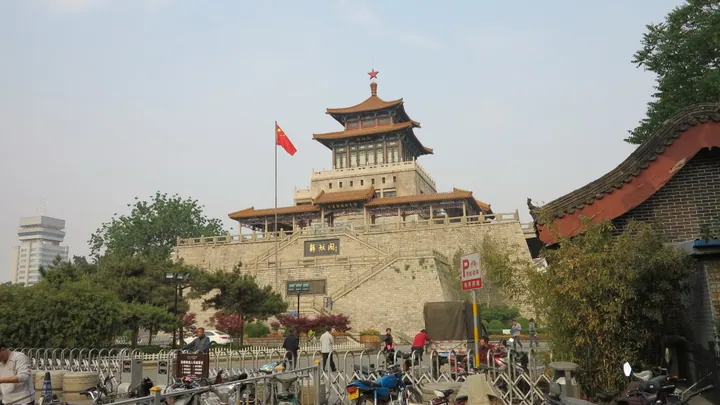
Liberation Pavilion (解放阁) in Lixia District (历下区), Jinan, stands on the spot where the People's Liberation Army broke through the old city wall on 24 September 1948 during the Jinan Campaign (济南战役).
The pavilion occupies what was the southeast corner of Jinan's walled city. The moat runs along its south side, Black Tiger Spring (黑虎泉) lies on the far bank, and a smaller spring, Baishi Spring (白石泉), rises between the moat and the pavilion. The Institute of Party History and Literature of the CPC Central Committee places it at the junction of Heibei Road and Heixi Road, with Quancheng Square (泉城广场) to the west.
The East China Field Army began its assault on 16 September 1948 and took the city on the 24th after eight days and nights of fighting. A platform was raised over the breach in 1965, which kept this stretch of wall standing when the rest was demolished, and in December 1977 the site became a Shandong provincial protected monument. Building of the pavilion itself started in 1985 and was finished on 24 September 1986. It was repaired in 1998, and in 1995 it was named one of Shandong's first provincial patriotic education bases. Ahead of the 60th anniversary in 2008, the Shandong culture and tourism department reported that more than 1,000 newly confirmed names of the fallen would be added to its memorial tablet.
Square in plan, the pavilion reaches 24.1 metres, or 34.1 metres counting the platform. Golden glazed tiles cover its roofs and granite faces its walls; a gallery joined by porches wraps the lower of its two storeys, and the upper storey has a double-eaved pyramidal roof with wind bells at the corners. The gilded three-character name on the west and south faces of the platform was written by Chen Yi (陈毅) in 1965. Against the east face stands the tablet to the campaign's dead, carved in regular script with 3,764 names. Relief carvings on the pedestal show the fighting, and the rooms inside hold an exhibition on the campaign, with the front committee's battle order, the banners of the Jinan First and Second Regiments, periscopes, bugles and guns used in the assault.
What to look for
- The southeast corner of Jinan's old city wall, kept beneath the 1965 platform
- The gilded pavilion name written by Chen Yi (陈毅) in 1965, on the west and south faces of the platform
- The Memorial Tablet to the Revolutionary Martyrs of the Jinan Campaign (解放济南战役革命烈士纪念碑), carved with 3,764 names
- Relief carvings of the 1948 battle on the pedestal
- The campaign exhibition inside, including the banners of the Jinan First and Second Regiments
- Black Tiger Spring (黑虎泉) and Baishi Spring (白石泉) beside the moat
Location & getting there
Getting to Liberation Pavilion
- Search for 解放阁 with 济南市 and 历下区.

Find Liberation Pavilion
解放阁 · 历下区
No reliable map pin yet: search by the Chinese name.
Sources & visit information
Written from the linked sources and checked sentence by sentence against quoted extracts by a separate reviewer on 2026-09-23. Opening hours, admission and access arrangements are not covered; confirm current visitor information with the site.
- 解放阁 - 维基百科,自由的百科全书 ↗
- Liberation Pavilion - Wikipedia ↗
- 山东省文化和旅游厅 工作动态 济南“新”解放阁8月份拟免费开放 ↗
- 济南解放纪念阁(济南篇) ↗
Some facts checked against Wikipedia contributors, "解放阁" · CC BY-SA 4.0.
Some facts checked against Wikipedia contributors, "Liberation Pavilion" · CC BY-SA 4.0.