

Photo adjustments
Full frame retained; EXIF orientation normalized, proportionally resized to at most 800 pixels and converted to WebP. No generated pixels or subject changes. Cards may crop the display.
Explore the region
About Temple and Cemetery of Confucius and Kong Family Mansion
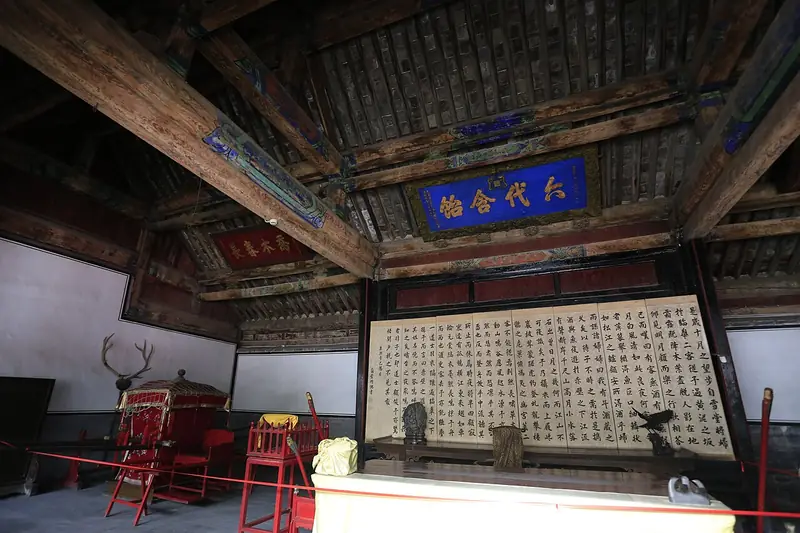
The temple was first built in 478 BC on the site of Confucius's own house, and offerings have been made there for more than 2,400 years. Most of the complex standing today was completed under the Ming and Qing dynasties. It covers 327 mu in nine successive courtyards with more than 460 halls, pavilions and gateways, ringed by a red wall with corner towers in imitation of an imperial palace. The central axis runs north from the Jinsheng Yuzhen arch through the Lingxing Gate, the Shengshi Gate, the Bishui bridges and the Dazhong Gate to the Kuiwen Pavilion, the stele pavilions, the Dacheng Gate, the Apricot Platform, the Dacheng Hall and finally the Shengji Hall. The State Council listed the three sites as a national key protected cultural heritage unit in 1961, and UNESCO inscribed them in 1994.
The Kong Mansion adjoins the temple on its east. It takes its formal name from the title Duke Yansheng, granted in 1055 to Kong Zongyuan, a forty-sixth-generation descendant, and covers about 7.4 hectares with some 480 historic building bays arranged in nine courtyards on central, eastern and western axes. Its family archive runs from 1534 to 1948. The cemetery, about a kilometre north of the town, covers more than 3,000 mu inside a wall four metres high and over seven kilometres around, and has been in use for more than two millennia. Between them the three sites hold over 5,000 steles dating from the Western Han onward, more than 100,000 graves and over 17,000 old and notable trees. Conservation work reported in 2021 included the first major restoration of the buildings' painted decoration in a century.
What to look for
- The ten marble columns of the Dacheng Hall's front veranda, each carved with a pair of dragons chasing a pearl
- The Thirteen Stele Pavilions between the Kuiwen Pavilion and the Dacheng Gate, eight to the south and five to the north, holding more than fifty large steles of the Tang, Song, Jin, Yuan, Ming and Qing
- The Apricot Platform in the courtyard before the Dacheng Hall, and the Shengji Hall at the north end of the temple's main axis
- The Kong Mansion's rear garden, Tieshan Yuan, with its 'five cypresses embracing a pagoda tree'
- In the cemetery, the thousand-metre spirit way, the Zhushui River inside the wall, and Confucius's tomb with its stele reading 'Tomb of the Great Perfection, Supreme Sage, Exalted King of Culture', flanked by the graves of his son Kong Li and grandson Kong Ji
Location & getting there
Getting to Temple and Cemetery of Confucius and Kong Family Mansion
Check which interiors and courtyards are accessible. Active places of worship and protected monuments may have different visitor rules.
- Search for 孔庙孔府孔林 with 济宁市 and 曲阜市.
Find Temple and Cemetery of Confucius and Kong Family Mansion
孔庙孔府孔林 · 曲阜市
No reliable map pin yet: search by the Chinese name.
Sources & visit information
The linked sources support the identity and background described in this introduction. Opening hours, admission, activity availability and exact arrival arrangements have not been comprehensively checked. Confirm current visitor information with the venue; the original catalogue locality and editorial review flag are retained.