

Explore the region
About Jidu Temple
Jidu Temple (济渎庙) is a temple complex in Jiyuan (济源), Henan, built for the god of the Ji River (济水) at the spot counted as the river's eastern source. Chinese Wikipedia describes it as the largest and most complete of the surviving temples to the ancient "Four Du" (四渎) rivers.
In ancient China a du (渎) was a river with a source of its own that ran straight to the sea; the four were the Yangtze, the Yellow River, the Huai and the Ji. The Sui court founded the temple at the Ji's source in 582, the second year of the Kaihuang era, and emperors from the Sui to the Qing sent envoys here to make offerings. Since the Western Han, Lake Baikal in present-day Russia had been called the North Sea (北海). Because it lay too far beyond the desert to reach, the temple's dragon pool was said to connect with it underground, and in 796 a North Sea Shrine (北海祠) was added so that the god of the North Sea could be worshipped from here. The complex is therefore also called Jidu Beihai Temple (济渎北海庙).
The plan resembles the Chinese character jia (甲), square at the front and rounded at the back. Four groups of buildings survive: the Jidu Temple proper at the front, the North Sea Shrine behind it, Tianqing Palace (天庆宫) to the west and Yuxiang Court (御香院) to the east, 23 buildings in all, dating from Song to Qing times. The central gate and processional way were kept for emperors and their envoys, while civil officials stood to the east and military officers to the west. The temple became a national protected site in 1996, and the Henan Cultural Relics Bureau calls it one of the largest groups of old buildings in the province.
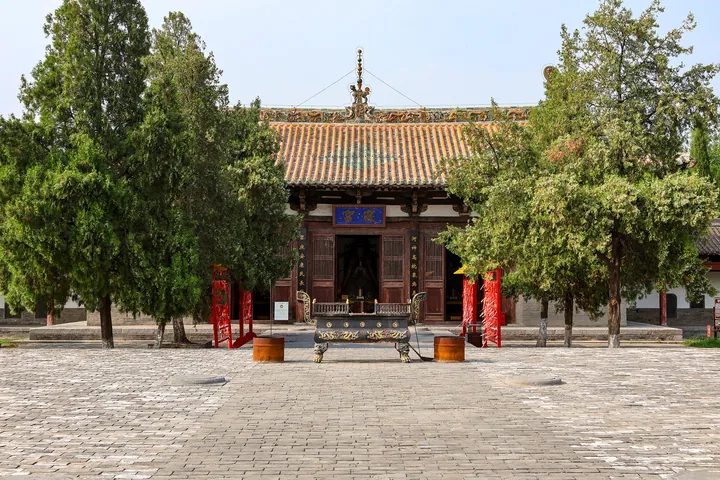
The main hall burned during the Tongzhi reign of the Qing, when the Nian rebels set it alight; only its base, with column bases 60 cm across, remains. Behind it stands the Rear Palace, built in 973 under the Northern Song, which the Henan Cultural Relics Bureau lists as the oldest surviving timber building in the province. The North Sea Shrine keeps the dragon pool, in which workers clearing silt in 2003 found a jade tablet thrown in by envoys sent to honour the Ji River god in 1068, when Emperor Shenzong came to the throne; it is now in the Jiyuan Museum.
What to look for
- Qingyuan Dongfu Gate (清源洞府门), a mid-Ming timber gateway of three bays and four posts, named after the Ji River god's title "Duke Qingyuan"
- The Rear Palace (寝宫) of 973, one of only two Song timber buildings in Henan
- The stone balustrade by the Dragon Pool in front of Lingyuan Pavilion (灵渊阁), described by Chinese Wikipedia as the only complete Song single-rail balustrade in China, matching the Song building manual Yingzao Fashi (营造法式)
- Linyuan Gate (临渊门), the only Yuan-dynasty building in the complex
- The Dragon Pavilion (龙亭) and Dragon Pool (龙池), the east pool of the Ji River's source
- The General's Cypress (将军柏), about 2,000 years old and over 20 m tall, where the Tang general Yuchi Gong (尉迟恭) is said to have hung his steel whip
- A Ming stele carved with a plan of the temple and its waterways
- A stretch of Tang wall rammed from earth mixed with sticky-rice soup
Location & getting there
Getting to Jidu Temple
- Search for 济渎庙 with 济源市(省直管县级市) and 市域.
Find Jidu Temple
济渎庙 · 市域
No reliable map pin yet: search by the Chinese name.
Sources & visit information
Written from the linked sources and fact-checked against them on 2026-09-23. Opening hours, admission and access arrangements are not covered; confirm current visitor information with the site.
Some facts checked against Wikipedia contributors, "济渎庙" · CC BY-SA 4.0.
Some facts checked against Wikipedia contributors, "Jidu Temple" · CC BY-SA 4.0.
Image credits & notes (1)
- The Resting Hall (Qingong) of Jidu Temple, Jiyuan · 济源济渎庙寝宫Photo: Windmemories · CC BY-SA 4.0 · taken 2025-07-16Resized for the web; the photo itself has not been edited. Thumbnails may show a cropped view.
