

Explore the region
About Shennong Valley
The park grew out of the Taoyuandong nature reserve and was approved as a national forest park by the former Ministry of Forestry in 1992; in August 2005 the State Forestry Administration approved changing its name from Taoyuandong to Shennonggu, a reference to its closeness to the mausoleum of Yandi Shennong. It covers 10,000 hectares with a recorded forest cover of 98.75 per cent, and is administered by the same organisation as the Taoyuandong National Nature Reserve, which carries the larger footprint of 23,786 hectares, about 11 per cent of the county. The reserve was created at provincial level in 1982 and raised to national level by the State Council in July 2002. The area lies immediately west of the Jinggangshan national nature reserve in Jiangxi, and the park entrance is about 39 kilometres from the Yanling county town.
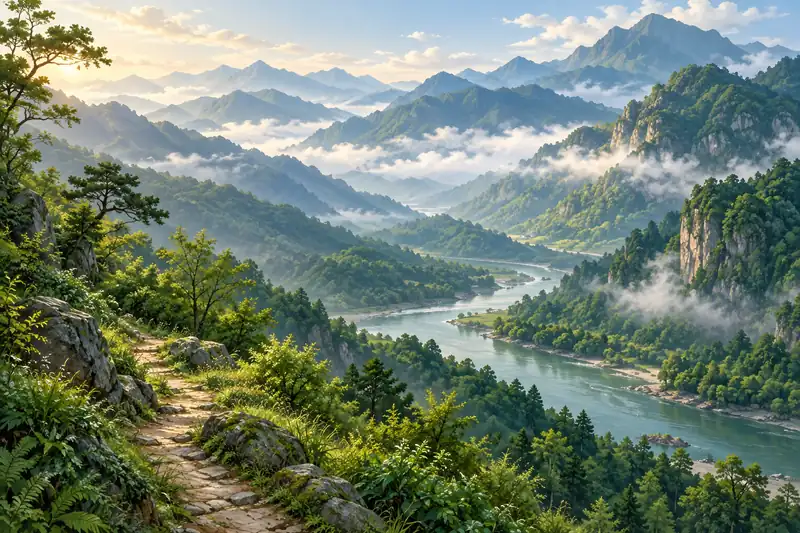
The forest is the reason for the protection. Survey work in the reserve recorded 2,019 species of vascular plants and 212 species of terrestrial vertebrates, including 74 nationally protected plant species and 29 nationally protected animal species. Six plants carry first-class national protection here, among them Cathaya argyrophylla, ginkgo, southern yew and the Ziyuan fir; the fir, known locally as Dayuan fir after a place inside the reserve, is critically endangered and was counted at just 1,170 individuals. The four first-class protected animals listed are the clouded leopard, the leopard, the South China tiger and Cabot's tragopan. The forest park is laid out as six scenic zones, Jiashui, Tianxinli, Jiuqushui, Pingkeng, Hengnishan and Taohuaxi, with six first-grade viewpoints among a graded total of forty-six.
What to look for
- Shennong Falls, recorded by the provincial forestry bureau as the waterfall with the greatest drop in Hunan at 235.5 metres
- Zhulian Waterfall, which the park cites for the highest negative-oxygen-ion readings in Asia at 136,426 per cubic centimetre
- Shennong Peak, also called Lingfeng, the highest point in Hunan Province, rising from a reserve whose lowest ground is at 420 metres
- The tract of old-growth forest, some 116,000 mu, where the East China, South China and Central China floristic regions meet
- Shibantan and Shubaoshi, two of the park's named landscape features
Location & getting there
Getting to Shennong Valley
Check weather, trail access and the last return service. A mountain or forest area is not one entrance, and a map’s central pin may be far from the trailhead.
- Search for 神农谷 with 株洲市 and 炎陵县.

Find Shennong Valley
神农谷 · 炎陵县
No reliable map pin yet: search by the Chinese name.
Sources & visit information
The linked sources support the identity and background described in this introduction. Opening hours, admission, activity availability and exact arrival arrangements have not been comprehensively checked. Confirm current visitor information with the venue; the original catalogue locality and editorial review flag are retained.