

Siping Smoked Pork 四平熏肉
Siping Smoked Pork is featured among the local specialties of Jilin.
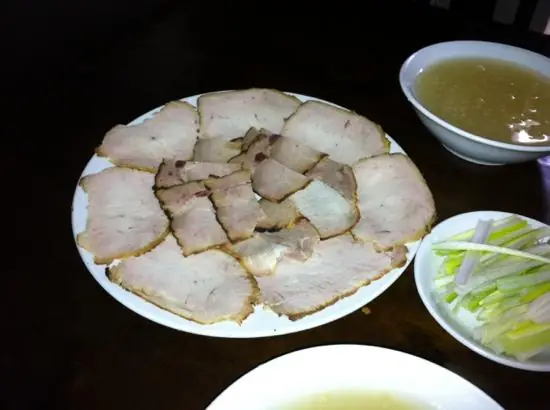
Image notes
Resized for the web; the photo itself has not been edited.
Siping Smoked Pork (四平熏肉) is pork first cooked in an old master stock with a secret seasoning mix and then smoked. In Siping (四平), Jilin, it is the meat half of Li Liangui smoked pork and flatbread (李连贵熏肉大饼), a pairing whose making technique is on China's national intangible cultural heritage list and which the national heritage entry calls a cultural symbol of the city.
How it is made
The pork is simmered in an old stock (老汤) with the house seasonings, then smoked. Chinese Wikipedia describes the meat as specially chosen pork stewed with Chinese medicinal herbs and seasonings before smoking, and the national heritage entry names a secret herbal formula as the core of the technique. The same entry links the ingredients to Siping's position in the middle of the Songliao Plain (松辽平原), on the northeastern black-soil belt: local wheat gives a strong, fragrant flour, and local Northeast black pigs give well-flavoured pork. The flatbread served with the meat is made by working fat from the meat stock and seasonings into the flour, shaping a flaky layered round and baking it on a griddle.
Flavour and texture
The finished pork is reddish brown, with skin and meat almost translucent. The heritage entry describes the fat as not greasy and the lean as not dry, with a smoky fragrance. The bread comes out round like a full moon, golden on the surface, in separate flaky layers, crisp outside and soft within.
How it is eaten
The pork is eaten with the flatbread, wheat-flour sauce (面酱) and shredded spring onion, and the heritage entry suggests a bowl of millet, mung bean and jujube porridge alongside. Either roll the meat, onion and sauce up in the bread, or cut the bread open and fill the pocket inside.
Where it comes from
Chinese Wikipedia dates the recipe to 1908, when Li Guangzhong (李广忠), whose childhood name was Li Liangui and who came from Luan County (滦县) in Hebei, created it in Lishu County (梨树县). Lishu is now part of Siping. According to the national heritage entry, the shop moved to Siping city in 1940, as the arrival of the railway turned Siping, rather than Lishu, into an important transport hub of the northeast, and the craft has passed from master to apprentice through four generations. The making technique joined the national list in 2021, in the fifth batch, with Siping as the applicant. The Jilin provincial gazetteer office also names the Li Liangui smoked pork range of Siping's Li Liangui restaurant among the famous dishes of Jilin cuisine (吉菜).
Sources & reading
Written from the linked sources and fact-checked against them on 2026-09-24. Recipes and servings vary between kitchens.