

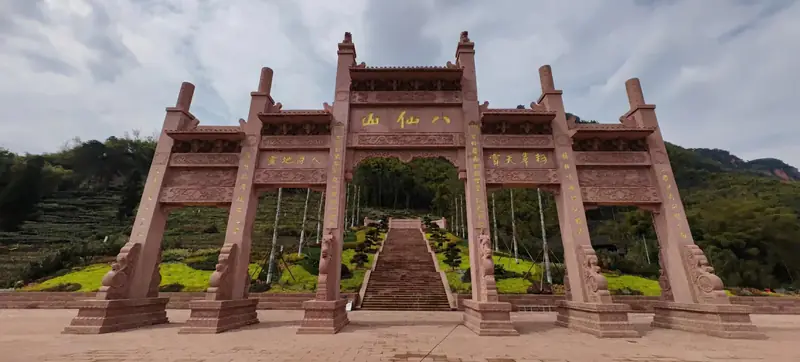
Photo adjustments
EXIF orientation normalized; resized without changing aspect ratio; converted to WebP. No subject edits.
Explore the region
About Longhua Ancient Town
The Sichuan Provincial Local Chronicles Work Office records an annual mean temperature of 16.5 degrees Celsius and average rainfall of 1,135.4 millimetres here, a local saying that the mountain holds four seasons at once and different weather every ten li, and the town's own epithet, 'misty-rain Longhua'. The same entry records that in 2017 Longhua was named a Chinese historical and cultural town. The core of the old town is its Ming and Qing street quarter, made up of four small streets — Zhengjie, Doufu Street, Xinjie and Shunhe Street — behind which stands the Yudi Gong, built by migrants from Hubei and once an important venue for local temple fairs.
The Baxianshan Buddha stands 32 metres high and its date of carving appears in no surviving historical source. It faces north-east and looks down over the town, the left hand held at the chest and the right hanging with the palm turned outward; both wrists wear bracelets, the ears do not reach the shoulders, and the figure has a shoulder cape but no kasaya and none of the high ushnisha of conventional Buddha images, a form the chronicles entry reads as a jieyin or welcoming Buddha. Those 32 metres were not the intended height: the feet were never carved at all, and holes for scaffolding survive in the rock below, which the entry takes as evidence that the work was abandoned unfinished.
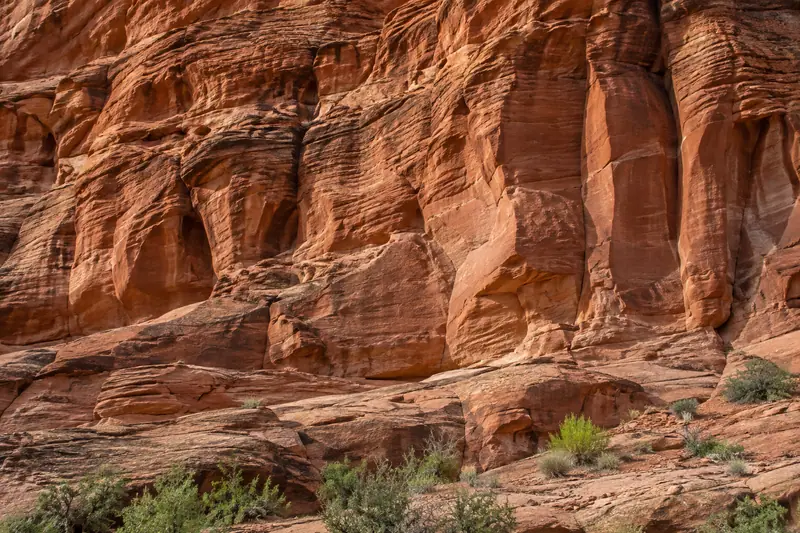
To the right of the Buddha, Danxia Dong is a set of artificially cut grottoes in a cliff that is ochre-red throughout, thickly vegetated along its top and bare on its face. The entry records that the grottoes were probably first dedicated to the Daoist Jade Emperor and later took in Confucian and Buddhist worship as well, making them a characteristic instance of the three teachings coexisting in Pingshan County since the Qing. At the head of the Ming and Qing street, where the old and new quarters meet and the Da Longxi and Xiao Longxi come together, stands Longhua Liangqiao, a covered bridge begun in the fourteenth year of the Guangxu reign, 1888, under the joint supervision of the county magistrate Tan Youqing and Kuai Henian, garrison commander of the Ping'an battalion stationed at Longhua, and paid for by local gentry and residents; it follows Huizhou covered-bridge form, is built of stone and timber together, and is under 40 metres long and under 5 metres wide.
What to look for
- The Baxianshan standing Buddha: 32 metres high, undated in any surviving record, with bracelets on both wrists, no high ushnisha and ears that do not reach the shoulders.
- The Buddha's unfinished lower part — the feet were never carved, and scaffolding holes remain in the rock below.
- Danxia Dong, grottoes cut by hand into an ochre-red cliff to the right of the Buddha, probably first dedicated to the Jade Emperor and later shared with Confucian and Buddhist worship.
- Longhua Liangqiao, the covered bridge of 1888 at the head of the old street, of mixed stone and timber construction and under 40 metres long.
- The four streets of the Ming and Qing quarter — Zhengjie, Doufu Street, Xinjie and Shunhe Street — and the Yudi Gong behind them, built by Hubei migrants.
Location & getting there
Getting to Longhua Ancient Town
Identify the main visitor approach and any separately managed houses, museums or performances. Ask before entering residential spaces or photographing residents.
- Search for 龙华古镇 with 宜宾市 and 屏山县.
Find Longhua Ancient Town
龙华古镇 · 屏山县
No reliable map pin yet: search by the Chinese name.
Sources & visit information
The linked sources support the identity and background described in this introduction. Opening hours, admission, activity availability and exact arrival arrangements have not been comprehensively checked. Confirm current visitor information with the venue; the original catalogue locality and editorial review flag are retained.