

Photo adjustments
EXIF orientation normalized; resized without changing aspect ratio; converted to WebP. No subject edits.
Explore the region
About Anyue Stone Carvings Main Sites
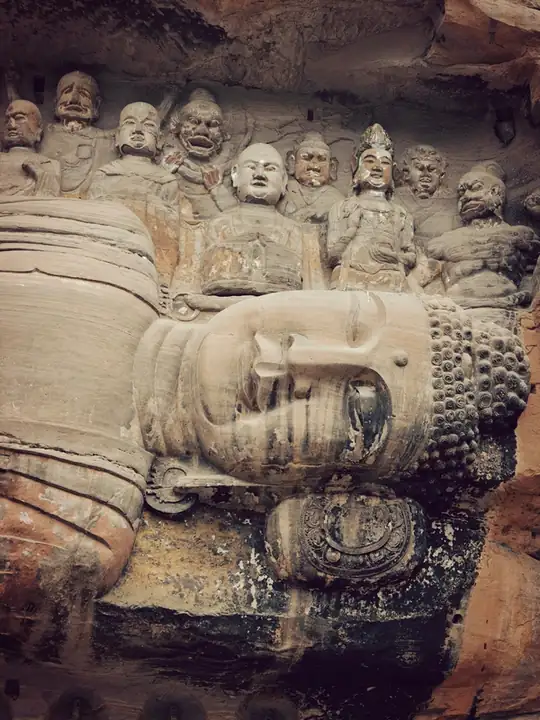
Anyue County holds more than 230 cliff-carving sites of Tang, Song, Ming and Qing date, with over 100,000 images and 400,000 characters of carved scripture, ten of which are national-level protected units, among them Wofoyuan, Piludong, Yuanjuedong, Huayandong, Qianfozhai, Mingshansi, Kongquedong and Xuanmiaoguan. The Ministry of Culture named the county the home of Chinese stone-carving art in September 2000. Wofoyuan, in Wofo gully at Wofo village in Bamiao township 35 kilometres north of the county town, is numbered to 139 niches and caves: 84 Buddhist carving niches, 15 scripture caves and 39 empty caves, with 1,593 images and 400,000 characters of carved sutra text, most of it High Tang work. Niche 3 on its north cliff is a full-length nirvana image of Sakyamuni 23 metres long. Yang Xiuwei of the Anyue Grottoes Research Institute told Xinhua that, unlike the usual right-lying figures, this Buddha lies on its left against the cliff, and called it the longest left-lying reclining Buddha in the world. The county cultural relics office was set up in 1982 and asked local people to report the relics around them; Wofoyuan became widely known and was published as a nationally key protected unit in 1988.
Yuanjuedong, on Yunju hill a kilometre southeast of Yueyang town, has 72 niches, 1,933 images and 25 carved inscriptions across its north and south cliffs, cut from the Tang Kaiyuan era through Former Shu, Later Shu and the Northern Song over more than four centuries. Its subjects are mainly Buddhist, with a smaller number of Daoist and mixed niches; the county chronicles office calls the three figures over six metres high on the north cliff — Sakyamuni, the lotus-holding Guanyin and the vase-holding Guanyin — Northern Song masterpieces, and dates the Ksitigarbha with ten kings, sixteen arhats and Vaisravana on the south cliff to the Five Dynasties. Piludong, 50 kilometres southeast of the county town at Youping village in Shiyang town, is numbered in 20 units including 13 cliff tombs and 7 carving niches, with 465 images, 14 stelae and 18 inscriptions concentrated in the Piludong, Youjudong, Qianfodong and Guanyintang caves. The Piludong cave carries the ten-austerities cycle of Liu Benzun, a Five Dynasties patriarch of Tantric Buddhism. The Water-Moon Guanyin in the Guanyin hall, commonly called the Purple Bamboo Guanyin, has been styled the Oriental Venus and is known locally as the cocked-leg Guanyin, sitting with the left foot hanging off the platform and the right foot cocked up. A steel-framed shelter has since been erected over the carvings at Piludong, which Yang Xiuwei says is to protect images exposed outdoors from rain erosion and weathering.
What to look for
- Niche 3 at Wofoyuan: a 23-metre full-length nirvana image of Sakyamuni, lying on its left side against the north cliff.
- The 15 scripture caves at Wofoyuan, carrying 400,000 characters of carved sutra text.
- The three figures over six metres high on the north cliff at Yuanjuedong — Sakyamuni, the lotus-holding Guanyin and the vase-holding Guanyin.
- The Water-Moon or Purple Bamboo Guanyin in the Guanyin hall at Piludong, one foot hanging off the platform and the other cocked up.
- Liu Benzun's ten-austerities cycle carved in the Piludong cave itself.
Location & getting there
Getting to Anyue Stone Carvings Main Sites
Check which interiors and courtyards are accessible. Active places of worship and protected monuments may have different visitor rules.
- Search for 安岳石刻重点开放点 with 资阳市 and 安岳县.
Find Anyue Stone Carvings Main Sites
安岳石刻重点开放点 · 安岳县
No reliable map pin yet: search by the Chinese name.
Sources & visit information
The linked sources support the identity and background described in this introduction. Opening hours, admission, activity availability and exact arrival arrangements have not been comprehensively checked. Confirm current visitor information with the venue; the original catalogue locality and editorial review flag are retained.