

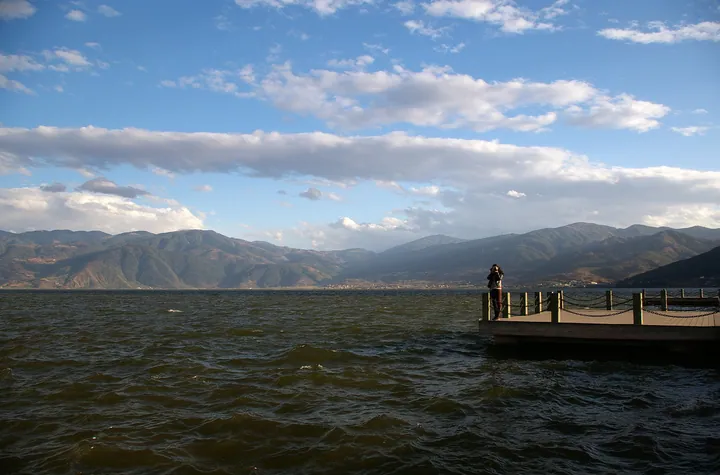
Photo adjustments
Full frame retained; proportionally resized and converted to WebP. No retouching or changes to the photographed subject. Card displays may crop the view.
Explore the region
About Qionghai Lake and Lushan Mountain
Lushan, also called Washan, is one of Sichuan's provincial-level scenic and historic areas. It has Qionghai to the east, the Anning river to the west, the old city of Xichang to the north and Luojishan to the south, and the prefecture's ethnic and religious affairs commission explains the old four-part formula song feng shui yue as the pines of Lushan, the wind of the Anning river, the water of Qionghai and the moon of Xichang. Its main peak, Shamaoxiang, stands at 2,317 m, about 800 m above the surface of the lake, and the commission gives about eight kilometres from the foot of the mountain to the top. More than ten old temples built in the Han, Tang, Ming and Qing periods stand among the trees – Guangfu Temple, Mengduan Shrine, Sanjiao An, Zushi Hall, Guanyin Pavilion, Wangmu Hall, Yuhuang Hall, Qingyang Gong and Wuzu An among them – and the commission assigns them to the Confucian, Daoist and Buddhist traditions respectively.
The commission calls Guangfu Temple the largest of these groups; it is made up of the Thousand Buddha Hall, the Wenwu Gong, the Kuixing Pavilion, the Wanghai Lou, the Feiliang Temple and the Mahavira Hall. It includes an earthquake-stele exhibition room listed as a provincially protected relic, poems and inscriptions left by figures of successive periods, Ming bronze and iron Buddha images, a large bronze image of several thousand jin and a pagoda-shaped censer. On the lake side, the Xichang city gazetteer office records the water area of Qionghai increased to 34 square kilometres and the surrounding wetland to more than 20,000 mu, with three wetland groups – Menglishuixiang, Mengxunhuahai and Menghuitianyuan – built and opened in turn; the wetland has been designated a national tourist resort, a national ecotourism demonstration area, a national wetland park and a national ecological-civilisation education base.
What to look for
- Guangfu Temple's earthquake-stele exhibition room, a provincially protected relic inside the group the commission calls the largest on the mountain.
- The Wanghai Lou, one of the six named components of Guangfu Temple.
- The Jiulong Han cypress, which the prefecture commission dates to two thousand years and counts among the ten Bashu tree kings.
- Other old temples on the mountain, among them Mengduan Shrine, Sanjiao An, Zushi Hall, Guanyin Pavilion, Wangmu Hall, Yuhuang Hall, Qingyang Gong and Wuzu An, which the commission assigns between three traditions.
- The Qionghai wetland, more than 20,000 mu of it, built and opened as three wetland groups, with the lake's water area increased to 34 square kilometres.
Location & getting there
Getting to Qionghai Lake and Lushan Mountain
Confirm the visitor entrance and which boat or walking routes operate on your date. Rainfall, water levels and weather can change access.
- Search for 邛海与泸山 with 凉山彝族自治州 and 西昌市.
Find Qionghai Lake and Lushan Mountain
邛海与泸山 · 西昌市
No reliable map pin yet: search by the Chinese name.
Sources & visit information
The linked sources support the identity and background described in this introduction. Opening hours, admission, activity availability and exact arrival arrangements have not been comprehensively checked. Confirm current visitor information with the venue; the original catalogue locality and editorial review flag are retained.