

Explore the region
About Tonghai Ancient City
Tonghai county holds 90 cultural relics protection units at various levels, including the Xiushan architectural complex at national level, and more than 4,000 catalogued relics including one grade-one item. Within the old city, 103 courtyard residences are counted as historic buildings, eight of them dating to the Ming dynasty, and the county holds two items of national-level intangible cultural heritage; it has also been given honorary titles including National Advanced Cultural Relics County and China Couplet-Culture County.
Juqui Ge, at the centre of the old city where its four main streets meet, takes its name from the star deity Kuixing enshrined on its third floor and held to govern literary fortune. First built in the Ming dynasty, it burned down in 1876 and was rebuilt on the same site in 1882, at 165.38 square metres and 17.5 metres over three storeys, and survived the two major earthquakes at Tonghai in 1915 and 1970, in which, the county cultural centre's director Zhang Huaiming says, most of the houses in the city collapsed. It is carried on 40 wooden pillars, including 16 outer ironwood columns 36 centimetres across and four inner columns running from base to roof, jointed at the beams by mortise-and-tenon and double dovetail work without any nails, which a Yuxi Media Convergence Centre report gives as the reason it is known locally as a treasure among central Yunnan's ancient buildings; the Yunnan provincial government listed it in 1993 among the fourth batch of provincial cultural relics protection units. Its second floor carries four Qing-dynasty plaques on its four faces, an inscribed 1885 record of its rebuilding written by the then Tonghai magistrate, and a poem tablet by the Qing calligrapher Qian Feng describing a solitary city by the water, backed by hills.
What to look for
- Juqui Ge, the three-storey Ming-origin pavilion rebuilt in 1882 at the crossing of the old city's four main streets, on 40 nail-free timber pillars.
- The four Qing-dynasty plaques on Juqui Ge's second-floor exterior: Guanmian Nanzhou, Siwei Tongniu, Juqui Ge and Gaogong Chenju.
- The 1885 inscribed record of Juqui Ge's rebuilding, written by the Tonghai county magistrate of the day, displayed on the building's second floor.
- The old city's mountain-city-lake street layout, with Xiushan behind it and Qilu Lake spread across the basin.
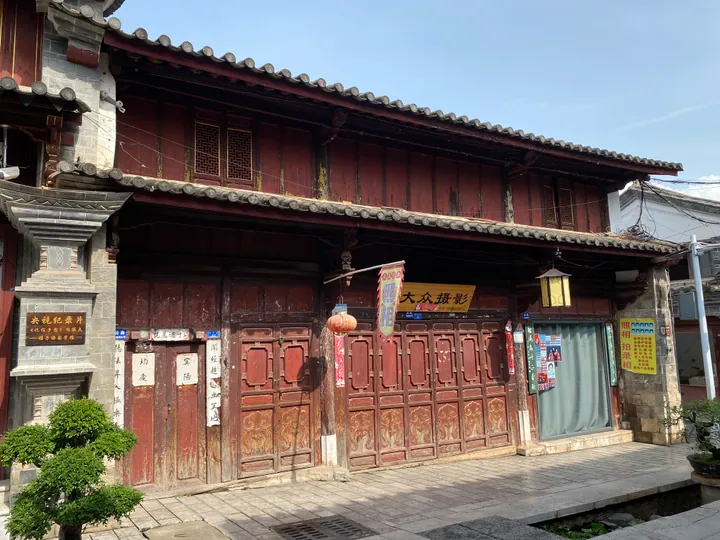
- The old city's surviving Ming-dynasty courtyard residences, eight of 103 historic courtyards so dated.
Location & getting there
Getting to Tonghai Ancient City
Identify the main visitor approach and any separately managed houses, museums or performances. Ask before entering residential spaces or photographing residents.
- Search for 通海古城 with 玉溪市 and 通海县.
Find Tonghai Ancient City
通海古城 · 通海县
No reliable map pin yet: search by the Chinese name.
Sources & visit information
The linked sources support the identity and background described in this introduction. Opening hours, admission, activity availability and exact arrival arrangements have not been comprehensively checked. Confirm current visitor information with the venue; the original catalogue locality and editorial review flag are retained.
Image credits & notes (1)
- A traditional two-storey timber building with tiled roof and carved doors on Wenmiao Street in Tonghai Old Town, Tonghai County · 通海古城文庙街的传统木构建筑,通海县Photo: 瑞丽江的河水 · CC BY-SA 4.0 · taken 2023-08-18Resized for the web; the photo itself has not been edited. Thumbnails may show a cropped view.
