

Entry & permits for Tibet (Xizang)
Foreign tourists need Tibet entry approval, commonly called a Tibet Travel Permit, and an organised visit arranged through a specialist travel agency in China. Confirm your approved route before booking transport. Requirements differ for Taiwan residents and for travellers using mainland or Hong Kong/Macao Chinese resident documents; check the document guide before you book.
Check the travel-document requirements →Policy scope verified: 2026-09-06. UK FCDO: China regional travel advice ↗ State Council Taiwan Affairs Office: Tibet entry approval ↗ Xizang Department of Culture and Tourism: Medog border permit notice ↗
Explore the region
About Yanjing Ancient Salt Fields
The Qamdo municipal government gives the place 1,300 years of salt production and calls it a pearl of the Tea Horse Road. The salt fields were graded a national AAAA tourist scenic area in 2012 and a national-level protected cultural relics unit in 2013; the Markam County government dates that listing to May 2013 and puts it in the seventh national batch, records the well-salt sun-drying technique as entering the second national batch of intangible cultural heritage in June 2008, and notes the site's inclusion in 2012 in the tentative list of Chinese World Cultural Heritage published by the State Administration of Cultural Heritage. In April 2017 the site was added to the national list of candidates applying to create a 5A-grade scenic area.
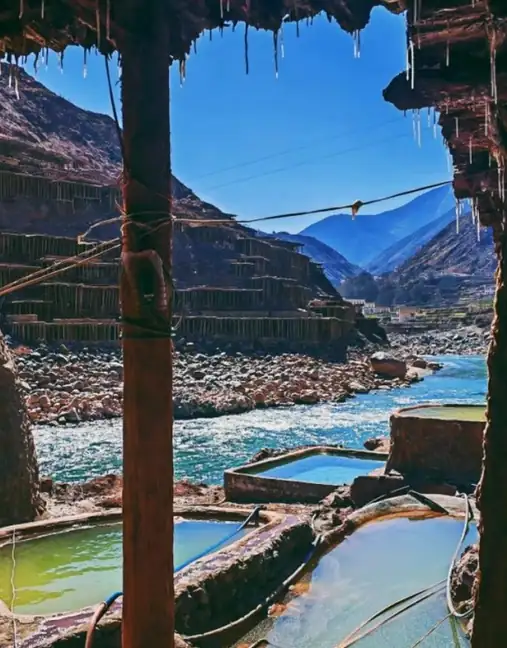
The pans are earth-and-timber platforms built along both banks of the river in Naxi Ethnic Township and Quzika Township. Each is floored with fine plant matter and then with soil, fine sand and plant debris lifted from older pans, its surface smoothed and compacted with white and purple clay and edged with a bund to make a level, inkstone-shaped basin; the larger pans do not exceed ten square metres and the smallest are one to two. They rise in ranks and tiers from the riverside to three or four hundred metres up the hillside, at an altitude of about 2,271 to 2,325 metres. The county government counted 371 households working more than 3,270 old pans over about 12,908 square metres, and set the fields out as three parts: the Xitongka remains at Naxi village on the east bank, the Jiada fields at Jiada village on the west bank, and the Sequlongyaka fields at Shangyanjing village, with total areas given as 3万, 3.5万 and 3.5万 square metres respectively.
Brine springs are concentrated at three places — Shangyanjing, Xiayanjing and Jiada village — where 83 spring eyes yield between 140 and 2,288 cubic metres a day. Salt makers pile stones at the spring eyes to hold the water, making brine wells of which some are 11 metres deep, and go down a path and steep ladders with cylindrical wooden buckets to lift the brine, carrying it back to household brine pools or to troughs at the pans before pouring it out to concentrate and crystallise. One drying takes two days in spring and summer and four to five days in autumn and winter, after which the grains are scraped together and drained; the first scrapings are white and clean and are eaten, while the later ones carry more soil and are fed to livestock. On the county government's account the east-bank villages of Naxi and Shangyanjing make white salt, also called snowflake salt, and Jiada and Quzika on the west bank make red salt, also called peach-blossom salt, red salt having the higher output and the lower price.
The two government pages disagree in three places and the disagreements are recorded rather than settled here. The municipal page gives more than 320 households and more than 3,454 pans where the county page gives 371 households and more than 3,270 pans. The municipal page places Jiada and Quzika to the east while also saying that the Lancang is the dividing line and that the two banks yield salt of different colours, whereas the county page places those two on the west bank. And the municipal page applies the name peach-blossom salt to both the white and the red salt, tying it to a March-to-May harvest peak that coincides with the peach blossom, where the county page attaches the name to red salt alone.
What to look for
- Tiers of timber-framed salt pans stacked on the gorge cliffs, running from the riverside to three or four hundred metres up the hillside
- The colour difference between the white salt of Naxi and Shangyanjing and the red salt of Jiada and Quzika, as the county government sets it out
- Brine wells made by piling stones at the spring eyes, some of them 11 metres deep
- The working method the two pages describe: brine lifted in cylindrical wooden buckets, poured into the clay-surfaced pans, and the dried grains scraped up afterwards
- Crystalline salt forming beneath the pans in shapes the municipal page compares to stalactites
Location & getting there
Getting to Yanjing Ancient Salt Fields
Check which interiors and courtyards are accessible. Active places of worship and protected monuments may have different visitor rules.
- Search for 盐井古盐田 with 昌都市 and 芒康县.
Find Yanjing Ancient Salt Fields
盐井古盐田 · 芒康县
No reliable map pin yet: search by the Chinese name.
Sources & visit information
The linked sources support the identity and background described in this introduction. Opening hours, admission, activity availability and exact arrival arrangements have not been comprehensively checked. Confirm current visitor information with the venue; the original catalogue locality and editorial review flag are retained.
Image credits & notes (1)
- Yanjing Ancient Salt Fields · 盐井古盐田Photo: baike.baidu.comResized for the web; the photo itself has not been edited.