

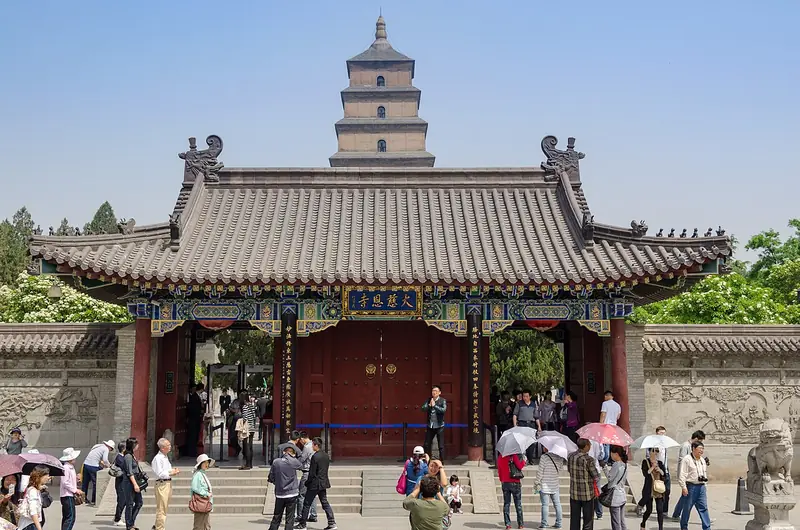
Photo adjustments
Full frame retained; EXIF orientation normalized, proportionally resized to at most 800 pixels and converted to WebP. No generated pixels or subject changes. Cards may crop the display.
Explore the region
About Big Wild Goose Pagoda and Da Ci'en Temple
The temple came first. People's Daily Overseas Edition records that Daci'en Temple was built by the future emperor Gaozong, Li Zhi, while he was still crown prince, for his mother Empress Wende, who died in 636 and was buried at Zhaoling; the decision to build came twelve years after her death. As completed it had more than ten courtyards and 1,897 rooms. It was partly destroyed and fell into ruin soon afterwards, was restored and enlarged under Wu Zetian, and was destroyed, repaired and rebuilt many times after that. Xuanzang, whom the paper calls the temple's first abbot, had set out from Chang'an for Tianzhu in the first year of the Zhenguan reign (627), studied under Silabhadra at Nalanda, travelled and debated across India, and came back after seventeen years and 50,000 li with 657 Buddhist texts; returning in the nineteenth year of Zhenguan (645) he organised, with court support, the translation work that produced 75 sutras and treatises in 1,335 fascicles, known as the new translations.
The pagoda was five storeys at first, was raised to nine, changed several times in storey count and height after that, and settled at the seven-storey body standing today, 64.517 metres in overall height with a bottom-storey side of 25.5 metres. Abbot Zengqin described it to the paper in 2013 as a square-plan pavilion-style brick pagoda of base, body and finial: a base 4.2 metres high and about 48.7 by 45.7 metres, a square pyramidal body 59.9 metres high, and a finial of 4.87 metres, with each storey imitating Tang timber construction in grey brick — eave columns, bracket sets, architraves, purlins, eave rafters and flying rafters — laid in ground-and-fitted brickwork. China.com.cn describes the pagoda as the earliest surviving and largest Tang four-sided pavilion-style brick pagoda and as evidence of the Indian Buddhist pagoda form entering the Central Plains with Buddhism. The State Council listed it on 4 March 1961 in the first national group of key protected cultural relics, and on 22 June 2014 the 38th session of the UNESCO World Heritage Committee, meeting in Doha, inscribed it as one site of the Silk Roads: the Routes Network of Chang'an-Tianshan Corridor, nominated jointly by China, Kazakhstan and Kyrgyzstan.
What to look for
- The seven-storey pagoda itself, 64.517 metres overall on a square plan of base, body and finial
- The grey-brick imitation-timber detailing of each storey — eave columns, bracket sets, architraves, purlins, eave rafters and flying rafters, in ground-and-fitted brickwork
- The Dabianjue Hall in the Xuanzang Sanzang Yuan, which holds Xuanzang's skull relic and a bronze seated figure, its walls covered with large murals of his life in bronze relief, wood carving and stone carving
- The standing statue of Xuanzang on Yanta Square in front of the temple gate
- The material displayed in the pagoda as the 2013 report describes it: Buddha relics, a carved Buddha-footprint stone and a stone carving of Xuanzang's pilgrimage route
Location & getting there
Getting to Big Wild Goose Pagoda and Da Ci'en Temple
Check which interiors and courtyards are accessible. Active places of worship and protected monuments may have different visitor rules.
- Search for 大雁塔与大慈恩寺 with 西安市 and 雁塔区.
Find Big Wild Goose Pagoda and Da Ci'en Temple
大雁塔与大慈恩寺 · 雁塔区
No reliable map pin yet: search by the Chinese name.
Sources & visit information
The linked sources support the identity and background described in this introduction. Opening hours, admission, activity availability and exact arrival arrangements have not been comprehensively checked. Confirm current visitor information with the venue; the original catalogue locality and editorial review flag are retained.