


About Shaanxi
Shaanxi at a glance
- Population
- 39,360,000Year-end resident population, entire provincial-level administrative area · 2025Source ↗
- Income per person
- 35,790Mean annual disposable income per person, all residents · 2025 · CNYSource ↗
- Languages & dialects
- Mandarin; Guanzhong speech (关中话), northern Shaanxi speech (陕北话) and southern Shaanxi varieties (陕南话).Regional names are used because provincial speech crosses several linguistic classifications.Source ↗
- Geography
- Northern Loess Plateau, central Guanzhong Plain, and southern Qinling–Daba mountain country.Source ↗
- Elevation
- Guanzhong Plain about 300–800 m; northern plateau roughly 900–1,500 m; southern mountains commonly 1,000–3,000 m.Broad landform bands from the provincial yearbook; individual peaks and valley floors can fall outside them.Source ↗
- Main gateway
- Xi’anProvince

Discover Shaanxi
Begin with Guanzhong's city and archaeological heritage
Xi'an's walls and pagodas give the city a visible historical structure, while the Terracotta Army in Lintong requires a separate archaeological outing beyond the urban core. Westward, Baoji and Qishan connect food traditions with Zhou history, and Famen Temple Museum offers a focused collection of objects associated with its Tang-period underground chamber. These sites reward attention to different periods and functions. Choose a theme and leave intervals for present-day streets and meals between major visits.
Decide which side of the mountains to explore
Huashan provides an eastern mountain-focused extension with its own route and access choices. Hancheng offers old streets, temples and associations with the historian Sima Qian. South of the Qinling, Hanzhong lies in the Han River basin and introduces museums, inscriptions and plank-road history. Northern journeys toward Yan'an and Yulin are different again. Each direction deserves deliberate travel days, rather than being attached to Xi'an as though it were another nearby district.
Use local staples to distinguish the regions
Bread and noodles vary considerably across Shaanxi. Tongguan-style roujiamo, Qishan saozi noodles and sesame-dressed noodle sheets provide distinct Guanzhong experiences, while Hanzhong's warm rice sheets point south. Lamb, buckwheat noodles and sour-cabbage dishes add northern differences. Let these foods be reasons to spend time in the relevant cities. Rail connections help between bases, but mountain approaches and archaeological sites still need local transfers, with the exact station and final destination checked together.
Explore Shaanxi
Core places to explore, with English and Chinese names.
Terracotta Army 秦始皇兵马俑
Xi'an City Wall 西安城墙
Giant Wild Goose Pagoda 大雁塔
Small Wild Goose Pagoda 小雁塔
Shaanxi History Museum 陕西历史博物馆
Great Mosque of Xi'an 西安清真大寺
Huaqing Palace 华清宫
Daming Palace 大明宫遗址
Stele Forest 碑林博物馆
Bell Tower 钟楼
Yuhua Palace 玉华宫
Zhaojin 照金
Famen Temple 法门寺
Baoji Bronze Ware Museum 宝鸡青铜器博物院
Mount Taibai 太白山
Zhouyuan 周原遗址
Qianling Mausoleum 乾陵
Han Yangling 汉阳陵
Maoling 茂陵
Zhaoling 昭陵
Huashan 华山
Hancheng 韩城
Dangjia Village 党家村
Tong Pass 潼关
Hukou Waterfalls 壶口瀑布
Huangdi Mausoleum 黄帝陵
Wuhou Tomb 武侯墓
Changqing Nature Reserve 长青国家级自然保护区
Tongwancheng 统万城
Yinghu Lake 瀛湖
Shiquan Ancient Town 石泉古城
Yangling Agricultural Museum 杨凌农林博览园
Xi'an 西安
Xi'an Xianyang Airport 西安咸阳国际机场
Yan'an 延安
Hanzhong 汉中
Jinsi Grand Canyon 金丝峡
Muslim Quarter 回民街
Tang Everbright City 大唐不夜城
Giant Wild Goose Pagoda North Square 大雁塔北广场
Qin Shi Huang Mausoleum 秦始皇陵
Mount Li 骊山
Drum Tower of Xi'an 西安鼓楼
Guangren Temple 广仁寺
Tang Paradise 大唐芙蓉园
Qinglong Temple 青龙寺
Han Chang'an City Ruins 汉长安城遗址
Banpo Museum 半坡博物馆
Xiangji Temple 香积寺
Xingjiao Temple 兴教寺
Caotang Temple 草堂寺
Shuilu Temple 水陆庵
Louguantai 楼观台
Zhaohui Pagoda 昭慧塔
China Aviation Culture Museum 中国航空文化博物馆
Yaozhou Kiln Museum 耀州窑博物馆
Yan’an Revolutionary Memorial Museum 延安革命纪念馆
Yan’an Pagoda Hill 宝塔山
Zhenbeitai Great Wall Tower 镇北台
Yulin Hongshixia Gorge 榆林红石峡
Zhashui Cave Scenic Area 柞水溶洞
Yanchuan Yellow River Qiankun Bend 延川黄河乾坤湾
Yangjialing Revolutionary Site 杨家岭革命旧址
Zaoyuan Revolutionary Site 枣园革命旧址
Huaqing Palace and Mount Li 华清宫与骊山
Emperor Qinshihuang's Mausoleum Site Museum 秦始皇帝陵博物院
Zhouzhi Old County Town Official Route 周至老县城正规游览线路
Yongxingfang Food and Culture Quarter 永兴坊
Daming Palace National Heritage Park 大明宫国家遗址公园
Weiyang Palace Site of Han Chang'an City 汉长安城未央宫遗址
Small Wild Goose Pagoda and Xi'an Museum 小雁塔与西安博物院
Xi'an Beilin Museum 西安碑林博物馆
Shuyuanmen Cultural Street 书院门
Huajue Lane Great Mosque 化觉巷清真大寺
Bell and Drum Towers and Muslim Quarter 钟鼓楼与回坊
Wangshun Mountain 王顺山
Lantian Man Site 蓝田猿人遗址
Taiping National Forest Park 太平国家森林公园
Zhuque National Forest Park 朱雀国家森林公园
Cuihua Mountain 翠华山
Nanwutai Mountain 南五台
Qinling Wildlife Park 秦岭野生动物园
Big Wild Goose Pagoda and Da Ci'en Temple 大雁塔与大慈恩寺
Sanyuan City God Temple 三原城隍庙
Maoling Museum 茂陵博物馆
Big Buddha Temple Grottoes 大佛寺石窟
Malan Revolutionary Site 马栏革命旧址
Anwu Youth Training Class Memorial Hall 安吴青训班纪念馆
Zhengguo Canal 郑国渠
Han Yangling Museum 汉阳陵博物院
Shaanxi History Museum Qin-Han Branch 陕西历史博物馆秦汉馆
Zhaoling Museum 昭陵博物馆
Yuanjia Village 袁家村
Xianyang Museum 咸阳博物院
Feng County Revolutionary Memorial Hall 凤县革命纪念馆
Lingguan Gorge 灵官峡
Duke of Zhou Temple 周公庙
Wuzhangyuan Zhuge Liang Temple 五丈原诸葛亮庙
Famen Temple Cultural Scenic Area 法门文化景区
China Stone Drum Park 中华石鼓园
Honghe Valley 红河谷
Guanshan Grassland 关山草原
Dasan Pass 大散关
Cishan Temple Grottoes 慈善寺石窟
Yijun Dryland Terraces 旱作梯田
Yaowang Mountain 药王山
Zhaojin Xiangshan Scenic Area 照金香山
Shaohua Mountain 少华山
Qiachuan Wetland 洽川
Fuping Ceramic Art Village 富平陶艺村
Tongguan Ancient City and Yellow River Viewing Area 潼关古城与黄河观景区
Yaotou Kiln Site 尧头窑
Cangjie Temple 仓颉庙
Qiaoling Mausoleum 桥陵
Shrine and Tomb of Sima Qian 司马迁祠墓
Hancheng Ancient City 韩城古城
Hukou Waterfall Shaanxi Side 黄河壶口瀑布陕西侧
Yangjialing and Zaoyuan Revolutionary Sites 杨家岭与枣园革命旧址
Qiankun Bay 乾坤湾
Yongning Mountain Ancient Fortress 永宁山古寨
Ganquan Yucha Grand Canyon Visitor Area 甘泉雨岔大峡谷正规开放区
Baiyun Mountain 白云山
Xianglu Temple 香炉寺
Fuzhou Ancient City 府州古城
Yulin Ancient City 榆林古城
Hongshi Gorge 红石峡
Shimao Site 石峁遗址
Hongjiannao Lake 红碱淖
Gaojiabao Ancient City 高家堡古城
Jiang Family Manor 姜氏庄园
Li Zicheng's Temporary Palace 李自成行宫
Suide Stone Lion Museum 绥德石狮博物馆
Wave Valley 波浪谷
Tongwan City Ruins 统万城遗址
Foping Panda Valley 佛坪熊猫谷
Mianxian Wuhou Shrine 勉县武侯祠
Liping National Forest Park 黎坪
Longtou Mountain 龙头山
Zhang Qian Memorial Hall 张骞纪念馆
Qingmuchuan Ancient Town 青木川古镇
Hanzhong Museum and Ancient Han Terrace 汉中市博物馆与古汉台
Shimen Plank Road 石门栈道
Crested Ibis Ecological Park 朱鹮生态园
Cai Lun Tomb and Shrine 蔡伦墓祠
Zhang Liang Temple 张良庙
Zibai Mountain 紫柏山
Tongchewan Scenic Area 筒车湾
Nangong Mountain 南宫山
Shuhe Ancient Town 蜀河古镇
Zhongba Grand Canyon 中坝大峡谷
Houliu Ancient Town 后柳古镇
Huangu Tea Town 焕古茶镇
Danfeng Boatmen's Guild Hall 丹凤船帮会馆
Dihua Ancient Town 棣花古镇
Tianzhu Mountain 天竺山
Fenghuang Ancient Town 凤凰古镇
Niubeiliang Scenic Area 牛背梁
Tayun Mountain 塔云山
Emperor Qinshihuang's Mausoleum Site Museum 秦始皇帝陵博物院(兵马俑)
Song of Everlasting Sorrow 《长恨歌》演出
Hukou Waterfall tourist area of the Yellow River 陕西黄河壶口瀑布
Xi’an Museum 西安博物院
THE GREAT QIN 赳赳大秦
Shaanxi local specialties
陕西特色美食 · 143 specialties to discover
 Tongguan roujiamo 潼关肉夹馍
The exterior flakes and crunches, while the meat filling is tender and savory. This creates a different balance from the firmer, less flaky breads used for some other roujiamo.
Source ↗Read the dish guide →Photo adjustments
EXIF orientation applied where present; resized proportionally to at most 640 px on the long edge and encoded as WebP. No crop, retouching, recoloring or subject changes.
 Beef or lamb paomo 牛羊肉泡馍
The bread becomes tender but retains bite, absorbing a rich broth; meat and optional starch noodles add further texture.
Source ↗Read the dish guide →Photo adjustments
EXIF orientation applied where present; resized proportionally to at most 640 px on the long edge and encoded as WebP. No crop, retouching, recoloring or subject changes.
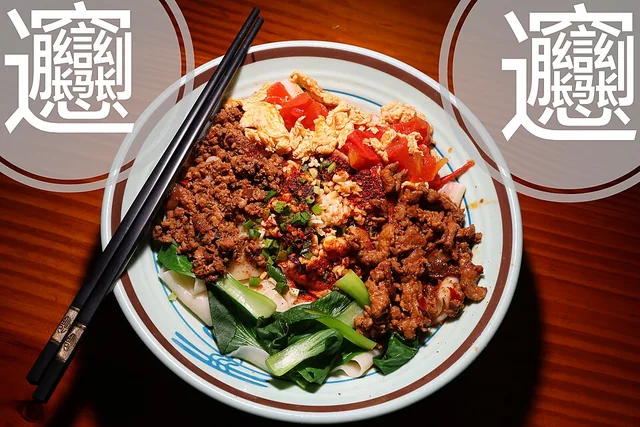 Biangbiang noodles biángbiáng面
The noodles have a strong, springy chew and a wide surface that carries the seasoning. Their thickness makes the texture central to the dish.
Source ↗Read the dish guide → Qishan saozi noodles 岐山臊子面
The flavor is fragrant, tangy and often spicy, with tender noodles and tiny toppings in nearly every spoonful. Vinegar is central to the overall balance.
Source ↗Read the dish guide →Photo adjustments
EXIF orientation applied where present; resized proportionally to at most 640 px on the long edge and encoded as WebP. No crop, retouching, recoloring or subject changes.
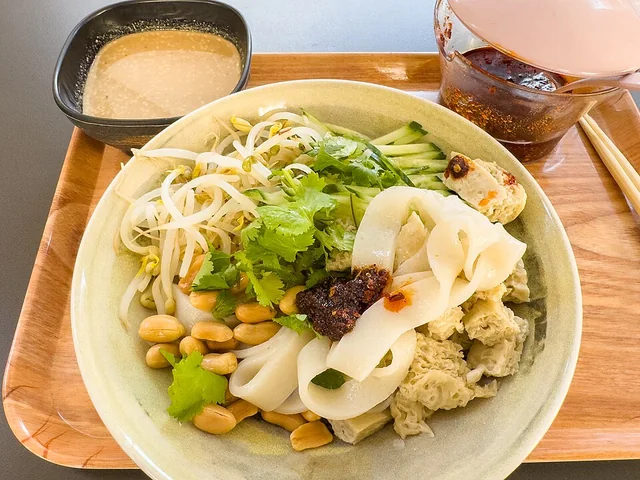 Sesame noodle sheets 麻酱酿皮
The sheets are soft and elastic, while sesame gives a rich, nutty body balanced by sourness and heat.
Source ↗Read the dish guide → Hanzhong warm rice sheets 汉中热米皮
The sheets are soft and smooth, with a gentler bite than thick wheat noodles. Warmth helps the dressing spread through them.
Source ↗Read the dish guide →Photo adjustments
EXIF orientation applied where present; resized proportionally to at most 640 px on the long edge and encoded as WebP. No crop, retouching, recoloring or subject changes.
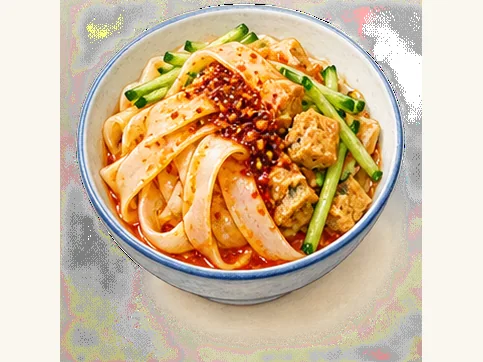 Qishan rolled noodle sheets 岐山擀面皮AI dish illustration · AI 菜品示意图
The strips are chewy and resilient, carrying vinegar, chili oil and garlic well. Their texture is as distinctive as the seasoning.
Source ↗Read the dish guide → Yan'an stewed lamb 延安炖羊肉AI dish illustration · AI 菜品示意图
The dish is meaty and warming, with tender flesh and a broth that may be clear or more concentrated.
Source ↗Read the dish guide →All dish names · 全部菜名 (143)
- Tongguan roujiamo · 潼关肉夹馍
- Beef or lamb paomo · 牛羊肉泡馍
- Biangbiang noodles · biángbiáng面
- Qishan saozi noodles · 岐山臊子面
- Sesame noodle sheets · 麻酱酿皮
- Hanzhong warm rice sheets · 汉中热米皮
- Qishan rolled noodle sheets · 岐山擀面皮
- Yan'an stewed lamb · 延安炖羊肉
- Wuqi chopped buckwheat noodles · 吴起剁荞面
- Golden-thread steamed towers · 金线油塔
- Hulutou intestine and bread soup · 葫芦头泡馍
- Clear mutton soup with bread · 水盆羊肉
- Osmanthus persimmon cakes · 黄桂柿子饼
- Lamb-blood vermicelli soup · 粉汤羊血
- Lantian buckwheat noodles · 蓝田荞面饸饹
- Stone-baked flatbread · 石子馍
- Wugong fried dough twists · 武功麻花
- Binzhou yumian wheat jelly · 彬县御面
- Suide yellow millet buns · 绥德黄馍馍
- Zichang thin pancake wraps · 子长煎饼
- Ziyang steamed basin · 紫阳蒸盆
- Ningqiang hand-pounded crisp candy · 宁强木槌千棰酥
- Liquan sweet fermented rice · 礼泉醪糟
- Qianxian thick flatbread · 乾县锅盔
- Northern Shaanxi grated potato grains · 陕北洋芋擦擦
- Shaanxi hot-oil chilli condiment · 油泼辣子
- Yaozhou savoury noodle soup · 耀州咸汤面
- Heyang xuemian noodles · 合阳踅面
- Danfeng chewy niujin noodles · 丹凤牛筋面
- Xi'an osmanthus rice wine · 黄桂稠酒
- Fish Hot Pot in Milky Broth · 奶汤锅子鱼
- Pork Knuckle with Trotter Attached · 带把肘子
- Stir-Fried Pork with Lotus Root · 莲菜炒肉
- Braised Three Delicacies · 烧三鲜
- Pork Trotters Stewed with Sea Cucumber · 海参烀蹄子
- Shangzhi Pork · 商芝肉
- Hulu chicken · 葫芦鸡
- Warm-Tossed Kidney Strips · 温拌腰丝
- Steamed Basin Stew · 蒸盆子
- Wine-Lees Pork · 糟肉
- Roujiamo · 肉夹馍
- Liangpi · 凉皮
- Biangbiang Belt Noodles · biangbiang面
- Shaanxi Hot-Oil Noodles · 油泼面
- Zenggao · 甑糕
- Xi’an Cured Beef and Mutton · 腊牛羊肉
- Peppery meatball soup · 肉丸胡辣汤
- Xi’an Steamed Beef Xiaosurou · 小酥肉
- Dumplings in sour soup · 酸汤水饺
- Mirror rice cakes · 镜糕
- Xi’an Persimmon Pastry Cakes · 柿子饼
- Shaanxi Saozi Noodles · 臊子面
- Huyi Noodles for Dipping in Broth · 摆汤面
- Wowo Noodles · 窝窝面
- Savory Noodle Soup · 咸汤面
- Yaozhou Snowflake Candy · 耀州雪花糖
- Yaozhou Pinched Dough Noodles · 耀州疙瘩面
- Xiaoqiu Knife-Cut Noodles · 小丘刀剺面
- Yijun Ear-Shaped Pasta · 宜君耳朵套
- Flatbread in Toasted Flour Gruel · 油茶泡馍
- Beiguan Pressed Noodles · 北关饸饹
- Tongchuan Big-Knife Noodles · 铜川大刀面
- Xifu Hand-Pulled Noodles · 西府扯面
- Soft Tofu with Soaked Flatbread · 豆花泡馍
- Vinegar-Lees Noodle Sheets · 醋粉
- Deer-Stamped Griddle Buns · 鹿糕馍
- Fengxiang Cured Donkey Meat · 凤翔腊驴肉
- Fufeng One-Bite Noodles · 扶风一口香
- Mei County Stove-Grate Noodles · 眉县炉齿面
- Long County Mutton and Bread Soup · 陇县羊肉泡馍
- Feng County Fermented Sour Noodles · 凤县浆水面
- Huitong Noodles · 汇通面
- Qian County Tofu Pudding · 乾县豆腐脑
- Qian County Hand-Drawn Dried Noodles · 乾县挂面
- Binzhou Imperial Noodles · 彬州御面
- Sanyuan Puffed Sesame Rice Candy · 三原蓼花糖
- Sanyuan Coiled Noodles · 三原疙瘩面
- Liquan Griddled Noodles · 礼泉烙面
- Yongshou Angongqiao Giant Fried Dough Twist · 永寿安宫桥大麻花
- Xunyi Decorated Steamed Buns · 旬邑花子馍
- Changwu Blood Strip Soup · 长武血条汤
- Shichen Steamed Buns · 时辰包子
- Chengcheng Clear Mutton Soup · 澄城水盆羊肉
- Dali Pork Knuckle with Trotter Attached · 大荔带把肘子
- Dali Stove-Grate Noodles · 大荔炉齿面
- Fuping Taihou Flaky Pastry · 富平太后饼
- Pucheng Rafter-End Steamed Buns · 蒲城椽头馍
- Hancheng Mutton Pressed Noodles · 韩城羊肉饸饹
- Huayin Big-Knife Noodles · 华阴大刀面
- Linwei Tofu Curds with Flatbread · 临渭豆腐泡
- Steamed Grated Potato · 洋芋擦擦
- Yan'an Fried Sweet Cakes · 延安油糕
- Minjie Pressed Noodles · 抿节
- Mutton Pressed Noodles · 羊肉饸饹
- Yellow Millet Steamed Buns · 黄米馍馍
- Flattened Bean and Millet Porridge · 钱钱饭
- Yanan Fried Millet Rings · 油馍馍
- Ganquan Dried Tofu · 甘泉豆腐干
- Luochuan Pressed Noodles · 洛川饸饹
- Huangling Soft Millet Buns · 黄陵软馍
- Hanzhong Warm Rice Sheets · 汉中热面皮
- Vegetable Tofu · 菜豆腐
- Fermented Sour Noodles · 浆水面
- Walnut Bread · 核桃馍
- Ningqiang Numbing-Spicy Chicken · 宁强麻辣鸡
- Xixiang Beef Jerky · 西乡牛肉干
- Lueyang Clay Jar Tea · 略阳罐罐茶
- Chenggu Rice Noodle Sheets · 城固面皮
- Yang County Jujube Steamed Buns · 洋县枣糕馍
- Zhenba Cured Pork · 镇巴腊肉
- Foping Green Leaf Tofu · 佛坪神仙豆腐
- Baohe Sliced Fish · 褒河片片鱼
- Sheep Offal Soup · 羊杂碎
- Suide Sheep Offal Soup · 绥德羊杂碎
- Yulin Three-Meat Stew · 榆林拼三鲜
- Fried Soy Milk Custard · 炸豆奶
- Heilengleng Potato Dumplings · 黑愣愣
- Yulin Buckwheat Bowl Jelly · 碗托
- Qingjian Buckwheat Wraps · 清涧煎饼
- Zizhou Jujube-Filled Pastry · 子洲果馅
- Dingbian Chopped Buckwheat Noodles · 定边荞剁面
- Fugu Fermented Sour Millet · 府谷酸饭
- Hengshan Stewed Goat · 横山炖羊肉
- Jingbian Big-Chunk Mutton · 靖边大块羊肉
- Ankang Steamed Noodle Sheets · 安康蒸面
- Ziyang Steamed Basin Stew · 紫阳蒸盆子
- Griddle-Baked Flatbread · 炕炕馍
- Hanyin Griddle-Baked Flatbread · 汉阴炕炕馍
- Xunyang Eight-Dish Banquet · 旬阳八大件
- Langao Duck Stewed with Konjac · 岚皋魔芋炖鸭
- Pingli Cured Pork · 平利腊肉
- Baihe Pork Cake · 白河肉糕
- Shiquan Guiguzi Cured Pork · 石泉鬼谷子腊肉
- Hanbin Hot-and-Sour Small Fish with Fennel · 汉滨酸辣茴香小鱼
- Ningshan Chicken Stewed with Chestnuts · 宁陕板栗炖鸡
- Acorn Starch Jelly · 橡子凉粉
- Shangluo Pounded Potato Cakes · 商洛糍粑
- Zhen'an Chicken Stewed with Big Chestnuts · 镇安大板栗炖鸡
- Zhashui Pounded Potato Cakes · 柞水洋芋糍粑
- Luonan Tofu · 洛南豆腐
- Shangnan Immortal Leaf Jelly · 商南神仙叶凉粉
- Shanyang Manchuan Eight-Dish Banquet · 山阳漫川八大件
- Shangzhou Noodles in Thick Soup · 商州糊汤面
Top sights in Shaanxi
 TOP1临潼区
Emperor Qinshihuang's Mausoleum Site Museum 秦始皇帝陵博物院(兵马俑)
Show on map TOP2西安
Shaanxi History Museum follows the region’s long role as a centre of Zhou, Qin, Han and Tang civilisation. The main Xiaozhai venue combines bronze ritual vessels, pottery figures and Tang-period objects in a building whose…
 TOP3西安
Xi’an’s city wall encloses the later imperial city in a near-rectangular circuit. Its main fabric dates from the Ming period, built partly on earlier city foundations. The interest is in the whole defensive system: projecting…
 TOP4渭南
Huashan’s granite peaks rise abruptly above Huayin, with narrow ridges linking a group of five named summits.
 TOP5西安
Tang Everbright City is a modern pedestrian district extending south from the Giant Wild Goose Pagoda.
 TOP6临潼区
Song of Everlasting Sorrow 《长恨歌》演出
Show on map TOP7宜川县
Hukou Waterfall tourist area of the Yellow River 陕西黄河壶口瀑布
Show on map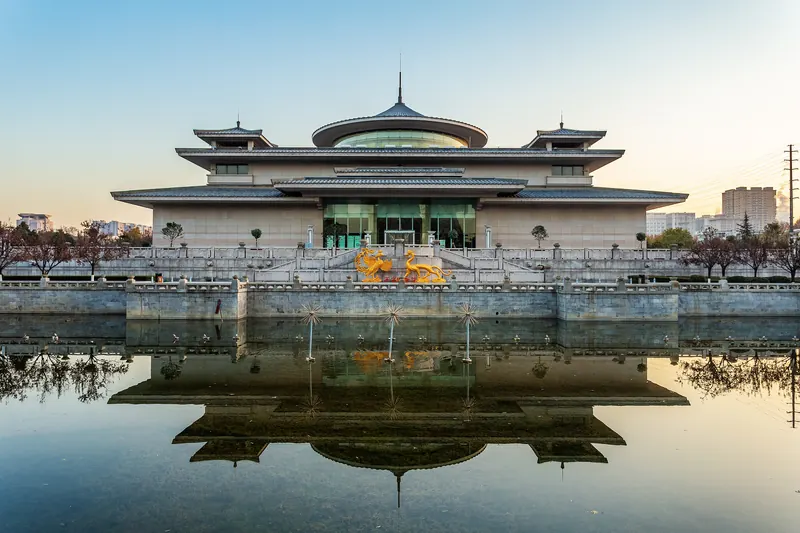 TOP8碑林区
Xi’an Museum places the city’s changing form at the center of its collection. Models of successive capitals help explain why Han Chang’an, Tang Chang’an and the later walled city occupy different footprints. Bronze vessels…
 TOP9西安
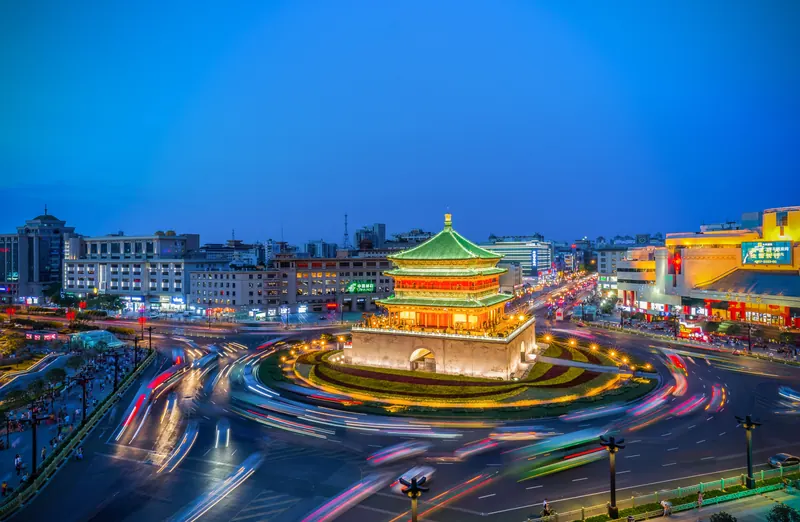
Xi’an’s Bell Tower marks the meeting of the four principal streets inside the old city. The timber pavilion stands on a tall brick platform and was moved to this position in 1582 after being built farther west in 1384. Its…
 TOP10未央区
THE GREAT QIN 赳赳大秦
Show on map
 Show on map


.jpg)
Change your destination on Trip.com.
Ranking source & photo credits
The first ten entries of Trip.Best Best Things to Do. Rankings reflect platform recommendations, not counts of international visitors. Read on 20 September 2026; platform pages may use cached snapshots.
- Emperor Qinshihuang's Mausoleum Site Museum: Source: Trip.com · Resized and WebP compressed; fitted to the ranking card.
- Shaanxi History Museum: Source: Trip.com · Resized and WebP compressed; fitted to the ranking card.
- Xi'an City Wall: Source: Trip.com · Resized and WebP compressed; fitted to the ranking card.
- Mount Hua: Source: Trip.com · Resized and WebP compressed; fitted to the ranking card.
- Grand Tang Mall: Source: Trip.com · Resized and WebP compressed; fitted to the ranking card.
- Song of Everlasting Sorrow: Source: Trip.com · Resized and WebP compressed; fitted to the ranking card.
- Hukou Waterfall tourist area of the Yellow River: Source: Trip.com · Resized and WebP compressed; fitted to the ranking card.
- Xi’an Museum: Source: Trip.com · Resized and WebP compressed; fitted to the ranking card.
- Bell Tower: Source: Trip.com · Resized and WebP compressed; fitted to the ranking card.
- THE GREAT QIN: Source: Trip.com · Resized and WebP compressed; fitted to the ranking card.
Cities, counties & districts in Shaanxi
10 areas belong directly to Shaanxi.
10 areas
Xi’an 西安市
Xi'an is the capital of the Chinese province of Shaanxi. A sub-provincial city on the Guanzhong plain, the city is the most populous in the province and third-most populous in Western China after Chongqing…
13 local areas →Prefecture-level cityTongchuan 铜川市
Tongchuan (simplified Chinese: 铜川; traditional Chinese: 銅川; pinyin: Tóngchuān; lit. 'copper river') is a prefecture-level city located in central Shaanxi province, People's Republic of China on the southern…
4 local areas →Prefecture-level cityBaoji 宝鸡市
Baoji (simplified Chinese: 宝鸡; traditional Chinese: 谿行市; pinyin: Bǎojī; Mandarin pronunciation: [pàʊ.tɕí] ) is a prefecture-level city in western Shaanxi province, People's Republic of China.
12 local areas →Prefecture-level cityXianyang 咸阳市
Xianyang is a prefecture-level city in central Shaanxi province, situated on the Wei River a few kilometers upstream (west) from the provincial capital of Xi'an.
14 local areas →Show fewer areas
Weinan 渭南市
Weinan is a prefecture-level city in east-central Shaanxi province, northwest China. The city lies on the lower section of the Wei River confluence into the Yellow River, about 60 km (37 mi) east of the…
11 local areas →Prefecture-level cityYan'an 延安市
Yan'an is a prefecture-level city in the Shaanbei region of Shaanxi province, China, bordering Shanxi to the east and Gansu to the west.
13 local areas →Prefecture-level cityHanzhong 汉中市
Hanzhong (simplified Chinese: 汉中; traditional Chinese: 漢中; lit. 'middle of the Han River'; abbreviation: Han) is a prefecture-level city in the southwest of Shaanxi province, China, bordering the provinces of…
11 local areas →Prefecture-level cityYulin 榆林市
Yulin is a prefecture-level city in the Shaanbei region of Shaanxi province, China, bordering Inner Mongolia to the north, Shanxi to the east, and Ningxia to the west.
12 local areas →Prefecture-level cityAnkang 安康市
Ankang is a prefecture-level city in the south of Shaanxi Province in the People's Republic of China, bordering Hubei province to the east, Chongqing municipality to the south, and Sichuan province to the…
10 local areas →Prefecture-level cityShangluo 商洛市
Shangluo is a prefecture-level city in southeastern Shaanxi province, People's Republic of China, bordering Henan to the northeast and Hubei to the southeast.
7 local areas →No areas match this name.
Arrive, stay & get around Shaanxi
交通枢纽、住宿与天气
Xi’an西安
This Shaanxi entry uses Xi’an as its selected gateway city. It does not describe transport coverage across the entire region.
Airports
Xi’an Xianyang International AirportXIY
西安咸阳国际机场
Airport in Xianyang serving Xi’an; the city-name difference is real. Check your terminal and onward airport-rail connection.
Railway stations
Xi’an North Railway Station
西安北站
Principal high-speed gateway north of central Xi’an.
Xi’an Railway Station
西安站
Central railway gateway beside the northern city-wall area, separate from Xi’an North.
Metro & city transport
Xi’an Metro Network 西安轨道交通线路图
The system connects the city, railway gateways and airport corridor. For the Terracotta Army, the museum’s guide uses a local-bus connection after Huaqingchi.
- 1Find your stations确认起点与终点站
- 2Check interchanges查看换乘线路与站点
- 3Follow exit signs到站后按站内标识出站
 Explore the full network查看站名、线路与换乘Enlarge map点击放大线路图
Check the legend for closed, reserved or future sections. 停运、预留与规划区间,请按图例辨识。
Map edition: 2026-09-06 · Diagram reviewed 2026-09-06
Map: China Revealed; data © OpenStreetMap contributors · CC BY-SA 4.0 diagram; ODbL 1.0 source database
Map coverage & sources 图示范围与来源说明
All 12 operating metro lines: 1, 2, 3, 4, 5, 6, 8, 9, 10, 14, 15, 16. Original station-connection diagram, not to geographic scale. Includes Line 15 opened 2025-12-29 and Line 5 Xi’an East station opened 2026-06-30. XiHu suburban railway and SkyShuttle outside this metro-only diagram.
Independent schematic layout and labels generated from OSM station order, names and coordinates. No operator diagram copied.
Coaches, ferries & onward travel
Lintong tourist bus 613 / bus 602
临潼游613路/临潼602路
The museum’s official directions use these local buses from Huaqingchi toward the Terracotta Army. Check the correct final stop and return direction.
Transport reference review: 2026-09-06. Consult the operator for current services and timetables.
More about getting around
Xi'an Xianyang airport and the city's main railway hubs connect to the wider region. Use the metro for urban journeys, then plan the final leg to Lintong's archaeological sites. A rail arrival near Huashan still requires a transfer to the mountain access area.
Stay in Shaanxi
A base inside or near Xi'an's South Gate works for wall walks and central meals; staying near a convenient metro stop can matter more than an old-town address. Add a separate Huashan overnight when your walking plan needs an early mountain start.
Find hotels on Trip.com →Change your destination, dates and guests on Trip.com.
Xi’an weather
The current-hour forecast loads when this section is visible. It uses MET Norway model data for the named city, not station observations.
Seasons & when to go
Xi'an has hot summers and cold winters, with spring and autumn often easier for long outdoor visits. Northern uplands and mountain summits can feel much colder. At Huashan, check wind, rain and trail conditions before fixing a route around a particular summit view.
Local life & communication
A province of hand-made staples and layered history: Guanzhong's wheat foods and former capitals differ from Hanzhong's rice-based dishes and Han River setting. The interesting detail is often the local variation within a familiar name.
Qin burial art, Tang-era pagodas and the surviving Ming city wall make Xi'an a useful place to compare periods. Its Muslim Quarter adds a continuing Hui cultural presence. Give archaeological sites context with a museum visit, and distinguish reconstructed settings from original remains.
Language & communication
Mandarin is useful throughout the main visitor circuit, alongside regional varieties that change between the central plain and northern Shaanxi. Save 陕西 for the province: English spellings distinguish Shaanxi from neighbouring Shanxi. Xi'an attraction names also benefit from a Chinese-text screenshot.
Useful local tips
- Write Shaanxi as 陕西 in map searches: neighbouring Shanxi is 山西 and is a different province.
- Choose a direction for your extension: west to Baoji, east to Huashan or Hancheng, south to Hanzhong, or north to Yan'an and Yulin; assess each as a separate route.
- Check individual museum booking channels and current mountain notices before fixing the day's transport.
- Specify the dish, not simply 'liangpi': sesame sheets, rolled wheat sheets and warm rice sheets differ in both ingredients and texture.
- Use the Shimen museum inscriptions and the scenic plank road as complementary experiences, remembering that the visitor road is partly reconstructed.
Sources & useful links
- China National Tourist Office: Shaanxi
- UNESCO: Mausoleum of the First Qin Emperor
- Ministry of Culture and Tourism: Guanzhong food route
- Shaanxi Archives: sesame noodle sheets
- Shaanxi Cultural Centre: Qishan saozi noodles
- Shaanxi Health Commission: paomo standard explanatory draft
- Huashan scenic operator
- Baoji Cultural Relics Bureau: Famen Temple Museum visit
- Hancheng tourism authority: heritage overview
- Hanzhong Science and Technology Association: city museum
- Hanzhong Economic Cooperation Bureau: Baoxie plank road
- Shaanxi Market Regulation Administration: Yan'an local food traditions
- Zhenbeitai Great Wall scenic-area operator
- Ministry of Culture and Tourism visitor service: Shaanxi
- Shaanxi — population background
- Shaanxi — languages background
- Shaanxi — geography background
- Shaanxi — Xi'an map reference
- Shaanxi — Xi'an Xianyang Airport map reference
- Shaanxi — Terracotta Army map reference
- Shaanxi — Giant Wild Goose Pagoda map reference
- Shaanxi — Huashan map reference
- Shaanxi — Yan'an map reference
- Shaanxi — Xi'an City Wall map reference
- Shaanxi — Shaanxi History Museum map reference
- Shaanxi — Famen Temple map reference
- Shaanxi — Qianling Mausoleum map reference
- Shaanxi — Hanyangling map reference
- Shaanxi — Hukou Waterfalls map reference
- Shaanxi — Hancheng map reference
- Shaanxi — Mount Taibai map reference
- Shaanxi — Hanzhong map reference
- Shaanxi attraction ranking source
- Shaanxi specialty reference — www.xakpw.com
- Shaanxi specialty reference — daj.shaanxi.gov.cn
- Shaanxi specialty reference — www.xakpw.com
- Shaanxi specialty reference — dfz.shaanxi.gov.cn
- Shaanxi specialty reference — www.xakpw.com
- Shaanxi specialty reference — m.gdcts.com
- Shaanxi specialty reference — xakpw.com
- Beef or lamb paomo — local food reference
- Shaanxi local chronicles: regional foods
- Longde government: northwest potato caca preparation
- 延川黄河乾坤湾 — place reference
- 合阳踅面 — local food reference
- 黄桂稠酒 — local food reference
- 杨家岭革命旧址 — place reference
- 枣园革命旧址 — place reference
- Xi'an official time-honored food traditions
- China Daily original Hui-quarter interviews via Xi'an official site
- China Daily original visitor interviews via Xi'an
- Xi'an official city-walk reporting
- Xi’an specialty reference — www.xakpw.com
- Xi’an specialty reference — www.xakpw.com
- Local food reference: 奶汤锅子鱼
- China Daily: Xi’an noodle descriptions
- China Daily regional guide: Shaanxi noodle varieties
- China Daily: youpo mian preparation
- China Daily regional guide: cured beef and mutton
- Lianhu District Gazetteer: Huanggui persimmon cakes
- China Daily regional guide: Xi’an persimmon cake
- Published Qishan-style recipe by a cook who learned it in Baoji
- Yuncheng District food-grain information: Huxian dipping noodles
- Xiachufang, 私甜艺术蛋糕: firsthand Xi’an-style beef recipe, 2016