

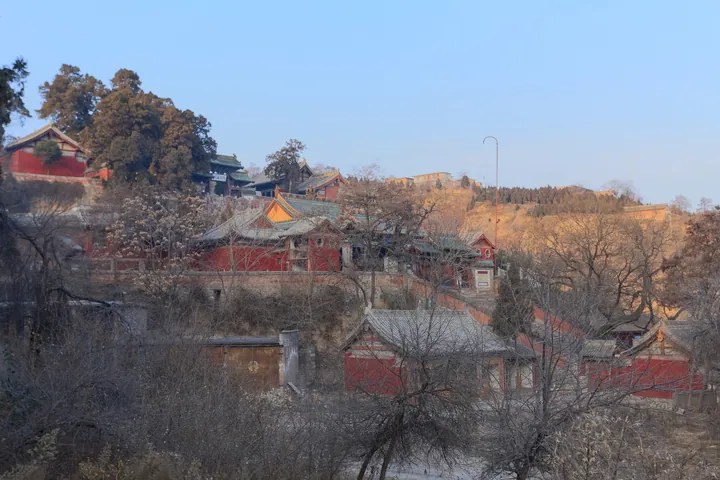
Photo adjustments
Full frame retained; proportionally resized and converted to WebP. No retouching or changes to the photographed subject. Card displays may crop the view.
Explore the region
About Yuquan Taoist Temple
Yuquan Taoist Temple (玉泉观) is a large Taoist temple complex in Qinzhou District (秦州区) of Tianshui (天水), Gansu, founded in the Tang dynasty and named after its "Jade Spring" (玉泉).
The temple was rebuilt early in the Yuan dynasty and enlarged through the Yuan, Ming and Qing, growing to more than 90 buildings. Its "Immortal Cave of the Jade Spring" (玉泉仙洞) is counted among the Ten Views of Qinzhou (秦州十景). The halls follow Taoist planning, with seven buildings on a north–south axis, among them the Jade Emperor Hall (玉皇殿) and the Hall of the Three Pure Ones (三清殿). The Jade Emperor Hall is one of the most complete Ming buildings in the complex, with a pavilion in front, bracket sets, upturned eaves and railings front and back. Two Ming memorial archways survive, one built in 1558 and the other rebuilt in 1630, and a full set of roof-ridge ornaments from 1598 is intact. Qing buildings make up a large share; the late-Qing shrines to Zhou and Tuo (周、托公祠) are singled out for their fine work.
The temple holds 55 inscribed steles and 11 smaller stone tablets. Five of the steles and all eleven tablets are Yuan, nine steles are Ming, and the rest are Qing and Republican. The most valued is the Yuan four-sided Daoliu Stele (四面道流碑), its body 1.58 m tall, whose faces carry a decree of honours from Kublai Khan (元世祖), a chart of the patriarchs of the Quanzhen (全真) school of Taoism, a record of its transmission and five secret sayings of its founders. Another set of four steles carries cursive calligraphy by the Yuan master Zhao Mengfu (赵孟頫), writing out five-character quatrains by the Tang poets Li Bai (李白) and Wei Yingwu (韦应物) and the Song poet Wang Anshi (王安石).
About 50 old trees grow in the temple grounds, 21 of them under first-class national protection. The best known is the "Braided Cypress" (辫柏), whose exposed roots twist together like a plait. The State Council listed the temple among the sixth batch of national key protected sites in 2006, and in early 2010 its scenic area was raised to 4A; Gansu's scenic-area list names it the Qinzhou District Yuquan Scenic Area.
What to look for
- The Jade Emperor Hall (玉皇殿), a Ming hall with a pavilion in front and upturned eaves
- The Hall of the Three Pure Ones (三清殿) on the central axis
- The Yuan four-sided Daoliu Stele (四面道流碑) recording the Quanzhen school's lineage
- Zhao Mengfu's (赵孟頫) cursive-script steles of Tang and Song quatrains
- Two Ming memorial archways and the 1598 roof-ridge ornaments
- The late-Qing shrines to Zhou and Tuo (周、托公祠)
- The Braided Cypress (辫柏), with roots twisted like a plait
Location & getting there
Getting to Yuquan Taoist Temple
- Search for 玉泉观 with 天水市 and 秦州区.
Find Yuquan Taoist Temple
玉泉观 · 秦州区
No reliable map pin yet: search by the Chinese name.
Sources & visit information
Written from the linked sources and checked sentence by sentence against quoted extracts by a separate reviewer on 2026-09-23. Opening hours, admission and access arrangements are not covered; confirm current visitor information with the site.
- 天水旅游:伏羲庙 南郭寺 玉泉观争创国家4A级旅游景区 ↗
- 伏羲庙、玉泉观、南郭寺三景区晋升为国家4A级旅游景区 ↗
- 甘肃省A级旅游景区名录(截至2025年12月31日) ↗
- 玉泉观 - 维基百科,自由的百科全书 ↗
Some facts checked against Wikipedia contributors, "玉泉观" · CC BY-SA 4.0.