

Explore the region
About Jiezi Great Mosque and Salar Folk Culture
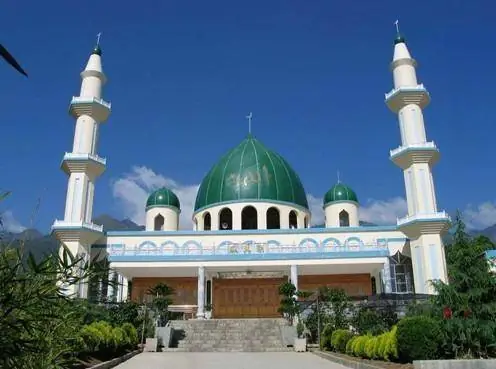
The Xunhua county government's page calls the mosque the Salar ancestral mosque and, in its own words, the second-largest mosque in Qinghai. It records that the mosque is shared by the six administrative villages of Jiezi town and has two 教长 (imams), six temple-management committee members and fifteen 满拉 (religious students). It was first built in the third year of the Ming Hongwu reign, expanded three times during the Qing dynasty and in the twentieth year of the Republic, destroyed during the Cultural Revolution and rebuilt in 1982, with a total area of 4,210 square metres of which the prayer hall accounts for 975 square metres. The page records that the mosque keeps one of only three hand-copied Qur'ans surviving in the world, and that the prayer hall was assessed as structurally unsafe in 2019 and, weighing a change to Arab-style architecture and the removal of safety hazards, was to be rebuilt on the original site with approval from the provincial ethnic and religious affairs commission. Among the honours the page lists are designation as a provincial-level key cultural relic protection unit and a city-level patriotism education base, alongside a national award for advanced collectives in building harmonious temples and churches and prefectural and county awards for ethnic unity and for religious venues; the list ends in 等 and the entry does not treat it as complete.
The Qinghai provincial portal's page on Chameleon Spring, credited to the Haidong city government, records that within a hundred paces of the spring stand the Salar ancestral mosque and the tombs of the ancestors Galamang and Aheman, under two old elms whose branches close over the tombs, and that the spring, the mosque beside it, the tombs, the hand-copied Qur'an, a poplar nearly a thousand years old and century-old cypresses together form testimony to Salar history. It tells the Salar origin story: a small tribe at Samarkand in Central Asia, led by the brothers Galamang and Aheman, left with eighteen people of the same clan and a white camel carrying the soil and water of their homeland and a copy of the Qur'an, travelled east through the Tianshan, past Jiayuguan, around the Hexi Corridor and across the Yellow River into Xunhua, and settled where the camel, gone missing, was found turned to white stone in a spring below the sand slope east of Jiezi. The page records that the Salar regard the spring as holy and that it holds an important place in Salar culture; that its site covers about 3,500 square metres in a rectangle, with a pool about 40 m long and 20 m wide fed from a spring eye, about 0.6 m deep and cement-lined at its edges; that at Salar weddings a dance is still performed in which two people wear sheepskin cloaks turned inside out to play the camel and two wear long gowns and turbans as Galamang and the local Mongols, singing in question and answer about the ancestors' migration; and that a folk food festival, a seminar on the hand-copied Qur'an and an embroidery exhibition are held at the spring each year.
What to look for
- The mosque building the county page measures — 4,210 square metres in all, with a prayer hall of 975 square metres, rebuilt in 1982
- The hand-copied Qur'an the county page says is one of only three surviving in the world
- The two tall wooden 尼那罗 minarets and the assembly hall the provincial page describes, facing west towards the Kaaba, with a single-eaved hip roof, grey barrel tiles and a vase, a sword and a crescent moon on the ridge
- The two rectangular tomb chambers under the old cypress and elm that the provincial page places below the mosque, burying Galamang and Aheman
- Chameleon Spring, within a hundred paces of the mosque, with its pool about 40 m by 20 m and the white stones the page describes in the water
Location & getting there
Getting to Jiezi Great Mosque and Salar Folk Culture
Check which interiors and courtyards are accessible. Active places of worship and protected monuments may have different visitor rules.
- Search for 街子清真大寺与撒拉族民俗 with 海东市 and 循化撒拉族自治县.
Find Jiezi Great Mosque and Salar Folk Culture
街子清真大寺与撒拉族民俗 · 循化撒拉族自治县
No reliable map pin yet: search by the Chinese name.
Sources & visit information
The linked sources support the identity and background described in this introduction. Opening hours, admission, activity availability and exact arrival arrangements have not been comprehensively checked. Confirm current visitor information with the venue; the original catalogue locality and editorial review flag are retained.
Image credits & notes (1)
- Jiezi Great Mosque and Salar Folk Culture · 街子清真大寺与撒拉族民俗Photo: baike.baidu.comResized for the web; the photo itself has not been edited.