

Explore the region
About Princess Wencheng Temple and Leba Valley
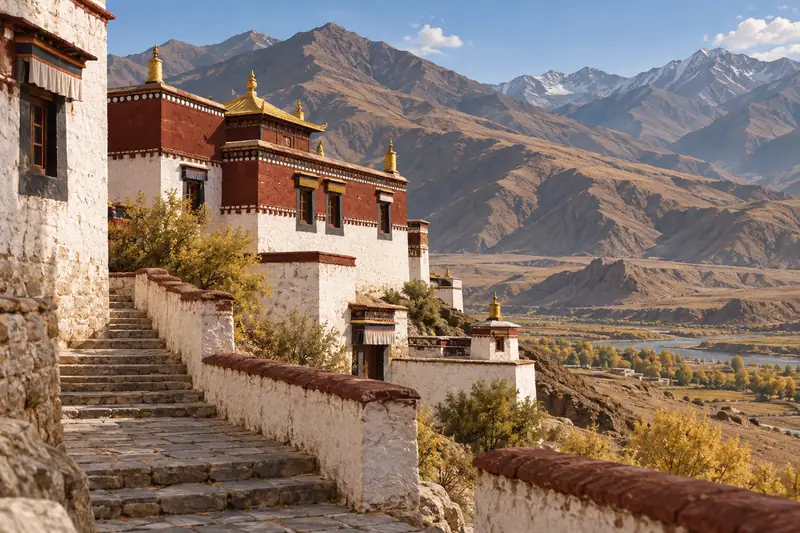
The China Tibetology Research Center's essay describes the temple as built against the hillside facing south in three parts — buildings, cliff reliefs and scriptures cut into the rock — with a brownish-red triple-eaved main building that looks like three storeys from outside but is a single hall within. On the cliff are nine relief figures: Vairocana at the centre in the meditation gesture on a lion-and-lotus seat, with eight standing attendant bodhisattvas whose dress and modelling the author calls a mix of early Tibetan and early Tang features, and a Tibetan inscription beside them. Old Tibetan in Lantsha script and Chinese Buddhist texts are cut into the rock on either side of the figures; tradition ascribes them to the minister Thonmi Sambhota and to Princess Wencheng herself, but the page warns that the characters are worn and hard to read. About 20 m to the right of the hall a spring called 公主泉 rises under the rock, where tradition says the princess washed, and about 4 km upstream on the 贝曲河 a hot-spring pool is said to be where she bathed. The essay gives the temple more than 1,300 years of history with two competing traditions — that it was built when the princess passed through, or that local Tibetans built it in her memory — and notes a 文成公主纪念馆 built east of it in recent years. The provincial government's archaeological report supplies the temple's other name, 贝大日如来佛堂, in recording the 2006 national listing.
The valley's own carvings are dated and counted differently by the two official pages. The Qinghai Provincial Information Office entry says 勒巴沟 holds three Tang-dynasty rock carvings numbered 1, 2 and 3, describes No. 1 as showing Buddhas, bodhisattvas, pilgrims and auspicious animals among others in a strongly late-Tang Han Chinese style, and records that in June 2006 the valley was listed in the sixth batch of national key cultural relic protection units. The provincial government's report of a 2012 joint survey counts 4 sites and 16 points instead, running inward from the valley mouth — 古秀泽玛, 吾那桑嘎, 恰冈 and 泽琼沟 — and singles out 恰冈, where Vairocana in shallow low relief is flanked by Vajrapani and Avalokiteshvara and a Tibetan inscription below the lion seat carries a date of 814 CE in the reign of the Tibetan ruler Ralpachen. The report calls such precisely dated Tibetan-period carvings rare anywhere in China, and says the 吾那桑嘎 group had never been published before that survey. The information office entry adds that the valley carries carving from a Tang-dynasty Shakyamuni image at its mouth to mani stones cut today, and that 勒巴 in Tibetan means 'beautiful, auspicious'. Both the provincial government report and the information office place the valley about 30 km from 结古镇, and the report adds that it lies east of it, on the west bank of the Tongtian River, at 3,538 m; the same report records the valley being declared a provincial-level protected unit in the fourth batch in 1986.
The pages disagree on where the temple itself stands. The China Tibetology Research Center essay puts it in 贝纳沟 about 20 km south of 结古镇 and separately places the mouth of 勒巴沟 about 8 km north-east of 贝纳沟; the information office entry places the 文成公主庙 at the south mouth of 勒巴沟. All three pages describe the temple as an active place of worship and none gives opening hours, ticket arrangements or a boundary for visitors, so the catalogue note that the open range of halls, courtyards and relic displays has to be confirmed one by one is left standing. The 641 CE date for the princess's stay and the 814 CE date on the 恰冈 inscription come from different pages and are not in conflict.
What to look for
- The nine cliff reliefs on the temple's rock wall — Vairocana in the meditation gesture on a lion-and-lotus seat at the centre, with eight standing attendant bodhisattvas
- The Old Tibetan in Lantsha script and the Chinese Buddhist texts cut into the cliff either side of the figures, which the essay warns are worn and hard to read
- 公主泉, the spring under the rock about 20 m to the right of the hall, and the hot-spring pool about 4 km upstream on the 贝曲河
- The rock carvings in 勒巴沟, among them the 恰冈 Vairocana group with its 814 CE Tibetan inscription and the 藏王与公主礼佛图 at the valley mouth
- The mani stones through the valley, from ones cut long ago to ones being cut today, which the information office calls its most compelling feature
- The 文成公主纪念馆 east of the temple, which the essay says depicts the princess's journey and Han–Tibetan life in painted scenes
Location & getting there
Getting to Princess Wencheng Temple and Leba Valley
Check which interiors and courtyards are accessible. Active places of worship and protected monuments may have different visitor rules.
- Search for 文成公主庙与勒巴沟 with 玉树藏族自治州 and 玉树市.
Find Princess Wencheng Temple and Leba Valley
文成公主庙与勒巴沟 · 玉树市
No reliable map pin yet: search by the Chinese name.
Sources & visit information
The linked sources support the identity and background described in this introduction. Opening hours, admission, activity availability and exact arrival arrangements have not been comprehensively checked. Confirm current visitor information with the venue; the original catalogue locality and editorial review flag are retained.