

Photo adjustments
Full frame retained; proportionally resized and converted to WebP. No retouching or changes to the photographed subject. Card displays may crop the view.
Explore the region
About Zuiweng Pavilion
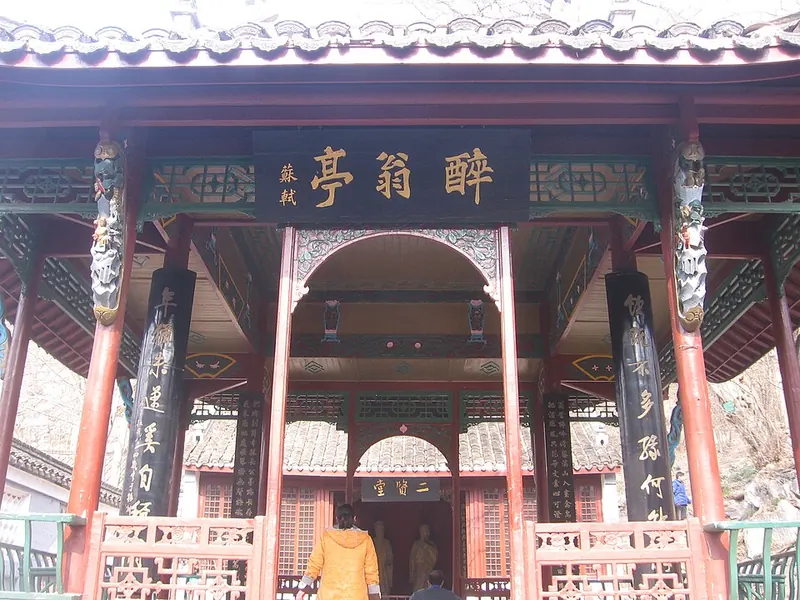
The present pavilion belongs to later rebuilding, surrounded by a wooded landscape that helps explain the essay’s appeal. Baosong Studio preserves a stele of the text in Su Shi’s calligraphy, while Tongle Garden adds other calligraphic versions. Reading the same work across these different settings makes the visit more substantial than a single photograph of the pavilion.
In the sixth year of the Qingli era (庆历) of the Northern Song, 1046, Ouyang Xiu (欧阳修) was demoted to serve as prefect of Chuzhou. He had taken 'Zuiweng,' or 'Old Drunkard,' as his own style name, which gave the pavilion its name, and he went on to write the Account of the Old Drunkard's Pavilion (醉翁亭记), source of the enduring line 'the drunkard's heart is not in the wine, but amid the mountains and streams.' The pavilion and the scenery of Langya Mountain became widely known as a result.
Zuiweng Pavilion is regarded as the foremost of China's Four Great Pavilions (中国四大名亭之首), a ranking also expressed by calling it the pavilion without equal under heaven (天下第一亭). It stands within the Langya Mountain Scenic Area (琅琊山风景名胜区), in the hills southwest of Chuzhou city.
What to look for
- The pavilion’s wooded setting associated with Ouyang Xiu’s essay.
- The Su Shi calligraphy stele in Baosong Studio and inscriptions in Tongle Garden.
Background & history
The Zuiweng Pavilion (Chinese: 醉翁亭; pinyin: Zùiwēng Tíng; lit. 'Old Toper's Pavilion') is a pavilion lying to the south east of Chuzhou City, Anhui Province, People's Republic of China. It dates to The Northern Song Dynasty whilst the structure that exists today dates to the Qing Dynasty (1644–1911). The pavilion takes its name from the Northern Song scholar, statesman, and prose writer Ouyang Xiu, who called himself the "Old Toper" and composed a widely circulated prose entitled Zuiweng Tingji or An Account of the Old Toper's Pavilion.
Excerpt from Wikipedia: Zuiweng Pavilion · Wikipedia contributors · CC BY-SA 4.0. Selected introductory sentences; formatting simplified. Background information, not current visitor-service advice.
Location & getting there
Getting to Zuiweng Pavilion
Enter Langya Mountain through the visitor approach on Langya Ancient Road, whose scenic-area address is No 30. Follow the signed route to Zuiweng Pavilion rather than aiming for an arbitrary point on the mountain.
Combine your visit
A suggested sequence linking the specific features of this visit.
-
Zuiweng Pavilion
Begin with the landscape and building associated with the essay.
-
Baosong Studio
Compare the written text with Su Shi’s calligraphic rendering.
-
Tongle Garden
See further versions of the essay in the garden setting.
This order is editorial. Confirm access and any transfers between stops; it does not establish a walking route, same-day connection or common admission ticket.
Find Zuiweng Pavilion
醉翁亭 · 滁州市
The pin marks the area, not the entrance.
More places nearby
Approximate straight-line distances between map pins, not travel distances.
Mount Langya 琅琊山
2 km awayMount Langya lies in the southwestern outskirts of Chuzhou. Wooded slopes, springs and lake scenery surround a group of historic pavilions and temple buildings.
View guide →Caishiji 采石矶
66 km awayCaishiji is a rocky promontory on the eastern bank of the Yangtze in western Ma’anshan. The narrowed river channel made the area important in river defence, including the Song-period Battle of Caishi.
View guide →Ma'anshan Museum 马鞍山市博物馆
71 km awayMa’anshan Museum connects the city’s Yangtze-side position with a longer history of regional exchange. Its local-history exhibition moves from the meeting of Wu and Chu traditions through the Six Dynasties and the area’s poetic…
View guide →Sources & visit information
The sources below support the place-specific description and arrival information. Suggested combinations are editorial planning ideas; confirm current opening, entry arrangements and transport services for your date.
- Zuiweng Pavilion ↗
- www.ctnews.com.cn ↗
- www.lysfjq.cn ↗
- Chinese Wikipedia: 醉翁亭 (revision 89465181, 2025-10-09) ↗
Visitor information adapted and edited from Wikipedia contributors, “Zuiweng Pavilion” · CC BY-SA 4.0. Source revision 1334051958.
Background paragraphs translated and condensed from Wikipedia contributors, "醉翁亭", Chinese Wikipedia · CC BY-SA 4.0. Source revision 89465181.