

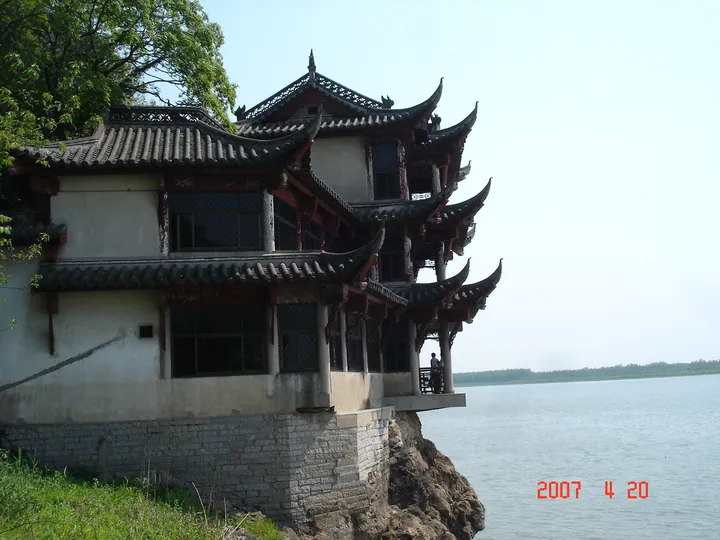
Photo adjustments
Full frame retained; proportionally resized and converted to WebP. No retouching or changes to the photographed subject. Card displays may crop the view.
Explore the region
About Caishiji
The narrowed river channel made the area important in river defence, including the Song-period Battle of Caishi.
Its other strong association is with Li Bai. Taibai Tower, Sanyuan Cave and Lianbi Terrace form named cultural features around the river landscape. Stories about the poet’s death belong to local legend; the buildings and inscriptions are the tangible focus of the visit.
The promontory was originally called Niuzhu Rock (牛渚矶), formed where Niuzhu Rock projects into the Yangtze, and was renamed Caishiji during the Three Kingdoms period. In 1161, the thirty-first year of the Shaoxing era of the Southern Song, the army officer Yu Yunwen (虞允文) defeated Jin forces here in the Battle of Caishi. The Buddhist Guangji Temple (广济寺) on the site was built in AD 239, during the Eastern Wu period; only its original well, Chiniao Well (赤乌井), survives, the rest of the temple having been rebuilt repeatedly after war damage.
The rock is bounded on the north and east by the Suoxi River (锁溪河) and further south by the Caishi River (采石河), and covers an area of around 80 hectares. Beyond Taibai Tower, Sanyuan Cave and Lianbi Terrace, the site includes the Tomb of Li Bai. It is counted as the first of the Yangtze's 'three great rocks', together with Yanzi Rock and Chengling Rock, is designated a National Key Scenic Area (国家重点风景名胜区), and has been a national 5A tourist attraction (国家5A级旅游景区) since 2020.
What to look for
- The rocky river projection explains the site’s strategic geography.
- Taibai Tower and nearby monuments commemorate Li Bai.
Location & getting there
Getting to Caishiji
Approach the Caishiji scenic area on Ma’anshan’s western Yangtze bank.
- Confirm the selected entrance and current internal access before departure.
Combine your visit
A suggested sequence through the source-confirmed features.
-
Taibai Tower
Begin with the monument that foregrounds the site’s Li Bai association.
-
Sanyuan Cave
Continue to the separately named cave feature in the river-rock landscape.
-
Lianbi Terrace
Complete the sequence at the terrace within the Caishiji cultural landscape.
The sequence is editorial. Check local access and connections between sectors; no walking time or same-ticket access is promised.
Find Caishiji
采石矶 · 马鞍山市
The pin marks the area, not the entrance.
More places nearby
Approximate straight-line distances between map pins, not travel distances.
Ma'anshan Museum 马鞍山市博物馆
7 km awayMa’anshan Museum connects the city’s Yangtze-side position with a longer history of regional exchange. Its local-history exhibition moves from the meeting of Wu and Chu traditions through the Six Dynasties and the area’s poetic…
View guide →Wuhu Mirror Lake 芜湖镜湖
39 km awayWuhu’s Mirror Lake consists of two adjoining lake spaces at the edge of the central shopping streets. Yanyu Dun, a small island with a red building and literary memorials, gives the landscape a distinctive cultural focus. Its…
View guide →Zheshan 赭山
40 km awayZheshan is a small hill group in central Wuhu. Its name refers to the reddish colour of the rock and soil.
View guide →Sources & visit information
The sources below support the place-specific description and arrival information. Suggested combinations are editorial planning ideas; confirm current opening, entry arrangements and transport services for your date.
- www.wikidata.org ↗
- 采石矶 ↗
- Chinese Wikipedia: 采石矶 (revision 90056008, 2025-11-17) ↗
- English Wikipedia: Caishi Rock (revision 1373247193, 2026-09-04) ↗
Visitor information adapted and edited from Wikipedia contributors, “采石矶” · CC BY-SA 4.0. Source revision 90056008.
Background paragraphs translated and condensed from Wikipedia contributors, "采石矶", Chinese Wikipedia · CC BY-SA 4.0. Source revision 90056008.
Background paragraphs condensed from Wikipedia contributors, "Caishi Rock", English Wikipedia · CC BY-SA 4.0. Source revision 1373247193.