

Explore the region
About Taiji Cave
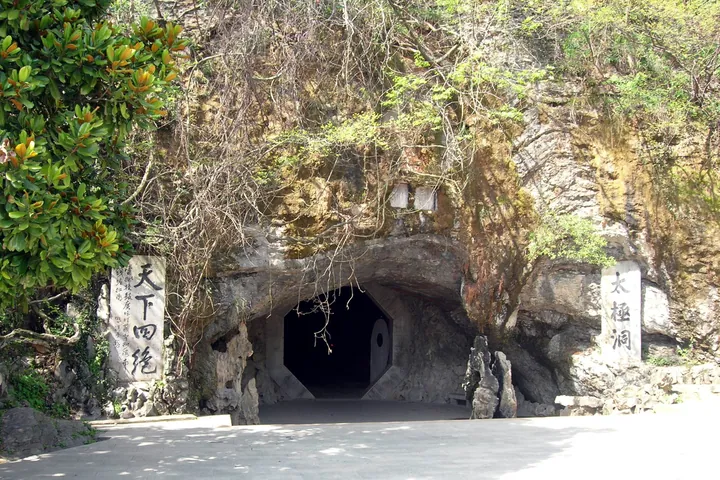
Taiji Cave (太极洞) is a karst cave system inside Shilong Mountain (石龙山) at Taoyuan village (桃园村), Xinhang town (新杭镇), in the north-east corner of Guangde, Anhui, where Anhui meets Jiangsu and Zhejiang.
The Anhui provincial government calls it the largest karst cave complex in East China: the passages run about 5,400 m and cover 141,000 m², divided into dry caves and water caves. The cave holds more than 700 stalactite formations, and a 750 m underground river, the "Silver River" (地下银河), can be travelled by boat. Outside the entrance lie an upper and a lower lake with willows, pavilions and rockeries.
The cave was known in early times as Changle Cave (长乐洞). In his story collection Stories to Caution the World (警世通言), the Ming writer Feng Menglong (冯梦龙) ranked it among the "Four Wonders under Heaven" (天下四绝), alongside the drums of Leizhou, the mirages of Dengzhou and the Qiantang tidal bore. The three characters of its present name were written by Wu Tongchun (吴同春), a Ming magistrate of Guangde, in a Wanli-era year; legend says the Daoist deity Taishang Laojun (太上老君) lingered here and turned to stone inside. Seven old stone inscriptions and more than ten early travel accounts survive, among them the carving "Qiongran Rock" (跫然岩) attributed to Fan Zhongyan (范仲淹), and the Wolong Bridge (卧龙桥) tied to a story of Liu Xiu (刘秀) taking refuge here. Zhao Puchu (赵朴初), a former vice-chairman of the national political advisory body (CPPCC), wrote a poem after his visit that mentions riding a boat inside the cave.
The scenic area covers 2,200 ha, of which 1,458.8 ha lie in Guangde. Its listings run from provincial scenic area (1987) to one of China's first 4A-rated scenic areas (2001), national scenic area in the State Council's fifth batch (2004), national geopark (2011) and national science-education base (2012). The surrounding hills are wooded mainly with Castanopsis sclerophylla (苦槠), ring-cupped oak and Phoebe sheareri, and the scenic area records more than 460 tree species and 29 kinds of bamboo.
What to look for
- The dry-cave and water-cave sections, about 5,400 m of passages in all
- A boat trip along the 750 m underground Silver River
- More than 700 stalactite and dripstone formations
- The carving "Qiongran Rock" (跫然岩) attributed to Fan Zhongyan, one of seven old inscriptions
- Wolong Bridge (卧龙桥), linked in legend with Liu Xiu
- The upper and lower lakes outside the cave mouth
Location & getting there
Getting to Taiji Cave
- Search for 太极洞 with 宣城市 and 广德市.
Find Taiji Cave
太极洞 · 广德市
No reliable map pin yet: search by the Chinese name.
Sources & visit information
Written from the linked sources and fact-checked against them on 2026-09-23. Opening hours, admission and access arrangements are not covered; confirm current visitor information with the site.
Image credits & notes (1)
- The rock-cut entrance to Taiji Cave, inscribed with the cave's name, in Guangde City, Xuancheng. · 宣城市广德市太极洞洞口,崖壁刻有洞名。 Source-recorded photograph date: Taken on 29 March 2007.Photo: luchangjiang~鲁昌江 · CC BY-SA 3.0Resized for the web; the photo itself has not been edited. Thumbnails may show a cropped view.
