

Explore the region
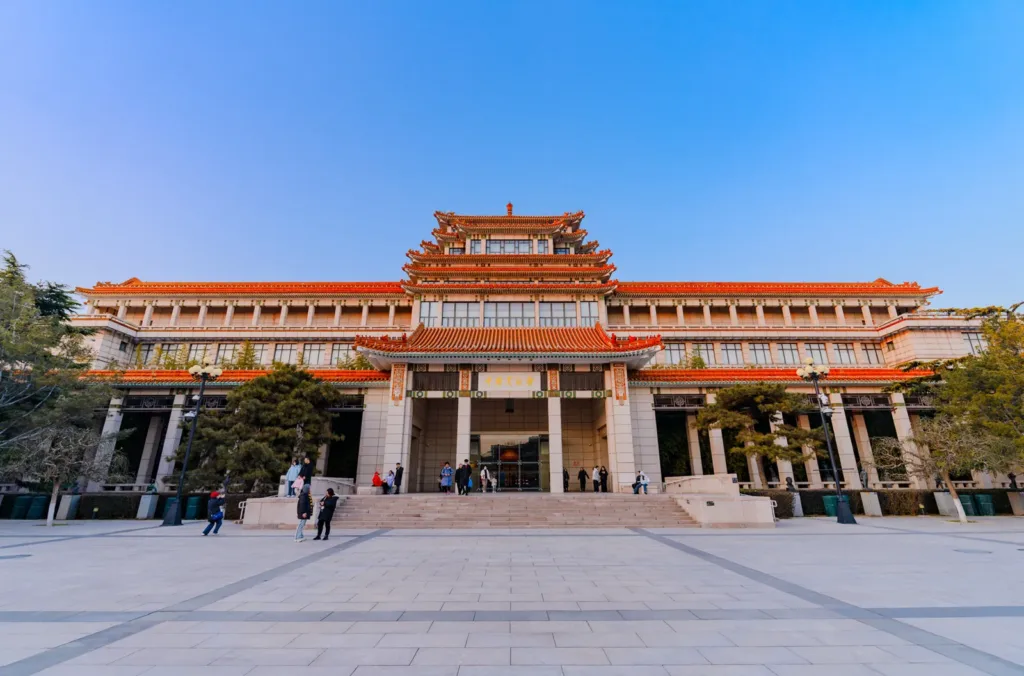
A national art museum in a modern, traditional-style building
The museum is at No. 1 Wusi Street, Dongcheng District, near the meeting of Wusi Street and Wangfujing Street. It is a purpose-built museum rather than a surviving palace or temple. Construction began in 1958 and the museum opened in 1963. The main building adopts a traditional Chinese pavilion-style form, with a prominent yellow glazed-tile roof and surrounding galleries. Look at the central roofed pavilion against the long, horizontal wings: the design gives a national public institution a distinctly Chinese architectural profile without making the building an ancient monument.
The museum reports a collection of more than 130,000 works, across Chinese painting, calligraphy, oil painting, printmaking and sculpture, as well as works by artists from outside China. Its collection includes artists such as Qi Baishi, Xu Beihong, Wu Guanzhong and Li Keran, alongside internationally known artists including Käthe Kollwitz, Pablo Picasso and Salvador Dalí. These are collection holdings, not a promise that any one work will be on view during a particular visit.
For a collection-focused stop, look for the museum’s Classics from the National Art Museum of China Collection display. The museum describes it as occupying galleries on the fifth and sixth floors, with traditional and modern Chinese art, calligraphy, sculpture and international works. Exhibition rooms and access can change, so use the current floor guide rather than assuming that all 21 galleries are open or that a named work is displayed.
The museum grounds also include a 3,000-square-metre sculpture garden. If it is open during your visit, it provides an outdoor counterpoint to the indoor galleries; check current on-site directions rather than treating it as a guaranteed extension of the exhibition route.
Build a visit around the exhibitions actually on view
NAMOC’s galleries occupy the first through sixth floors. Rather than trying to cover every room, choose one current exhibition as your main thread, then add the collection display if it is open and interests you. This is an editorial route, not an official sequence: begin with the exterior, enter through the south visitor entrance, follow the live floor map to the exhibition you most want to see, and finish with a collection gallery or the sculpture garden if access and time allow.
Allow about 2–3 hours as an editorial planning estimate for one or two exhibitions at an unhurried pace. A larger temporary show, a guided or public program, mobility needs, or a busy day may call for more time. Exhibition schedules rotate; the museum’s live exhibition page is the useful place to choose a date-specific focus.
Reserve before you set out
Regular museum admission is by free advance reservation. The official visitor guide says reservations open up to seven days ahead, at 16:00 each day; each person may reserve once per day, and one account may book for up to five people. Daily capacity is limited, and a visitor must bring the original identity document used for the booking and arrive in the selected time slot. Visitors from outside mainland China may reserve with a passport or a foreign permanent-residence identity card. Use the museum’s official website or official WeChat service, not an unofficial ticket intermediary.
The museum opens 09:00–17:00, with last entry at 16:00, and is closed on Mondays except statutory holidays. Some special exhibitions have separate tickets and rules; the museum’s 2026 ticket notice, for example, distinguished a paid special exhibition from the free general-admission reservation. Check the current listing for any show you plan to see, as its price, sale period and admission conditions can differ.
Getting there
Use China Art Museum (中国美术馆) station on Metro Line 8 as the most direct rail starting point, then follow current station and museum wayfinding to the south visitor entrance. The museum also lists Dongsi on Lines 5 and 6 as an alternative, with a walk west of about 600 metres. It names bus stops Art Museum (美术馆), Art Museum East (美术馆东) and Art Museum North (美术馆北); routes serving them are listed in the official visitor guide. Choose the stop that best fits your live route rather than assuming all three are equally close to the entrance.
The enquiry number published by the museum is 010-6400-6326; its listed service hours are 09:00–16:00. Recheck the official visitor guide and exhibition notices close to your visit for holiday adjustments, temporary closures, reservation availability and any separately ticketed show.
Find National Art Museum of China
中国美术馆 · No. 1 Wusi Street, Dongcheng District, Beijing
The pin marks the area, not the entrance.
Sources & visit information
Visitor details checked on 21 October 2026. Planning times below are editorial suggestions, not museum guarantees. Hours, tickets, reservations and transport can change; confirm with the operator before you go.
Image credits & notes (1)
- The front elevation of NAMOC, with the central pavilion and yellow-tiled roof visible above the entrance. Photo: Jackiejackie123123Photo: CC BY-SA 4.0