

Photo adjustments
Resized and WebP compressed; subject not altered.
Explore the region
About Qianmen
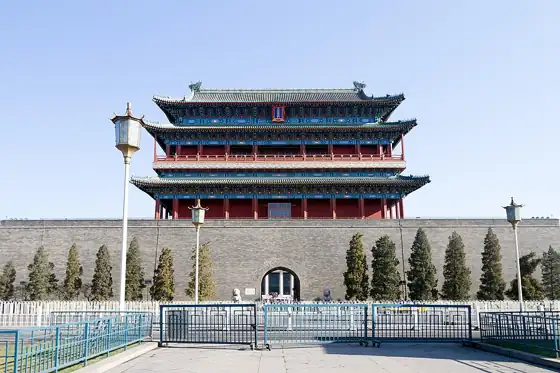
Its gatehouse and separate archery tower preserve the scale of the former inner-city defenses, although the enclosing barbican walls have gone. South of the towers, Qianmen Street continues the area’s commercial role with reconstructed historic-style shopfronts. Read the surviving defensive structures first, then explore the shopping streets as a different layer of the neighborhood; the present retail streetscape should not be mistaken for an entirely unchanged Ming-era street.
The gate was first built in 1419, originally named Lizhengmen (丽正门); in 1436 an archery tower and barbican were added, forming the largest barbican in Ming and Qing Beijing at 108 by 85 meters, and in 1439 it was renamed Zhengyangmen. The archery tower burned and was rebuilt several times under the Ming and Qing, including damage from Eight-Nation Alliance artillery in 1900. In 1915 the barbican was demolished to ease traffic, separating the gatehouse and archery tower into the independent structures that survive today.
After the Communist victory in 1949, the gatehouse was occupied by the Beijing garrison of the People's Liberation Army until the military vacated it in 1980. The archery tower was severely damaged in the 1976 Tangshan earthquake and was fully repaired; it reopened to the public in 1990, and the gatehouse, renovated in 1991, reopened in 1993.
Zhengyangmen was named a Major Historical and Cultural Site Protected at the National Level (全国重点文物保护单位) in 1988, and in 2024 it was inscribed on the World Heritage List as part of the Beijing Central Axis. At about 42 meters high, its gatehouse remains the tallest of Beijing's city gates and was the only one to survive the 1960s demolition of the city walls during subway construction.
What to look for
- Zhengyangmen gatehouse and archery tower: compare the two surviving parts of the former gateway and the space between them.
- Qianmen Street and Dashilan: look at the commercial lanes south of the gate and their contrasting shopfront scales.
Location & getting there
Getting to Qianmen
Qianmen station serves the gate area on Metro Lines 2 and 8. The towers stand south of Tiananmen Square, with the commercial street continuing farther south.
- Set the gatehouse, archery tower, or pedestrian street as your meeting point; the name Qianmen is used for all three.
Combine your visit
Suggested order within this visit:
-
Zhengyangmen gatehouse
Start with the inner-city gateway on the central axis.
-
Archery tower
Compare the separate defensive tower to the south.
-
Qianmen Street and Dashilan
Continue into the commercial streets beyond the old gate.
This sequence is an editorial suggestion based on the features described in the sources. Access to individual buildings or areas should be checked locally; no travel time or shared admission is implied.

Find Qianmen
前门 · 东城区
The pin marks the area, not the entrance.
More places nearby
Approximate straight-line distances between map pins, not travel distances.
Tiananmen Square 天安门广场
Less than 1 km awayTiananmen Square is the monumental open space south of Chang'an Avenue, framed by the National Museum of China, the Great Hall of the People and the Tiananmen gate to the north. The Monument to the People's Heroes and Chairman…
View guide →National Museum of China 中国国家博物馆
Less than 1 km awayThe National Museum of China occupies the east side of Tiananmen Square. Its Ancient China exhibition provides a chronological route from prehistoric cultures to the late Qing dynasty, while specialist galleries let visitors…
View guide →National Centre for the Performing Arts 国家大剧院
Less than 1 km awayThe National Centre for the Performing Arts brings opera, concerts, drama and smaller performances together immediately west of the Tiananmen area. Its operator identifies four principal auditoriums: the Opera House, Concert…
View guide →Sources & visit information
The linked encyclopedia sources support background and place descriptions. Current opening hours, ticket prices, booking rules and transport schedules have not been independently verified for this guide. Confirm them with the venue or operator before travelling.
- Wikipedia: Zhengyangmen ↗
- Chinese Wikipedia: 正阳门 (revision 93680987, 2026-07-28) ↗
- English Wikipedia: Zhengyangmen (revision 1373903672, 2026-09-08) ↗
Visitor information adapted and edited from Wikipedia contributors · CC BY-SA 4.0. Source revision 1371030469.
Background paragraphs translated and condensed from Wikipedia contributors, "正阳门", Chinese Wikipedia · CC BY-SA 4.0. Source revision 93680987.
Background paragraphs condensed from Wikipedia contributors, "Zhengyangmen", English Wikipedia · CC BY-SA 4.0. Source revision 1373903672.